


Americans give President Donald Trump his worst approval ratings ever for his handling of the economy, as they also express concerns about the cost of living, healthcare prices, and personal finances, a new PBS News/NPR/Marist poll finds.
Fifty-seven percent of Americans disapprove of how Trump is handling the economy, once viewed as one of the president’s strengths. Thirty-six percent say the president is doing a good job, the lowest this poll has found across both of his terms in office.
Fifty-seven percent of Americans disapprove of how Trump is handling the economy, according to the latest PBS News/NPR/Marist poll. Thirty-six percent say the president is doing a good job, the lowest this poll has found across both of his terms in office. Graphic by Steff Staples/PBS News.
Sagging support for Trump on the economy is likely a major factor dragging down his overall approval rating – 38% of Americans think Trump is doing a good job as president, the lowest percentage since the end of his first term.
“This is a major problem for him,” said Lee Miringoff, director of the Marist Institute for Public Opinion. “When affordability is so front and center in people’s minds, that’s going to be laid at the doorstep of a chief executive.”
Seven in 10 Americans say the cost of living in their area is unaffordable, including nearly half of Republicans and three-quarters of independents, according to the latest poll. Three in 10 Americans say the cost of living is affordable, falling 25 percentage points since June.
“The longer this goes on, the harder it is to get those numbers back,” said Amy Walter, editor of The Cook Political Report. “It becomes sort of a self-fulfilling situation. People don’t feel confident in you, and they think prices just continue to go up.”
Public frustration with the economy also plagued Trump’s predecessor, Joe Biden, during his presidency. When inflation began to peak in early 2022, Biden’s approval on the economy also dipped to 36% before improving slightly by the end of his term.
Trump capitalized on voters’ economic dissatisfaction during the 2024 presidential election to win back the Oval Office. Now, those same feelings could be potentially perilous for Republicans in next year’s midterm elections.
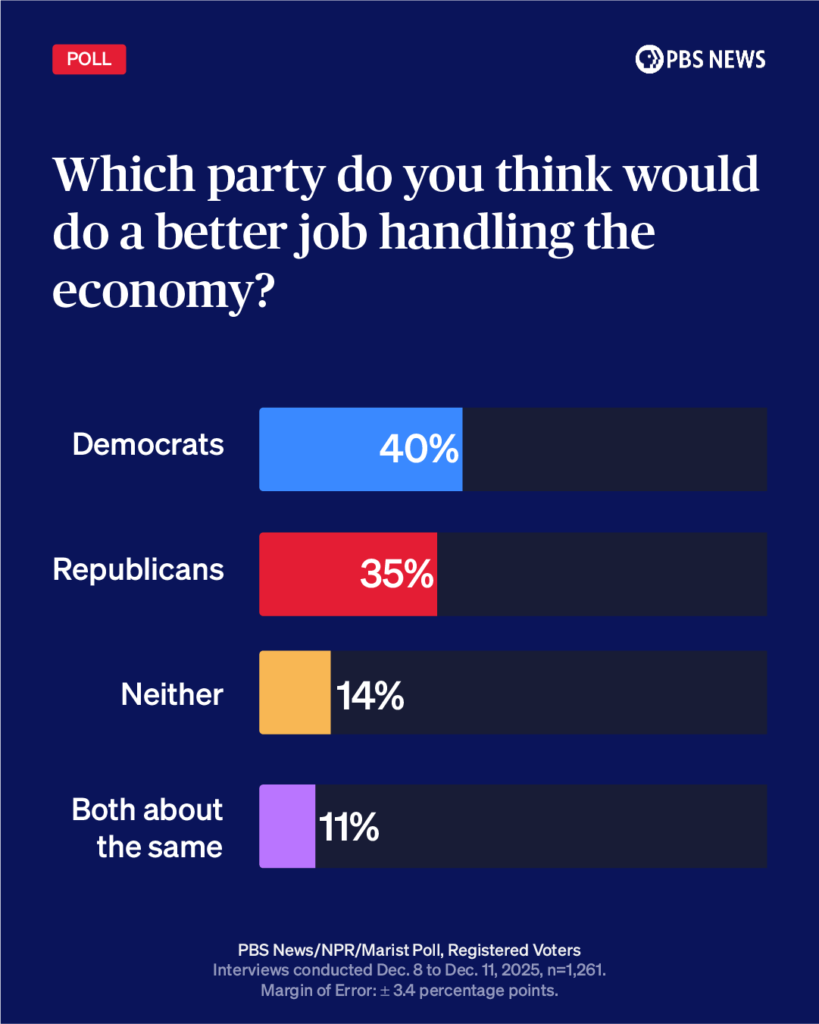
Registered voters were more likely to say the Democratic party would do a better job compared to the Republican party, according to the latest PBS News/NPR/Marist poll. Graphic by Steff Staples/PBS News.
On the economy, registered voters were more likely to say the Democratic party would do a better job compared to the Republican party, 40% to 35%. Independent voters gave Democrats an 11-point edge in this poll (though the margin of error for that group was 6.2).
It’s a dramatic reversal from September 2022, months before the last midterm elections, when Republicans held a 15-point advantage on the economy with voters overall and a 23-point advantage with independents.
Since the Republican Party now controls the White House and both chambers of Congress, “it’s tough to point a finger at the Biden economy and say that’s what’s driving this situation,” Miringoff said.
While Democrats are positioned well for the midterms right now, their support on this issue has not fully hardened, Miringoff added. Democrats made issues of affordability their top concern in off-year elections and will likely continue to do so. “This may be where you throw a few punches, step back and hope the other side collapses,” Miringoff said.
Americans don’t see brighter days in 2026
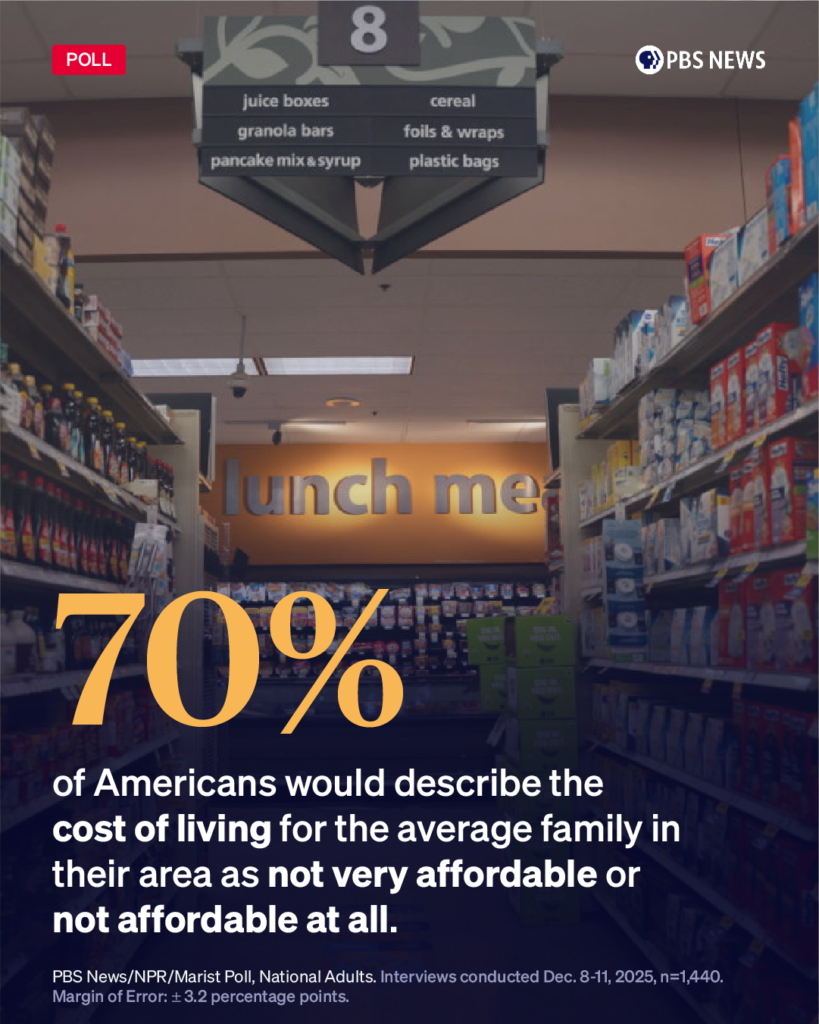
Seven in 10 Americans say the cost of living in their area is unaffordable, including nearly half of Republicans and three-quarters of independents, according to the latest poll. Graphic by Dan Cooney/PBS News.
Economic concerns are fueling an overall sense of pessimism as 2025 comes to an end. More than half of Americans (57%) described themselves as having a more negative view of what’s to come in the year ahead, while 43% say they are more optimistic. It’s a reversal from a year ago when the majority felt hopeful about what would come to pass in 2025.
A year ago, people felt like 2025 might offer some relief with prices of goods stabilizing, Walter said. That didn’t happen, and now people are less inclined to believe it will happen next year.
Instead, the price of goods remains the biggest economic concern for Americans in this latest poll, with 45% listing the issue as the most pressing issue for them – more than double the number who named any of the other options, including housing costs, tariffs, job security or interest rates.
Even as the president has begun to acknowledge issues of affordability and promised to bring prices under control, he has also dismissed concerns as a “con job” perpetrated by Democrats.
Some Republicans in Congress have broken publicly with the president over his repeated claims. “Affordability or the lack of ability of Americans to afford the cost of living is not a Democrat hoax,” Rep. Marjorie Taylor Greene, R-Ga., told PBS News Hour co-anchor Amna Nawaz last week. Greene, who will resign her seat in Congress next month, pointed to record credit card debt as one factor in an continuingly unstable economy.
Americans are experiencing it firsthand, Miringoff said, and Trump’s continued denials about how Americans are feeling about the cost of living “creates even a bigger issue” for him and could risk turning gentle wind “into a hurricane.”
How Trump voters see the economy right now
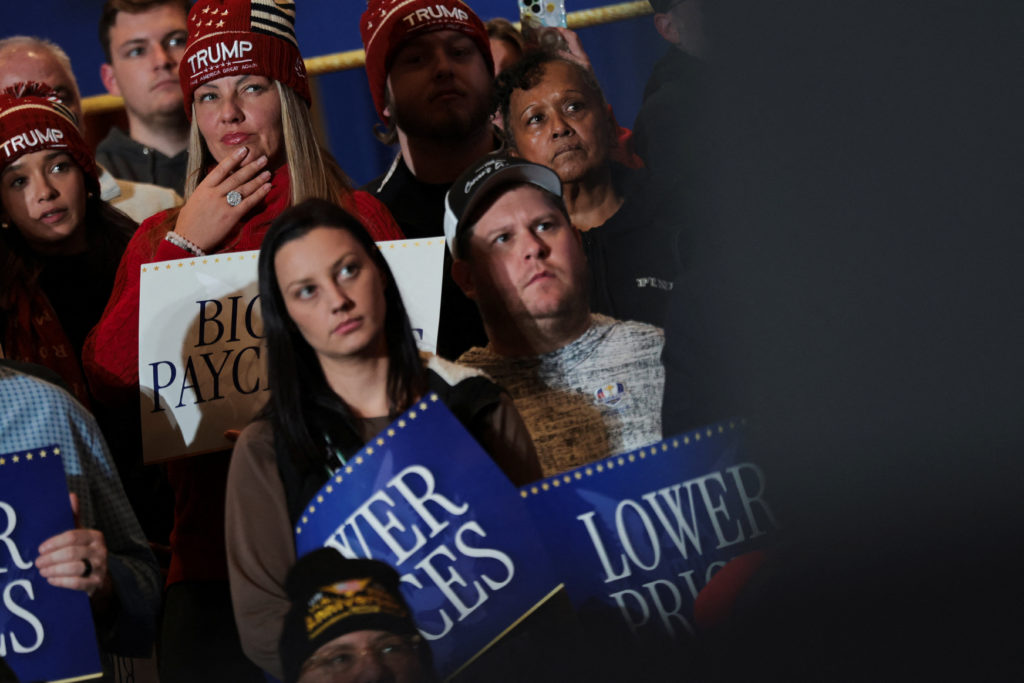
People listen Dec. 9 as President Donald Trump delivers remarks on the U.S. economy and affordability at the Mount Airy Casino Resort in Mount Pocono, Pennsylvania. Photo by Jonathan Ernst/Reuters.
Those worries about the economy have bubbled up even among people like Roger Chester, 48, an Illinois independent who voted for the president last year. He said Trump’s governing philosophy is best described as shifting winds.
“He’s not conservative. He’s not liberal. He is none of the above,” Chester said. “He literally blows with the wind to what his base wants and that is it. Which is fine. That’s all I want my politicians to do.”
Chester said he’s had a “love-hate” relationship with Trump since the president first ran for office a decade ago. He now says the president is a “populist puppet.”
While Chester said prices of goods are “horrendous” and “unbearable,” he doesn’t solely blame Trump.
“He’s the only one that’s actually made an effort to actually keep any of the promises that he’s made, and he definitely hasn’t been perfect,” he said.
WATCH: Trump says the word ‘affordability’ is a ‘con job’ by the Democrats
To stay afloat, Chester, who lost his job in a casino several years ago, says he works seven days a week to support his family. He also believes the United States has to go through some tough times to emerge in a better economic place, with more jobs and better pay.
“I’m willing to suffer. I’m never going to retire. That’s how it is,” he said. “I’m doing pretty much anything to have a better life for my son.”
Hundreds of miles away in North Carolina, independent Justine Hawkins is also playing the economic long game. The health care worker and mother of three was a reluctant Trump voter last year.
She said the economy is mostly working fine for her upper middle-class family, but she disagrees with the president’s assertion that affordability is a hoax.
“If you walk into any grocery store, you know everything costs more money,” she said.
Hawkins said while everyone is feeling discomfort right now – especially in the height of holiday shopping — she is trying to prioritize essential needs over things she may want. She hopes Trump’s policies like tariffs on imported goods will pay off eventually.
“If I looked at it today, I’d say, ‘Oh, I’m very unhappy,’” Hawkins said. “I think in the long run we will, as a nation, be better off because of it.”
Others strongly disagree with that prediction, including some Republican voters. In this poll, the president’s support from his own party dropped five points since last month.
Sherry Kamphaus, 61, is one Republican who has grown disillusioned with Trump.
She lives in Illinois, a solidly Democratic state, and voted for Trump last year. She likes how the president is handling some issues, such as immigration. But that approval is outweighed by economic concerns, the major area where she said the president has failed to meet her expectations.
“He was supposed to help with food prices. That was the main reason that I voted for him,” she said. “Food prices just keep going up.”
Her frustration has spilled over to the Republican Party.
“They promised they’d do better, but they didn’t follow through,” she said. “They’re not doing what they promised to do, especially with the economy and inflation.”
Majority say they are worried about cost of health care
For millions of others, the cost of health care remains a serious concern as enhanced subsidies for the Affordable Care Act are all but certain to expire at the end of the year. Average monthly premiums are likely to double on average, and millions of Americans are expected to drop coverage altogether.
More than half of Americans are concerned that they will be unable to pay for needed health care services next year. Another 46% say they are not worried.
WATCH: How the Affordable Care Act subsidies work and who depends on them
But perspective is sharply divided along income, race and age:
- 67% of people who make under $50,000 are concerned while 47% of those who make above $50,000 say the same.
- 47% of white respondents expressed worry compared to 69% of Black voters and 65% of Latino voters.
- 63% of people under 30 years old are concerned. 40% of those over 60 years old say the same.
While the poll paints a concerning picture about the overall state of the economy, there are some potential signs of hope for the Trump administration.
Two-thirds of Americans are concerned about the effect of tariffs the president is implementing, but as he has reversed course on some of them and scaled back the announcement of many, the percentage of those who are worried has dropped 14 points since June.
Additionally, half of Americans think the U.S. economy is currently in a recession, the lowest number who believe that since 2010.
The poll also found:
- 39% say the economy is working well for them personally.
- 21% say their family finances have improved in the last year; 35% say they’ve gotten worse; and 44% say things have mostly stayed the same.
- 33% expect their financial finances to improve next year – down 15 percentage points since June. Another 29% believe things will get worse, and 39% expect their situation to stay the same.
For many Americans, the cumulative effect of all the swirling economic pressures can be almost too hard to manage.
Sherry Kamphaus, the Illinois Republican, has been married for 41 years and now stays home full time to care for her disabled husband. She said they pay all their bills, stick close to their budget and try to live within their means. Every month is still a challenge.
“There’s a difference between living and surviving,” Kamphaus said. “We’re surviving.”
PBS News, NPR and Marist Poll conducted a survey from Dec. 8 through Dec. 11, 2025, that polled 1,440 U.S. adults by phone, text and online with a margin of error of 3.2 percentage points, and 1,261 registered voters with a margin of error of 3.4 percentage points.
This story originally appeared on pbs.org

