


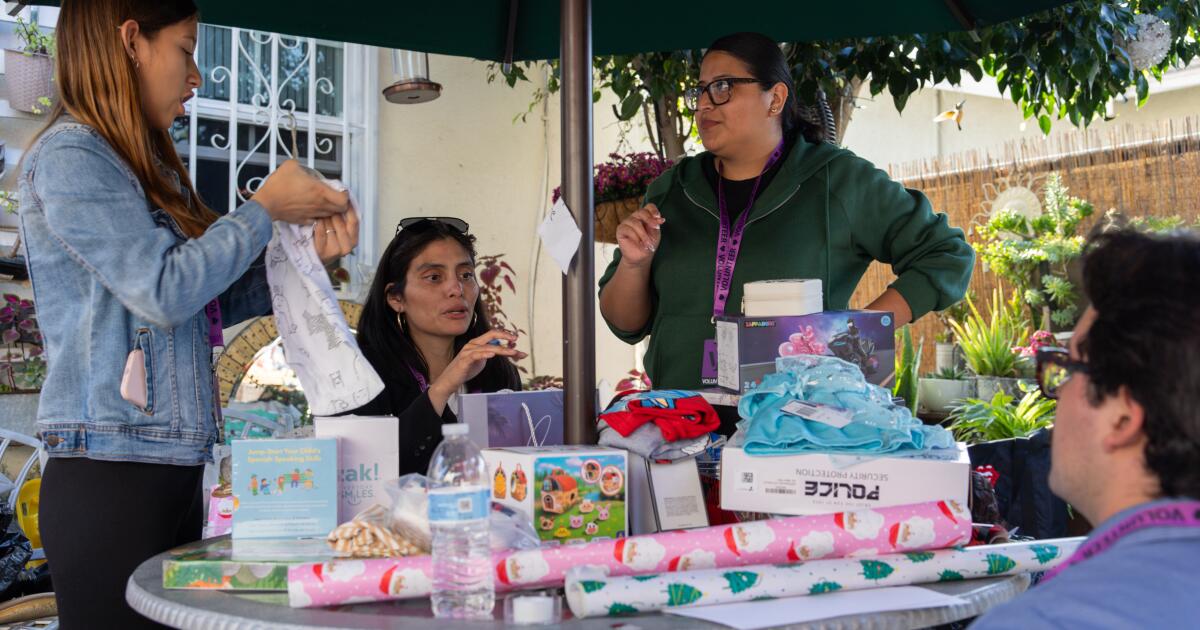
The steady drizzle tested the limits of the string of tarps stretched across the backyard of a Maywood home. Beneath them, dozens of boxes, overflowing with clothes, shoes and toys, lay scattered across the pavement.
Each gift was destined for one of more than 50 Southern California homes whose families have been caught in the growing immigration enforcement crackdown.
This was not charity bestowed from afar, but mutual aid. The organizers are a group of immigrant women who have endured their own struggles and face similar risks as the people they are helping. Five of them asked to use only their second last names because of fears of being targeted by ICE.
The same drive that has guided them through their own harrowing journeys is what motivated them to form Barrio Power.
One of the leaders, Cruz, grew up working in the fields with her family in Oaxaca, Mexico, and spoke only their indigenous language, Chinanteco, as a child. Determined to learn Spanish, she would sneak out to the local school and eventually began teaching others in her town.
Barrio Power volunteers wrap Christmas presents for immigrant families in Maywood.
(Juliana Yamada / Los Angeles Times)
When she got to the U.S. decades later, she would tape dollar bills to the wall to memorize the country’s currency, which landed her a cashier job.
She brings that same ambition to Barrio Power.
“My ancestors, my parents, all the hardship we’ve gone through as Indigenous people, and we still have to suffer? It’s enough,” Cruz said. “We have to come out of the shadows because we’ve done nothing wrong. And if we have to leave, we are going to leave with pride.”
Instead of preparing their own holiday festivities on the day before Christmas Eve, the women raced against the clock, with only hours left to perform a Christmas miracle. As the sun went down and a phone notification warned of more rain, the women, donning elf aprons and Santa hats, scrambled to move the boxes under cover.
Mireya, a petite and reserved woman, approached Franco’s driveway, her ear-flap beanie pulled snugly over her head, 12-year-old son following quietly. She makes a living selling gelatin in the streets of Los Angeles, but she has been terrified to leave her home since the raids first started over the summer.
“You can’t walk down the street with confidence,” said Mireya, who asked to use only her first name for fear of immigration enforcement. “If we leave our house, we have no idea if we’re going to return.”
Unable to work, Mireya couldn’t afford gifts for her son. All she wanted was a smile on her son’s face this Christmas.

Rosa Vazquez organized angel trees for more than 100 immigrant families across the country through the organization Barrio Power.
(Juliana Yamada / Los Angeles Times)
Barrio Power, also known as Semillas de Poder (Seeds of Power), began as a small collective spearheaded by Rosa Vazquez and the five other women, all immigrants, who sought a space for the community to safely express themselves. Their goal is to build a large network of immigrants, who can be mobilized to advocate for themselves.
They began hosting community forums over Zoom during the immigration raids in June and spent months speaking with hundreds of immigrant families to get a sense of their needs. One concern quickly rose above the rest: How would they afford Christmas?
Many families had a head of household detained, deported or unable to work because of the raids, Vazquez said.
She suggested an angel tree program for families affected by ICE. They set up an Instagram account just days after Thanksgiving and initially adopted 10 families.
“This is not charity for us,” Vazquez said. “This is what mutual aid can look like when it’s organized by undocumented people for undocumented people.”

Volunteers put together a gift bag for an immigrant family during an angel tree event in Maywood.
(Juliana Yamada / Los Angeles Times)
The stories they heard over the last month were heartbreaking.
One of the leaders, Catarino, spoke with multiple day laborers in Bakersfield who couldn’t afford food, let alone warm jackets during the harsh winter.
Their experiences flooded her mind: the father of a young boy with autism was detained by ICE; two brothers, whose family now struggles to sell half the desserts they used to, needed bicycles to get to school. A 13-year-old girl requested a replacement for her mom’s broken bike, as riding in their neighborhood was their only chance to spend time together.
One 8-year-old boy asked for “the cheapest shoes at Walmart.”
The interviews were a painful reminder that the impact of immigration enforcement ripples through families, she said.
But the generosity people showed lifted their spirits.
“Oh my god! They just bought the AirPods!” exclaimed Vazquez at a meeting in early December, as she scrolled through Barrio Power’s Amazon registry. A single donor bought nearly all 350 items.
Just the night before, Azusena Favela, a Central Los Angeles resident, had bought the organization’s entire Walmart registry.

A Christmas card addressed to an immigrant family during an angel tree event.
(Juliana Yamada / Los Angeles Times)
For the last nine years, Favela had turned her late-November birthday into a fundraiser, encouraging family and friends to donate. The funds have often gone toward toys for a shelter in Tijuana. This year she raised $2,000 and wanted to support families affected by ICE raids. After a 10-minute phone call with Vazquez, Favela said she knew this is where the money would go.
The Amazon items ranged from gift cards and shoes to Beats headphones and even a Nintendo switch that a farmworker family from Bakersfield had asked for.
“What this administration is forcing us to recognize is that we’ve only got each other,” Favela said. “I think it’s these small acts of kindness that remind us, this is what the holidays are for, and this is what community does.”
The community responded in droves, donating nearly $15,000 and around 900 gifts.
By Dec. 24, they had fulfilled wish lists for 130 families, 54 of whom are based in Southern California.
Vazquez and other volunteers coordinated deliveries for 50 out-of-state families last week, including in Chicago and North Carolina. On Christmas Eve, she planned to deliver gifts to about 20 families in Orange County and they will head to Bakersfield on Sunday to deliver gifts to another 20 farmworker families, she said.
Barrio Power will also keep accepting donations until the end of the year for 12 local families who celebrate Three Kings Day on Jan. 6 instead of Christmas, Vazquez said.
Barrio Power’s community leaders began meeting at least twice a week right after Thanksgiving, when they first launched the angel tree sign-up sheet.

Rosa Vazquez coordinates with volunteers to wrap Christmas gifts for immigrant families.
(Juliana Yamada / Los Angeles Times)
Vazquez was always confident the program would be a success, but the others worried. A few of them had already planned to organize a fundraiser and sell food in case they didn’t get donations.
The process was complex, first requiring an initial application. Then the community leaders interviewed potential families. They also asked families to submit wish lists for all members, including adults, and a stick-figure drawing of their family unit.
None of the women imagined how many people, mostly strangers, would rally around their efforts, Vazquez said. The gifts were donated not by the wealthy, said Cruz, one of the women, but by community members, many of whom are immigrants themselves.
“So, what’s left to do now?” Cruz asked as the excitement settled.
Catarino, another community leader, clasped her hands and thanked God. Her eyes drifted to the four large boxes in the center of the room — all gifts delivered just in the last two days. She’d never seen so many toys in her life.
Franco greeted Mireya in the driveway with a warm smile. Mireya’s gifts weren’t yet wrapped, so Franco guided her and her son to one of the many patio chairs in her backyard. The timid 12-year-old wore a Christmas sweater and laid his head on the table as Vazquez and the other women prepared his gifts. He was a last-minute addition to their list, Vazquez said, so they didn’t have the time to order specific items. Instead, they quickly sifted through what they had on hand.
The boy tried not to peek at his gifts, but at times his eyes wandered toward the opposite side of the backyard, where the women were wrapping.
He needed shoes, Vazquez said quietly, reading off of her small blue book, where all of the families’ information is noted. Catarino dug through a pile before pulling out a pair of Nikes. Vazquez breathed a sigh of relief when the shoes turn out to be his size. The women wrapped them up along with toys, a sweater, a backpack and some shirts.
A green bell rang — a signal that the women had finished wrapping the small family’s gifts.
The boy’s wide eyes stared in excitement at his hands, which quickly overflowed with presents, about eight just for him. Vazquez said Mireya hadn’t added anything to her Christmas list, so she handed her a $100 Visa gift card. Mireya started tearing up.
“It’s just so hard when one can’t work,” Mireya said.
This story originally appeared on LA Times

