


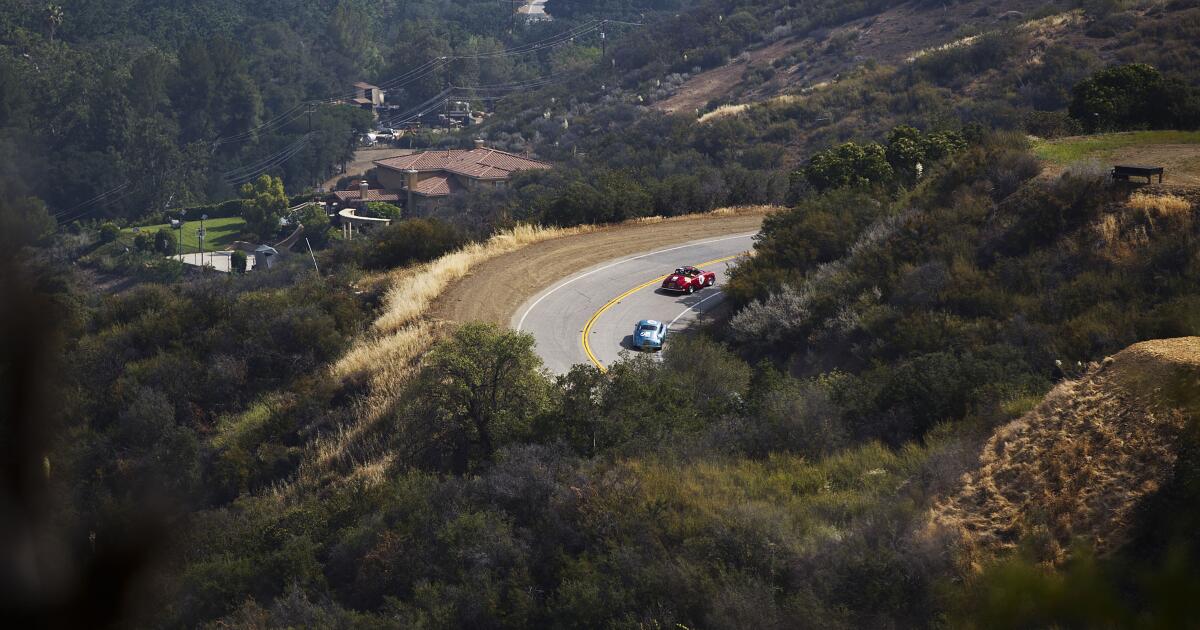
For more than six years, adrenaline junkies have yearned for the moment that, once again, they can careen around the serpentine corners of a stretch of Mulholland Highway with the crisp mountain air rushing through their hair.
Their wait came to an end Tuesday as a 2.4-mile section of the road known as “the Snake” slithered back to life.
The area of the highway roughly between Kanan Road and Sierra Creek Road has been closed to vehicle traffic since early 2019 after it was charred in the Woolsey fire and further damaged by winter rains.
Prior to the closure, the Snake was known for attracting speeding motorcyclists and car races and frequent collisions.
Now, with a new set of safety improvements in place, L.A. County officials are hoping the road can shed its dangerous reputation.
Motorcyclists ride along Mulholland Highway near Agoura Hills in 2010.
(Chris Carlson / Associated Press)
This includes new curve-warning signs, tightened intersections, updated road stripes, safety bollards and rumble strips designed to slow traffic. The California Highway Patrol will perform traffic enforcement and establish routine patrols to deter nightly racing and takeovers, while the L.A. County Sheriff’s Department will issue citations to vehicles parked illegally along the edge of the road.
“We have kept this road closed following the Woolsey Fire for as long as state law allows, and we remain committed to keeping Mulholland Highway safe for everyone,” L.A. County Supervisor Lindsey Horvath said in a statement. “My office has directed Public Works to continue evaluating the area for additional improvements and report back in six and twelve months.”
In 2016, prior to the road closure, the Board of Supervisors voted to ban vehicles stopping along both sides of the highway in an attempt to eliminate races that drew spectators.
During the Woolsey fire, which scorched some 97,000 acres of Malibu over 13 days, the Snake’s guard rails melted, pavement burned, and a bridge was destroyed.
The road reopened for pedestrians and cyclists in April 2020 after infrastructure repairs.
In 2023, Horvath spearheaded a motion for the implementation of Vision Zero on Mulholland Highway, which instructed Public Works to evaluate traffic conditions and propose ways to enhance safety and reduce vehicle speeds.
Vision Zero is a national effort to eliminate fatalities and serious injuries from traffic accidents. As part of the initiative, L.A. County established a goal to reach zero traffic deaths on unincorporated roadways by 2035. On average, more than 75 people die each year on unincorporated county roadways.
While many motorcylists rejoiced at the reopening of the Snake this week, some residents mourned the end of a tranquil era.
In a 2023 opinion article in local news outlet the Acorn titled “Keep the Snake closed, it’s quiet,” resident and avid cyclist Todd Bank described how peace and safety abounded in the absence of vehicles.
“This section of L.A. County roadway, while still closed to motorized traffic, has become a magical place again, probably like it was a hundred years ago,” he wrote. “It offers so much happiness now.”
Although some residents had advocated for privatizing the road for resident access only, the Snake does not meet state requirements to do so.
“Maintaining Mulholland Highway as a functioning roadway is critical for public safety in emergency response, evacuation, and recovery efforts and provides access and connections throughout the Santa Monica Mountains,” the Public Works Department said in a September report. “This need can be compared to how Tuna Canyon Road served as a critical connection for ingress and egress in the Santa Monica mountains when Topanga Canyon Boulevard was closed as a result of the recent Palisades Fire.”
Public Works also pointed out that were the road to be converted to a private highway, residents would have to collectively assume costs for repairs and maintenance. After the Woolsey fire, the county spent $3 million fixing the closed section of Mulholland Highway and was able to get the majority of spending reimbursed by the federal government.
This story originally appeared on LA Times

