


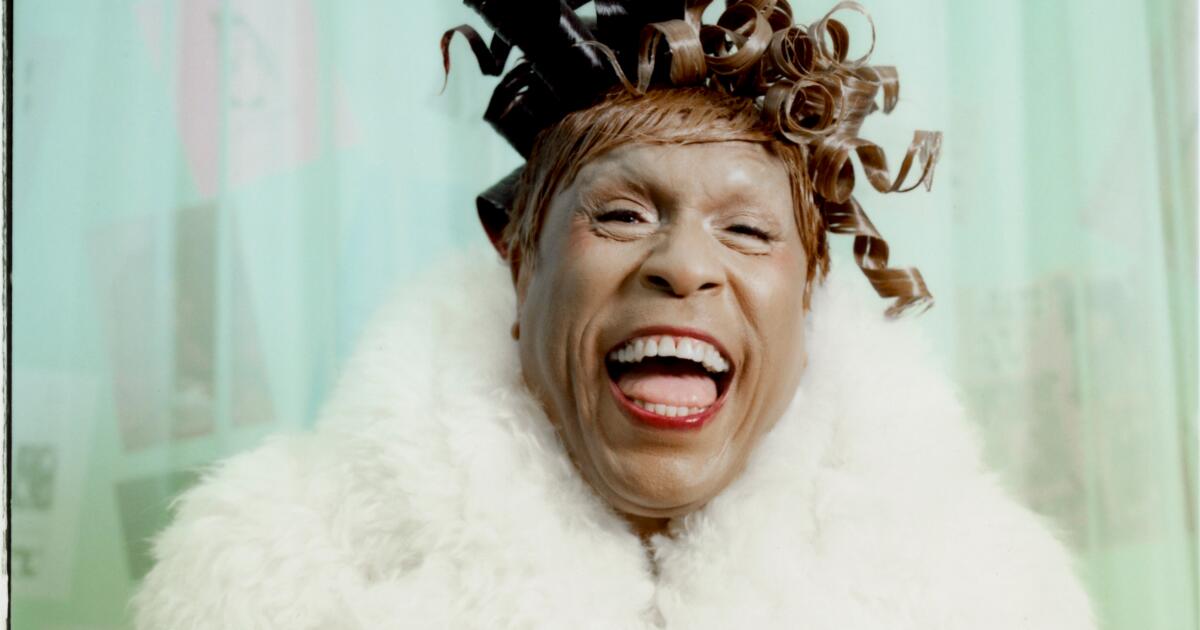

Vaginal Creme Davis has long been a star. “I’ve always thought of myself as a success,” she said during a recent Zoom call, “a messy success.”
A statuesque femme, way over 6 feet tall, Davis was, for decades, a ubiquitous, commanding figure across much of Los Angeles’ artistic landscape. From the early 1980s until the mid 2000s, one could find her performing at underground venues from Alcohol Salad to the Lhasa to Largo (or as internet legend has it, perhaps opening for the Smiths at the Hollywood Palladium) in an eclectic variety of bands and personas. There was her Blaxploitation a cappella group, the Afro Sisters, for which she donned a bleached blond wig, flanked by a revolving host of backup singers with names like Clitoris Turner, Urethra Franklin and Pussi Washington. There was the time she was Gabriela in the band ¡Cholita! The Female Menudo, where she sang alongside Sad Girl, the punk icon Alice Bag, who described Davis to me as “the most exciting and audacious performer I’ve ever worked with.” Alongside Warhol actor Bibbe Hansen, Davis was also behind Black Fag, a send-up of the seminal L.A. band, and she collaborated with Glen Meadmore on the queercore outfit Pedro, Muriel & Esther, whose 1991 album “The White to Be Angry,” was recorded by rock legend Steve Albini.
If, unfortunately, only a smattering of documentation of these groups exists online, their performances are likely still vivid in the imaginations of anyone who attended them. The musician Kathleen Hanna praised Davis as an inspiration for starting her band Le Tigre in the late 1990s, and the comedian Margaret Cho chose Davis as the opening act for her U.S. tour in 2001. Part of what makes Davis such an intrepid performer is, as Bag said, that she “will not tolerate a passive audience.” Davis’ version of engaging an audience “might be pointing a light-up dildo ray gun” at them, “dry humping or shrimping an enthusiastic fan on the dance floor” or giving “a Spanish lesson, using only the nastiest profanity.” In a 2012 piece she wrote for Artforum, Davis remembers that, one night, when performing at the famed venue Jabberjaw, she singled out the actor Drew Barrymore and her then-boyfriend, Eric Erlandson, of the band Hole, and “attacked both of them” using her tongue “as a power drill to bore into their mouths.”
The move embodies the confrontational ethos of punk rock. But in Davis’ case, a formative grounding in punk and social consciousness is melded with the stinging dish of a professional gossip, a historian’s eye for names and places, a poet’s linguistic virtuosity, and the exuberant, subtle viciousness and delightfully naive curiosity of a teenage girl.

Davis wears a Prabal Gurung jacket and BODE shoes and pants.
These many facets of Davis’ persona and more are being celebrated in “Magnificent Product” at MoMA PS1 in New York, her biggest and most comprehensive show in the U.S. to date (the retrospective originated in Stockholm before traveling to Berlin over the summer). Over a video call, Connie Butler, the director of the PS1 iteration, called Davis a “trailblazer.” “I think she is a pivotal figure that brings together a number of generations, and the show will really make the case for her historical importance,” she said, noting that she hoped it would also honor the “theatricality and playfulness” of Davis’ performance persona through its range of presentation and vintage equipment. “We painted many of the walls pink,” Butler added, “we did some things like that that are not typical of our usual exhibitions.”
Now in her 60s (Davis gives her birth year as 1961, but the internet abounds with alternative dates), Davis has become something of an art world darling, lecturing and teaching across Europe, working the biennial circuit, and increasingly being included in museum exhibitions. It wasn’t until she moved to Berlin in 2006 that she began to experience these more conventional markers of artistic success, showing her work in commercial galleries and achieving wider attention.
“One day you’re being shown in a museum, and then the next day you’re back in the gutter,” Davis said from Berlin, wearing a casual black hoodie and speaking from a light-filled room with posters and photographs tacked to every surface of the wall. “I’ve been doing what I’ve been doing for people who’ve known of it for the last 40 years. They know that not much has really changed.”

Vaginal Davis. Memorabilia and ephemera as part of “The Wicked Pavilion.” 2021. Installation view, “Vaginal Davis: The Wicked Pavilion,” Eden Eden, Berlin, 2021.
(From the artist and Galerie Isabella Bortolozzi, Berlin. © Vaginal Davis. Photo by GRAYSC)

Vaginal Davis. Hofpfisterei (detail). 2024/2025.
(Photo by Steven Paneccasio/MoMa PS1.)

Vaginal Davis. “Middle Sex,” 2024. Installation view of “Vaginal Davis: Magnificent Product,” on view at MoMA PS1.
(Photo by Steven Paneccasio/MoMa PS1.)

Vaginal Davis. “The White to be Angry,” 1999, film still.
(From the artist and Galerie Isabella Bortolozzi, Berlin.)

Vaginal Davis. “The Wicked Pavilion: The Fantasia Library,” 2021.
(Photo by Steven Paneccasio/MoMa PS1.)
Though leaving her hometown of Los Angeles wasn’t exactly her choice — she departed after being forced out of a $500-a month, three-bedroom apartment in Koreatown with original tile and peg and groove hardwood floors that she still rhapsodizes about, when her landlord died — Davis recognizes that the move helped to build her reputation. Even before leaving L.A., she had been collaborating with the Berlin-based art collective Cheap, and once she was in Europe, American institutions suddenly began to take her more seriously.
“You get taken for granted when you live in the same city that you were born in,” Davis said. “People just think, ‘Oh, she’s always going to be here, she just does her little thing.’”
The writer Lisa Teasley, who has known Davis since the late 1980s through their mutual close friend, the artist Ron Athey, agreed that relocating to Berlin has made much of Davis’ later career possible. “Most countries in Europe have been way ahead of the U.S. in terms of supporting the arts,” she said. There is also the legacy of Black artists like Nina Simone, Tina Turner, Miles Davis and James Baldwin taking refuge outside of the country, as well as more basic necessities being provided for. “I mean, there she has healthcare,” Teasley said, “which is something that so many of us artists here don’t.”
While Davis can’t really see herself living back in the States again, she was also quick to interject: “Berlin is no panacea, sweetie. There’s no safe spaces anywhere.”

Davis wears BODE pants and a Gogo Graham dress and headpiece.
Earlier in our conversation, Davis had apologized for her brain fog, a result, she said, of being more of a morning person who usually wakes at 5 a.m. to work in her “atelier,” and the Type 1 diabetes she got diagnosed with only a few years ago during the pandemic. But she was energized talking about the Los Angeles of her youth — a time when the city was still among the cheapest international places in the world, underdeveloped, with remnants of its Old West roots like horses and hitching posts visible alongside glamorous 1920s architecture. When I asked the designer Rick Owens, a longtime friend of Davis’, for comment on their formative years in Los Angeles, he sent a document he and Davis had worked on together that ended up in his first book and that paints the city as an endless stream of “welfare watering holes” where “amazing fights … would break out between rough trade concubines with names like Animal or Spider or Eyeball”; “dank apartments” had “walls covered in molding peacock feather fabric”; and Little Richard parked in a limo outside of Roscoe’s House of Chicken ‘N Waffles, handing out Bibles from the window.
Recalling the era, Davis seemed nostalgic, but her memory also turned out to be crystal clear. It extended back much further to the names of the underage discos she used to attend as a teen, and the middle school teachers who “encouraged my sort of whimsical nature and my sort of use of humor in everything that I did.” She credits her local library branch, Pio Pico, on Oxford Street in what is now Koreatown, for facilitating her love of reading and language. Davis, a gifted writer, regularly wrote about music and culture for the LA Weekly, and ran an infamous fanzine, Fertile LA Toya Jackson, which she started off printing on a Xerox machine during her day job at UCLA in the mid-’80s.
Davis also readily cites her mother, Mary Magdalene Duplantier, as one of her main inspirations. “My mother made art objects too, but she would make something and then dispose of it because she didn’t consider herself an artist.” Davis describes much of the work that appears in “Magnificent Product” — from her delicate paintings of feminist icons composed with makeup and nail polish to her totemic bread sculptures of fertility goddesses — as appropriations of Duplantier’s art. “I’m just copying her,” she said. “My whole career has just been copying my mother.”


Davis wears a Telfar suit.
Davis’ mother is also the subject of an autobiographical novel, long in process, that is excerpted in the “Magnificent Product” catalog. Titled “Mary Magdalene,” it mixes fact and fiction, as in general seems to be Davis’ wont as a natural-born storyteller, always refining her tale through fabulation and embellishment. The excerpt shares how Davis’ mother came west from Louisiana during the Great Migration, a Black Creole who arrived in Los Angeles in 1945. She gave birth to four daughters, three of whom were the result of her first marriage, before having Davis in her mid-40s. (Davis said her father was 19 when her mother met him, the Jewish-Mexican son of owners of a grocery store in East L.A., where her mother worked briefly.) In the novel, Mary Magdalene is portrayed as tough and no-nonsense, violently attacking a doctor who touched Davis inappropriately as a child, and sending a man who insulted her with a racist slur on the street flying through the glass window of a May Company department store.
When we spoke, Davis described her mother as being intellectually curious, someone who, like Davis, was a voracious reader, subscribing to five newspapers; a practicing Jehovah’s Witness, but also involved in political activism. She moved the family from the Ramona Gardens housing project in Boyle Heights to the apartment where Davis grew up around Pico and Western when Davis was just a few years old. Davis remembered that around this time, during the 1965 Watts uprising in L.A., while visiting her older sister nearby their apartment, she and her mother saw tanks in the street. “My mother was holding my hands and she told me, ‘Look at this, see these tanks, always remember this.’ ”
Of course, race has played an equally important role in Davis’ work as gender, if christening herself after the activist Angela Davis when she was a teenager wasn’t enough of a clue. (The conversion was distinct enough that Davis does not refer to her birth name and notably, the information is not included in any of the literature for the PS1 show.) When the beloved queer theorist José Esteban Muñoz called Davis’ style of performing “terroristic drag,” he was commenting primarily on the politicized manner of her performance and the ways in which it became a form of cultural critique, rather than the way she dressed.
Davis has acknowledged racial antagonism and the randomness of racial categorization in ways both transparent and ambiguous: leading, for instance, a mostly white crowd in a chant of “I hate your whole family,” during a ¡Cholita! performance with the American flag prominently displayed. In one of Davis’ videos, the character of Fertile, played by a friend of hers in a giant afro-wig, points a gun at the camera and admonishes the viewer to admit their racism. “If you’re white, you’re racist … we’re all racists,” she hollers. For Pedro, Muriel & Esther, Davis sometimes performed as a bearded, camo-ragged white supremacist named Clarence, and the band’s album cover bears a Confederate battle flag.

Davis wears a Dolce & Gabbana jacket and her own pants.
While it was planned in a different political climate, there is perhaps some poetic justice that “Magnificent Product,” Davis’ highest profile exhibition to date, has arrived at a time when prejudice and transphobia have become nearly state-sanctioned, a development Davis might have easily anticipated. Far from feel-good drag queen story hours and gay weddings covered by the New York Times, Davis’ version of queerness was never meant to be assimilated, which makes it even more up to the challenges of the present day. As she said in an interview with Athey a few years ago, reflecting on the emergence of mainstream gay culture: “[T]here was a big difference between queerness and gayness.” To which Athey answered that their version of queerness was “queer, as in ‘f— you,’ not queer as in unicorn stuffed animals and the cult of tenderness. We weren’t tender.”
At the same time, Davis, both in conversation and in her work, is nothing if not charming, playful, seductive and extremely reverent of both the forebearers she often paints, references and writes about — a whole cosmos of actors, writers, singers and teachers — as well as the artists who have risen in her wake. She is also unbelievably funny. Recently, I watched her in the 1993 inaugural edition of the “Fertile La Toya Jackson Video Magazine,” directed by the photographer Rick Castro (a second issue followed in 1994). Davis gallivants around L.A., interviewing drag queens and trans sex workers on Santa Monica Boulevard about where they buy their clothes (inevitably the answer is either Playmates or Frederick’s of Hollywood). She converses earnestly with a restaurant valet attendant, and giggles and gags with a girlfriend at another friend’s house, standing in front of an open refrigerator at one point and pulling out a jar of mustard as if it were a kind of magical object that Davis had never before seen. (“It’s light!” she keeps exclaiming of the mustard, “it’s light!”).
Watching the video, I found myself enchanted, identifying with its sense of delirium and fun, which reminded me of the best parts of being young. I yearned to have Davis as a friend, and most of all, I laughed harder than I had at anything in a long time. The quietly revolutionary aspect of Davis choosing to address “all the girls in their natural habitat, but treating them like the human beings that they are,” as she said of the sex workers she talked to on Santa Monica Boulevard (“working ladies because sex work is work”), didn’t strike me until after the fact. “To me, her work corrects assumptions that anyone can fit into any kind of box really,” Teasley said, “unless they want to, unless they want to be some kind of cookie cutter, and even then, it’s impossible.”
“I believe in preaching, of course,” Davis told me. “There’s a lot of religious overtones with me, but you have to really figure out how to use your pulpit to get people to see that there’s something there. It hits them much later — ‘oh, that’s what she was trying to say.’ But whether people get it or not, it almost doesn’t really matter. Ever since I was young and writing my crazy little short stories and stuff, people got something from it.” Even if they hadn’t, one has the sense that Davis would have probably still continued to write, perform and make art. Her work has a continuity, an obsessional quality that transcends any one given form and reflects instead on the eccentric and brilliant slant of her personality and perspective. “I do have a very original voice,” she said. “It’s an unusual voice, and it’s an unorthodox voice, but there’s a voice there.”
Kate Wolf is a writer and editor based in Los Angeles.
Makeup Mollie Gloss
Hair Sean Bennett
Movement director Ash Rucker
Production Dionne Cochrane
Photo assistants Michael Delaney, Kimmy Campbell
Styling assistant Rendi Alemu
Production assistant Déjah Small
Location MoMA PS1

This story originally appeared on LA Times

