


After being eliminated from the United States in 2000, measles is making a comeback — and not only in Season 1 of HBO’s popular drama, “The Pitt.” The cases are now numerous enough that the U.S. is on track to lose its measles-free status.
In 2025, the Centers for Disease Control and Prevention reported 2,267 confirmed measles cases, the most since 1991. So far this year, 588 cases have been confirmed, many stemming from a large, ongoing outbreak in South Carolina. But other states, including Florida, North Carolina and Utah, had also reported cases by late January.
For many parents of young kids, who are especially vulnerable to the virus, measles is a disease of the past — widespread vaccination made infections rare. It’s even new for some doctors, many of whom are encountering the first infections of their careers.
But as cases pop up in communities nationwide, we thought it was time for a crash course on the virus and how to protect your family.
What are the symptoms of measles?
Measles is a highly contagious respiratory virus that causes a rash. Even milder cases that don’t require hospitalization are miserable, doctors told us.
“This is not a trivial virus,” said Dr. William Schaffner, an infectious disease doctor at Vanderbilt University. “I would not wish measles on any child.”
Symptoms typically appear one to two weeks after exposure. The first symptoms aren’t unusual — a cough, runny nose, fever, and red watery eyes.
A few days after symptoms start, tiny white spots, called Koplik spots, may appear on the inside of the mouth. Three to five days in, the measles rash’s flat, red spots will appear, starting on the face and moving down the body to the trunk and limbs. On darker skin tones, the spots can appear purple-ish or dark brown.
“The measles rash can look like other childhood rashes like scarlet fever, roseola and rubella,” said Dr. Peter Chin-Hong, an infectious disease doctor at the University of California, San Francisco. But the combination of cough, runny nose, and red eyes amid an outbreak of the disease “is kind of a clincher for measles.”
Measles can cause high fevers, over 104 degrees Fahrenheit. Most people recover in around 10 days, but complications are possible.
A sign warning of measles is posted on a glass door as a patients wait in the family medicine wing of at the Texas Tech Physicians of the Permian Basin Monday, Feb. 24, 2025, in Odessa, Texas. (AP)
What are complications from the measles?
Beyond feeling sick and miserable, the most common complications are ear infections and diarrhea, which can lead to dehydration.
More severe complications are possible. According to the CDC, about 1 in 5 unvaccinated people who get measles in the U.S. requires hospitalization.
Among children, about 1 in 20 who are infected will develop pneumonia, and about 1 in 1,000 experience swelling of the brain that can cause deafness and permanent disability.
Tragically, as many as 3 in 1,000 children will die from complications of the disease.
An even rarer fatal complication is subacute sclerosing panencephalitis, which doesn’t appear until around 7 to 10 years after infection. This has no cure and causes a slow, progressive cognitive decline into a vegetative state and then death.
Certain groups are at especially high risk for complications: children under 5, adults older than 20, pregnant women, and people who have compromised immune systems. Most people fall into one of those groups.
How is the measles spread?
Like many other respiratory viruses, measles is spread through coughing or sneezing. But it’s highly infectious. Of people who aren’t vaccinated or who haven’t had a previous infection, up to 90% will get sick after being exposed to someone with measles.
And you can get it from someone you’ve never even met or seen. If a person with measles has been in a room, someone else can get infected from breathing the same air, up to two hours after the infected person has left.
A person with measles is infectious four days before the rash appears and four days afterward, according to the CDC.
Face masks and regular hand washing may provide some limited protection. Given how infectious measles is, “I would not want to rely on a mask or hand washing alone in order to reduce my chance of getting measles,” Schaffner said.
But you don’t need to lock yourself in the house. If you are living in an area with no reported cases of measles, “the likelihood of you having measles is close to zero,” said Dr. Aaron Milstone, a pediatric infectious disease doctor at Johns Hopkins University. The probability is even lower if you are vaccinated.
How is measles treated?
There is no cure for measles. Doctors can provide supportive care and try to manage the symptoms — reduce fever, prevent dehydration, treat secondary bacterial infections — until the disease has run its course, but there is no treatment.
For people who are deficient in vitamin A, taking supplements can reduce the risk of serious complications once they are sick. But there is no evidence that vitamin A prevents infection.
“There’s nothing to do for kids with measles,” said Milstone. “It’s ‘cross your fingers and hope for the best.’ And, as a parent, that scares me.”
To prevent further spread, public health departments place unvaccinated people who have come into contact with an infected person under quarantine. Home quarantine lasts around three weeks.
Hundreds are currently quarantined in South Carolina thanks to the outbreak there.
Should I get vaccinated?
Doctors say yes.
Vaccination is the best way to protect yourself and your children from measles.
In the U.S., it is recommended that all children be vaccinated against measles with the MMR vaccine that also protects against mumps and rubella. The first dose is recommended at 12 to 15 months, and the second dose between 4 and 6 years. This recommendation didn’t change with the CDC’s recent updates to the childhood vaccine schedule.
Older children and adults who were not vaccinated as children can still get vaccinated with two doses at least 28 days apart.
Two doses of the MMR vaccine are about 97% effective at preventing measles, meaning if you are vaccinated, you are highly unlikely to be infected. Protection is usually lifelong.
Last year, 93% of all measles cases were among people who were unvaccinated or whose vaccination status was unknown.
Breakthrough infections among those who are fully vaccinated are still possible, and accounted for 4% of cases in 2025.
Milstone advised adults to double-check what their vaccine status is, in case they only received one dose as a child. But for people who got two doses as a child, there is no need to get another shot as an adult, even if you are living in an area with an outbreak.
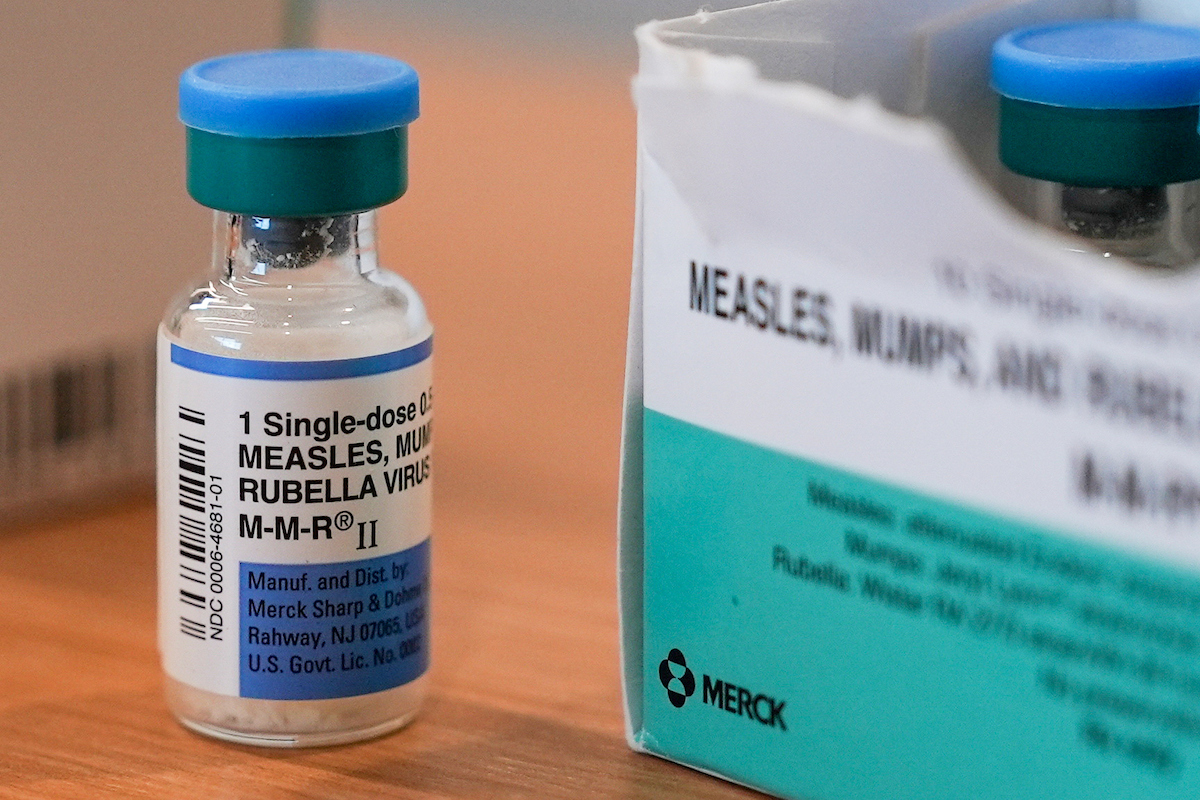
A vial of the measles, mumps and rubella vaccine is on display at the Lubbock Health Department, Feb. 26, 2025, in Lubbock, Texas. (AP)
Does the vaccine have side effects?
The MMR vaccine uses a live but weakened version of the measles virus.
There is a small risk of a slight fever and mild rash following vaccination.
“It’s not measles, but you know, this is a tamed virus, so on occasion, it can produce a very mild version of the illness,” said Schaffner.
The MMR vaccine has long been a target of claims linking the vaccine to autism.
Decades of epidemiological research have not demonstrated a link between autism and the MMR vaccine.
The claim traces back to a 1998 paper by a British doctor who lost his medical license after his study was found to be — in the British medical journal BMJ’s words — an “elaborate fraud.”
Because it is a live virus, it cannot be administered to pregnant women or people who have compromised immune systems.
That means that kids who are already at the greatest risk of getting sick are those who can’t get protection. Schaffner said he believes healthy people have an obligation to their neighbors who cannot be immunized and are at risk of severe disease.
This story originally appeared on PolitiFact

