


The US has carried out a “large-scale strike” against Venezuela, and its leader, Nicolas Maduro, has been flown out of the country with his wife.
The strikes mark a dramatic escalation after months of tension between the two countries and a US military build-up in the region.
This is what we know so far.
Where and when did the US strike?
Several explosions rang out in Caracas, Venezuela’s capital, early on Saturday, as low-flying aircraft swept over the city.
Witnesses reported smoke rising from the hangar of a military base in Caracas.
Read more:
US strikes Venezuela: Follow latest
Why removal of Maduro is unprecedented
How did we get here?
The explosions in Caracas sent people rushing into the streets, while others posted videos of the blasts on social media.
The strikes, which lasted about 30 minutes, also hit the states of Miranda, Aragua and La Guaira, according to the Venezuelan government.
Donald Trump told Fox News there were a few injuries to US forces, but no deaths.
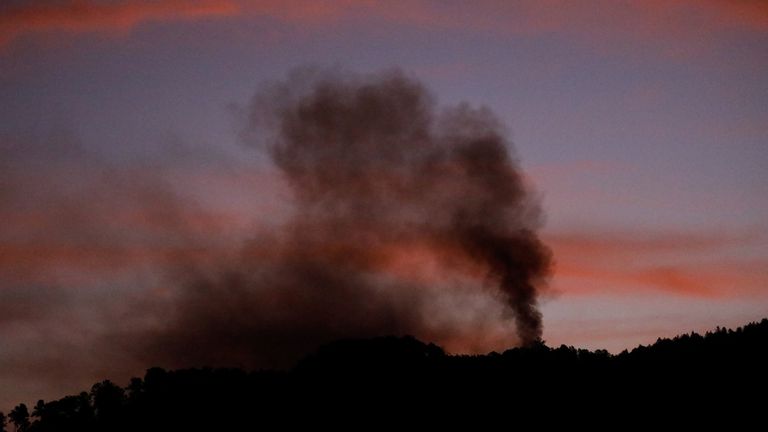
Smoke rises from military base in Fort Tiuna, Venezuela. Pic: Reuters
How was Maduro captured?
In a post on Truth Social, Donald Trump said Maduro and his wife Cilia Flores were “captured” and flown out of the country after the US “successfully carried out a large-scale strike”.
He added: “This operation was done in conjunction with US Law Enforcement. Details to follow.”
Maduro was captured by elite special forces troops, a US official told the Reuters news agency.
On Saturday morning, sources inside the opposition told Sky News they believe Maduro’s capture was a “negotiated exit”.
According to the country’s ruling party leader, Nahum Fernandez, the president and his wife were at their home within a military base when they were seized.
“That’s where they bombed,” he told The Associated Press.
“And, there, they carried out what we could call a kidnapping of the president and the first lady of the country.”
US broadcaster CNN reported the couple were “dragged from their bedroom”.
Citing two sources, they said they were “captured in the middle of the night as they were sleeping”.
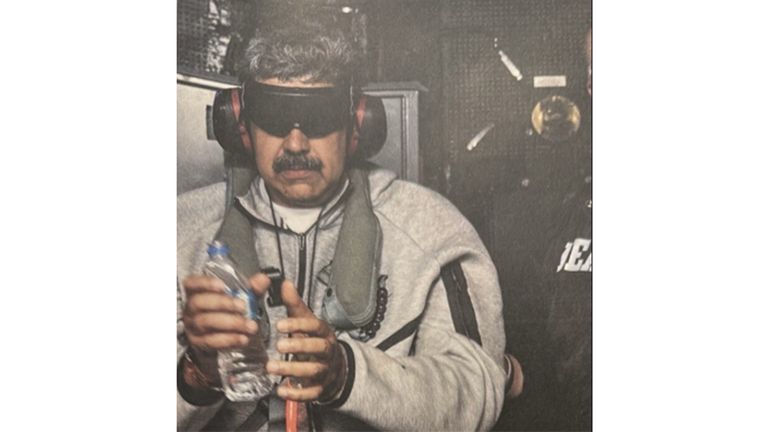
Donald Trump shared an image on Truth Social, captioned: ‘Nicolas Maduro on board the USS Imo Jima.’ Pic: Truth Social
Maduro to face charges
US attorney general Pam Bondi said Nicolas Maduro and Cilia Flores have been indicted in the Southern District of New York.
“They will soon face the full wrath of American justice on American soil in American courts,” Ms Bondi wrote on X.
She said the Venezuelan president faces charges of narco-terrorism conspiracy; cocaine importation conspiracy; possession of machine guns and destructive devices; and conspiracy to possess machine guns and destructive devices against the US.
Maduro was indicted in March 2020 on “narco-terrorism” charges in the Southern District of New York.
What next for Venezuela’s leadership?
Mr Trump said they are now making decisions on what’s next for Venezuelan leadership.
He warned any Maduro loyalists have a “bad future” if they remain loyal, adding they will look at opposition leader Maria Corina Machado.
The US will also be “strongly involved” in the country’s oil industry, he said.
Ms Machado shared a statement on social media, with the caption: “Venezuelans, the hour of freedom has arrived.”
“Nicolas Maduro, starting today, faces international justice for the atrocious crimes committed against Venezuelans and against citizens of many other nations,” she said.
“Given his refusal to accept a negotiated solution, the United States government has fulfilled its promise to uphold the law.”
What has Keir Starmer said about the strikes?
Sir Keir Starmer said the UK had no involvement and he has not spoken to Donald Trump about the “fast-moving situation”.
He added: “I will want to talk to the president, I will want to talk to allies.”
When asked about Trump saying that Venezuelan president Nicolas Maduro had been captured, Sir Keir said he wanted to “establish facts” and added: “As you know, I always say and believe that we should uphold international law.”
The prime minister also noted that there are roughly 500 Britons in Venezuela, and said the government is working with the embassy “at pace”.
National emergency declared
The Venezuelan government declared a national emergency “to protect the rights of the population, the full functioning of republican institutions, and to immediately transition to armed struggle”, adding: “The entire country must mobilise to defeat this imperialist aggression.”
It accused the US of trying to “seize Venezuela’s strategic resources, particularly its oil and minerals, attempting to forcibly break the nation’s political independence”.
It said it “rejects, repudiates, and denounces” America’s “military aggression”.
A statement added: “Such aggression threatens international peace and stability, specifically in Latin America and the Caribbean, and seriously endangers the lives of millions of people.”
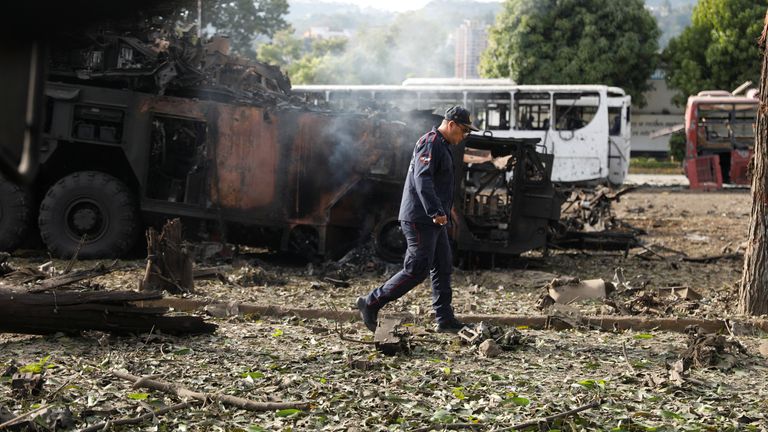
A firefighter walks past a destroyed anti-aircraft unit at La Carlota military air base. Pic: Reuters
Why now?
Mr Trump has escalated a pressure campaign on Maduro, threatening to order strikes on targets on Venezuelan land following months of attacks on boats that the US administration accused of carrying drugs.
Maduro repeatedly said the campaign was simply the US trying to oust him from power.
The Trump administration has accused Venezuela of failing to cooperate with anti-drug efforts over domestic criminal groups.
This story originally appeared on Skynews

