


A faulty rail joint may be key to understanding the cause of one of Spain’s deadliest railway disasters in years, experts have said.
At least 40 people were killed and 159 injured in a high-speed collision between two trains on Sunday.
Here, the Sky News Data & Forensics team looks at how the crash unfolded.
A timeline of the crash
Before the crash, a train run by private company Iryo and carrying around 300 passengers departed from Malaga on a journey to the capital Madrid at 6.40pm (5.40pm GMT).
The other train, which was carrying nearly 200 people and managed by Spain’s public train company Renfe, departed Madrid for Huelva in the south at 6.05pm local time (5.05pm GMT).
Around 7.45pm local time (6.45pm GMT), the tail end of the first train travelling from Malaga to Madrid derailed and jumped onto the opposite side of the tracks.
It then crashed into the other train near the town of Adamuz in the province of Cordoba, around 230 miles south of Madrid.
At the time of the crash, both trains were travelling at more than 120mph.
Footage showed passengers climbing out of smashed windows after the crash, with emergency services on the scene.
The injured were taken to a nearby hospital.
‘A truly strange’ incident
Spain’s transport minister Oscar Puente said the cause of the crash was unknown, but called it “a truly strange” incident because it happened on a flat stretch of track that had been renovated in May.
He said the back of the Iryo train had derailed and then veered across the other track, slamming into the front of the Renfe train and knocking its first two carriages off the track and down a four-metre slope.
The worst damage was to the front section of the Renfe train, he added.
Mr Puente shared a picture showing the system used to monitor the infrastructure and movement of all trains along the network.
The map showed the live positions of the two trains just under two hours after the crash happened, with red lines indicating the track was blocked.
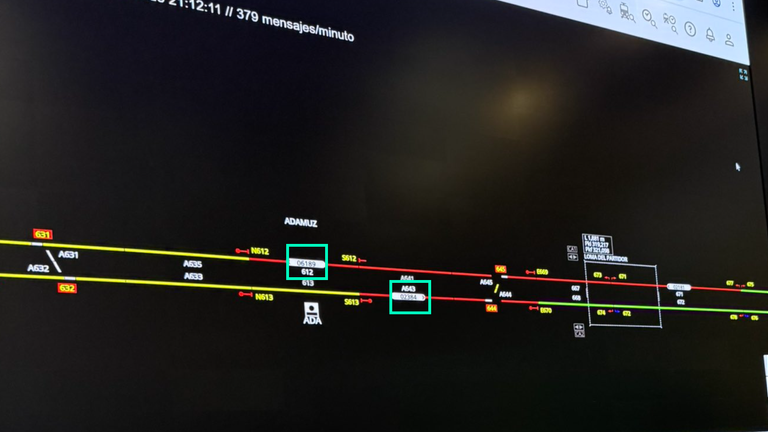
A map showing the live position of the trains
Investigators say faulty joint could be key to crash
An initial investigation has identified a faulty joint as key to the train crash, Reuters reported, citing a source.
The news agency said technicians identified some wear on the joint between sections of the rail, known as a fishplate, which they said showed the fault had been there for some time.
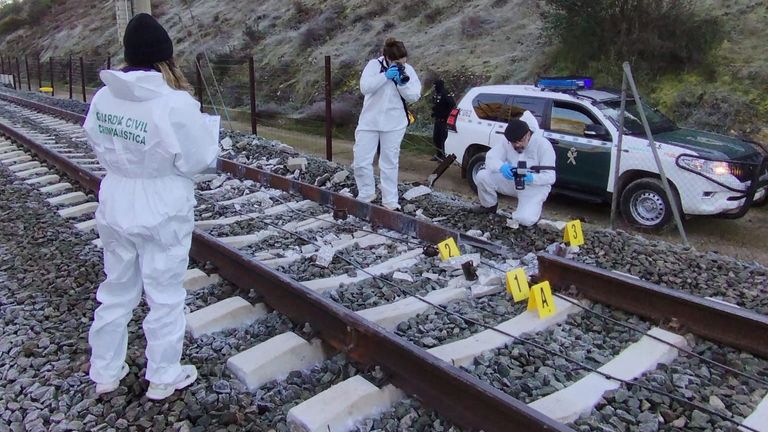
Spanish Civil Guard at the site of the derailment. Pic: Reuters
Ian Prosser, former HM chief inspector of railways, said the derailment was most likely due to a track issue, such as a broken rail.
“The most likely case would be a track fault of some sort or something went wrong with the train,” he said. “But that would be very rare.”
High-speed train crashes on straight rail lines, as happened in this case, are also rare, Mr Prosser said.
“It takes quite a long time for a train to actually come and sort of stop,” he added. “So at that speed would be travelling for quite some time after the actual initial impact.”
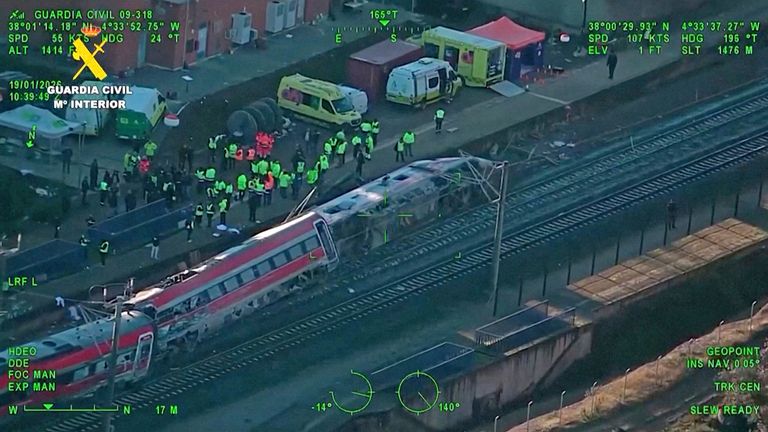
Emergency personnel at the scene of the crash. Pic: Guardia Civil/Reuters
Human error ‘ruled out’
Earlier, the president of Spain’s national railway company Renfe, Alvaro Fernandez Heredia, had said “human error could be ruled out”.
The Iryo train had been built in 2022, with its last inspection carried out on 15 January this year.
The track the crash occurred on was also new, having been completely renovated last May, with an investment of €700m (£607m).
However, it still had issues, with a Spanish train drivers’ union warning rail operator Adif of the heavy wear and tear on the tracks, including the one where the two trains collided, in a letter last August.
In October last year, rail unions approached the government to request a reduction of speed to avoid accidents on the line.
Spain’s rail safety record
Spain’s railway safety agency (AESF) has recorded between 42 and 98 significant rail accidents per year since 2006, with the most accidents in 2007 and 2023, at 98 and 77 respectively.
Those years saw a particularly high number of level crossing and personal injury accidents, with the agency highlighting the notably lower figure for 2024, at 57 compared with 77, was mainly due to a reduction in those types of incidents rather than in collisions and derailments.
In 2024, one in five incidents in Spain were caused by derailment – five times the EU average of 4%, with the country recording a smaller proportion of level crossings and other personal injury incidents than the EU average.
Some 18 people were killed in railway accidents in Spain in 2024, the equivalent of around one person per 1,000km of railway tracks, leaving Spain among the countries with the lowest level of rail fatalities in the EU, according to the European Commission.
The worst Spanish railway accident this century was a train derailment in Santiago de Compostela in July 2013, which killed 79 people.
Prosecutors set to open criminal probe as soon as possible
Sources from Spain’s interior ministry told Sky News local prosecutors are waiting for the report from police, and are then set to open a criminal probe as soon as possible.
Asked by reporters how long an inquiry into the crash’s cause could take, the transport minister Mr Puente said it could be a month.
Spain’s Prime Minister Pedro Sanchez expressed his condolences to the victims’ families in a post on X, writing: “Tonight is a night of deep pain for our country.”
On Monday night, as many of the injured left hospital, some family members were still scouring social media and hospitals for more information about their missing loved ones.
The Data x Forensics team is a multi-skilled unit dedicated to providing transparent journalism from Sky News. We gather, analyse and visualise data to tell data-driven stories. We combine traditional reporting skills with advanced analysis of satellite images, social media and other open source information. Through multimedia storytelling we aim to better explain the world while also showing how our journalism is done.
This story originally appeared on Skynews

