


It’s easy to appreciate groundbreaking shows long after the fact, but it’s often forgotten how difficult some of them were to get made in the first place. Network executives often like to play it safe by greenlighting series that adhere to risk-free formulas, and creators have to fight for the opportunity to do something radical. “Hill Street Blues” creators Steven Bochco and Michael Kozoll can attest to this, as they butted heads with NBC’s censors while making their influential cop show.
These days, “Hill Street Blues” is regarded as one of the best crime dramas ever made – one that’s praised for its innovation, ambition, and forward-thinking sensibilities. Bochco and Kozoll knew they were onto something special from the outset, but they were under the impression that NBC had agreed to give them creative freedom; however, that quickly proved incorrect. NBC’s censorious overlords weren’t fans of the early “Hill Street Blues” scripts, and the battles between the creators and the network commenced as early as their first post-writing meeting.
“At the end of the meeting, I got up and said, ‘We can’t do this project. This project will not be what you wanted us to do — and what we want to do — if we have to accommodate all these ridiculous notes.’ And I left,” Bochco told CNN. “They went berserk,” he added. Fortunately, Bochco and Kozoll were supported by MTM Enterprises co-founder and former NBC CEO Grant Tinker, who joined them in the fight against the censors’ would-be interference and creative meddling. Their combined efforts ultimately led to “Hill Street Blues” making it to the screen, though disputes with censors continued even after it became a staple of NBC’s 10 p.m. time slot between 1981 and 1987.
Making Hill Street Blues was an uphill battle
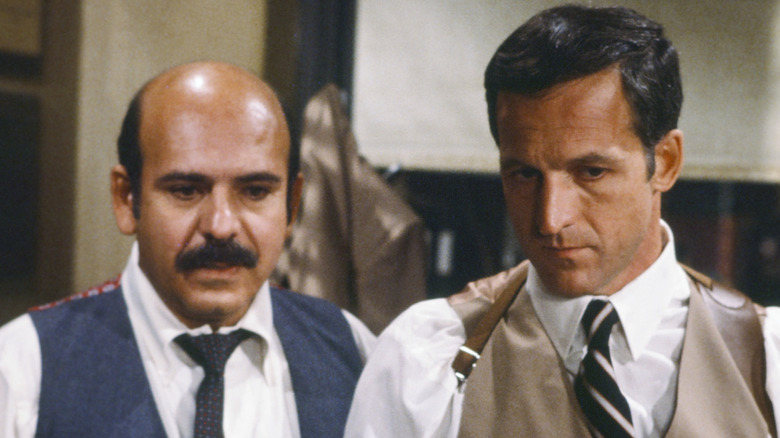
“Hill Street Blues” introduced innovations that are now considered standard fare in crime dramas. Until that point, cop shows typically centered around lone-wolf heroes or detective pairings solving crimes. “Hill Street Blues,” by contrast, focused on a large ensemble of law enforcement officers in both their personal and professional lives. The series also used serialized storytelling rather than case-of-the-week plots and employed handheld cameras to create a documentary-style feel.
Unfortunately, the show’s innovative qualities weren’t enough to ease the concerns of NBC’s bigwigs, as Steven Bochco recalled in the aforementioned conversation with CNN. “Here we had, at an impetuous moment from a network floundering in last place, extracted the promise of creative autonomy. And I knew I had something unprecedented in terms of that kind of control, and I wasn’t going to give it up. I knew if I gave it up, I’d never get it back.”
The rest is, as they say, history, as the show’s legacy ultimately proved Bochco and his collaborators right, cementing “Hill Street Blues” as an influential crime drama. “Hill Street Blues” won 26 Emmy Awards but also produced one of the worst spin-off series ever made in the form of “Beverly Hills Buntz.” Even so, the existence of such an ill-fated offshoot is a testament to the success of the original series.
This story originally appeared on TVLine

