


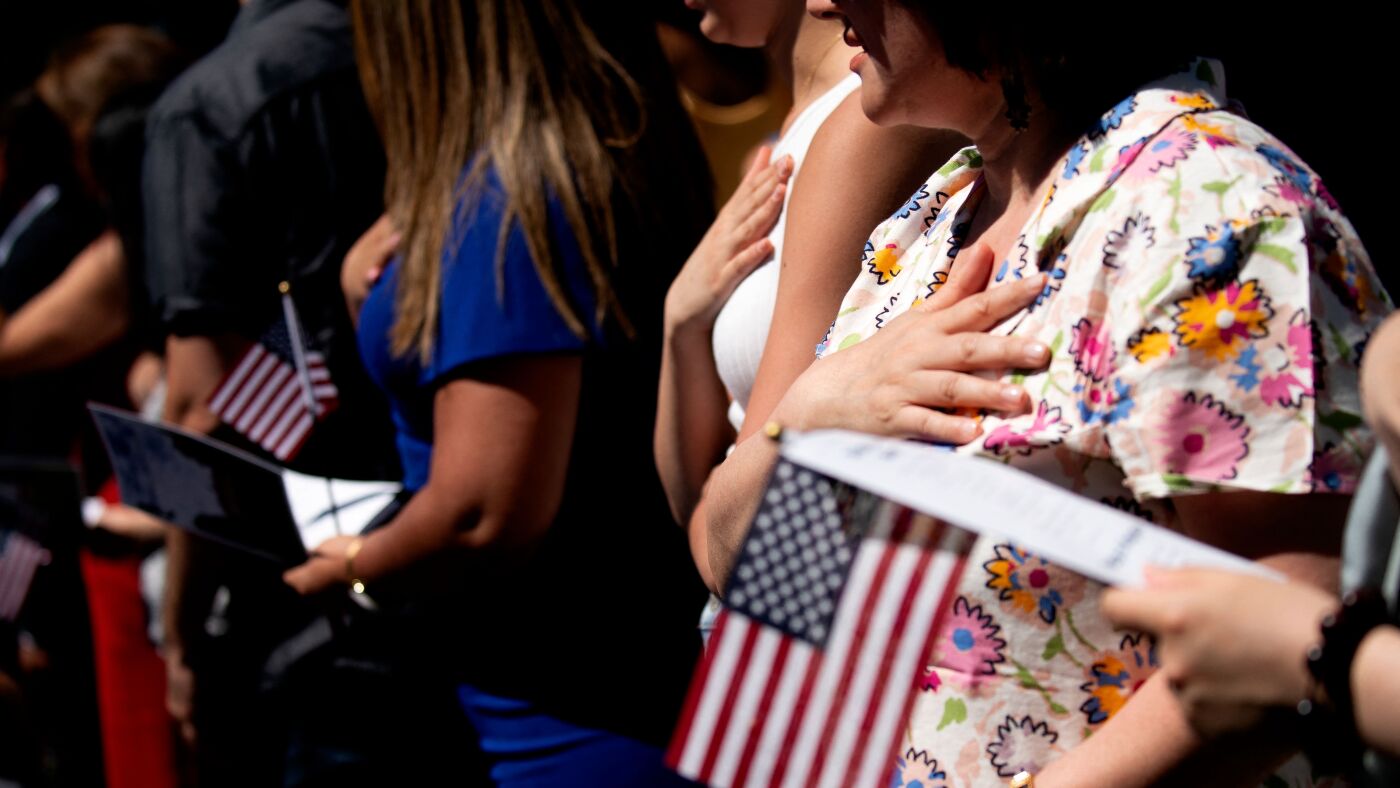
New U.S. citizens recite the Pledge of Allegiance during their naturalization ceremony in Mount Vernon, Va., in 2022.
Stefani Reynolds/AFP via Getty Images
hide caption
toggle caption
Stefani Reynolds/AFP via Getty Images
Participants in this year’s field test of the 2030 census may be asked about their U.S. citizenship status, the Trump administration revealed Thursday.
The proposal, which is part of a regulatory filing for the test, comes months after President Trump — in the middle of a redistricting push for new voting maps that could help Republicans keep control of the U.S. House of Representatives — put out a call on social media for a “new” census that would, for the first time in U.S. history, exclude millions of people living in the country without legal status.
In Congress, a growing number of Republican lawmakers are backing similar controversial proposals to leave out some or all non-U.S. citizens from a set of census numbers used to determine each state’s share of congressional seats and Electoral College votes.
According to the 14th Amendment, those census apportionment counts must include the “whole number of persons in each state.”
And in federal court, multiple GOP-led states have filed lawsuits seeking to force the bureau to subtract residents without legal status and those with immigrant visas from those counts. Missouri’s case goes further by calling for their exclusion from all census counts, including those for distributing federal dollars for public services in local communities.
Results from the 2026 test are not expected to be used to redistribute political representation. Instead, the test is designed to inform preparations for the next once-a-decade head count in 2030, which include a report on the planned question topics that is due to Congress in 2027.

The planned questionnaire for the test comes from an annual Census Bureau survey that is much longer than recent forms for the national tally. It’s not clear why the bureau is using the American Community Survey to test methods for the census. Spokespeople for the bureau and its parent agency, the Commerce Department, did not immediately respond to NPR’s requests for comment.
In addition to citizenship status, the form asks about people’s sources of income, whether their home has a bathtub or shower, and whether the home is connected to a public sewer, among other questions.
The form, however, does not reflect changes to racial and ethnic categories that the Biden administration approved for the 2030 census and other federal surveys, including new checkboxes for “Middle Eastern or North African” and “Hispanic or Latino.” A White House agency official said in December that the Trump administration is considering rolling back those changes.
On Monday, the bureau announced major cutbacks to the census test, which is now set to take place between April and September and involve around 155,000 households in Huntsville, Ala., and Spartanburg, S.C.
As with all surveys conducted by the bureau, federal law bans the agency from putting out information that would identify a person to anyone, including other federal agencies and law enforcement.


Still, many census advocates are concerned the Trump administration’s plan will discourage many historically undercounted populations, including households with immigrants and mixed-status families, from participating in the field test at a time of increased immigration enforcement and murky handling of government data.
Previous Census Bureau research has found that adding a citizenship question would likely undermine the count’s accuracy by lowering response rates for many of the least responsive populations.
During the first Trump administration, the U.S. Supreme Court blocked a citizenship question from being added to the 2020 census, while declining to rule on whether the president can carry out an unprecedented exclusion of people without legal status from apportionment counts.
In one of its new filings to the White House’s Office of Management and Budget, the bureau says the form for this year’s census test “will ask no questions of a sensitive nature.” Whether its proposed questions move forward is now for OMB to decide.
Edited by Benjamin Swasey
This story originally appeared on NPR

