


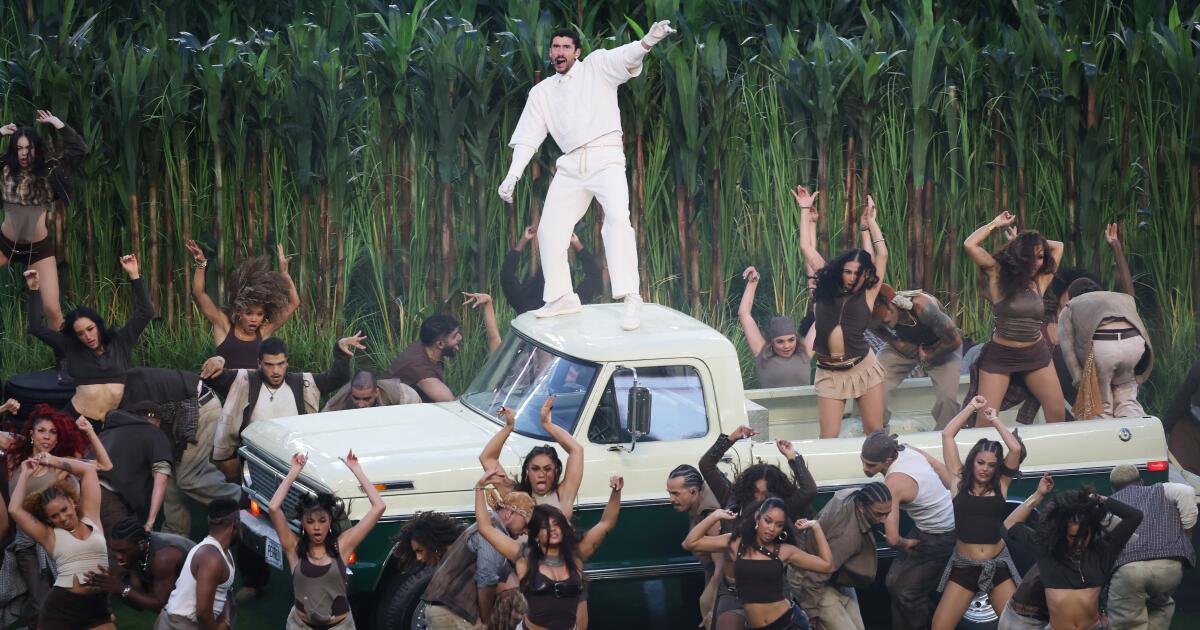
At a time of widespread fear and distrust in the United States, Bad Bunny offered a loving and optimistic vision of the American experience during his halftime show at Sunday’s Super Bowl LX at Levi’s Stadium in Santa Clara.
Leading an expansive and multigenerational crew of singers, dancers and musicians, the 31-year-old Puerto Rican superstar followed up his historic album of the year win at last weekend’s Grammy Awards with a busy and colorful performance that drew lines between the traditional folk forms of his native island and the throbbing reggaeton beats that have made him an icon to young people around the globe.
The first Spanish-language halftime show in Super Bowl history, Bad Bunny’s 13-minute set transformed the gridiron into a collection of settings including a field filled with laborers, a bodega, a wedding party and a casita like the one the singer built his popular 2025 San Juan arena residency around. The performance included surprise appearances by Lady Gaga, who sang a salsa-fied version of her hit “Die With a Smile,” and Ricky Martin, who joined Bad Bunny for “Lo Que Le Páso a Hawaii.” Karol G, Cardi B, Pedro Pascal and Jessica Alba were among those dancing on the field.
Dressed in a cream-colored football jersey marked with his real last name, Ocasio, Bad Bunny seemed eager to showcase the many facets of ordinary Latino life; among the extras in the show were a group of older gentlemen playing dominoes, a guy selling tacos and a small child watching TV — watching Bad Bunny deliver his Grammy acceptance speech, in fact. The singer then materialized and handed the boy one of his Grammys and told him always to believe in himself.
For “El Apagón,” which explores Puerto Rico’s troubled electric grid, Bad Bunny and several dancers performed while twirling around prop utility poles. That song comes from the singer’s 2022 album, “Un Verano Sin Ti,” but much of the halftime show pulled from Bad Bunny’s latest LP, “Debí Tirar Más Fotos,” including “Baile Inolvidable,” which had him and Gaga dancing as though at a wedding reception, and “Nuevayol,” which featured a beautifully detailed street scene.
The show ended with the album’s title track, “DTMF,” as Bad Bunny proclaimed, “God bless America” — he then listed the countries of Latin America along with the U.S. and Canada — against a giant message on the stadium’s scoreboard that read, “The only thing more powerful than hate is love.” As he left the field, he spiked a football emblazoned with another note: “Together, we are America.”
Bad Bunny’s performance was controversial before it even began.
President Trump called his booking “a terrible choice” and said that “all it does is sow hatred.” Right-wing commentators framed Bad Bunny’s selection as un-American (though Puerto Rico is of course a U.S. territory); Turning Point USA, the conservative organization founded by the late Charlie Kirk, put together a so-called All-American Halftime Show featuring Kid Rock in an appeal to viewers scandalized by … the Spanish language? Dancing? The idea of fun?
For the NFL, the blowback was a calculated risk as the league makes a push to globalize its fan base. Bad Bunny’s show was the latest in a long-term deal between the league and Jay-Z’s sprawling entertainment company, Roc Nation, which took over producing halftime in 2020 amid bruising criticism of the NFL’s handling of race in the wake of Colin Kaepernick’s protest against police violence targeting Black people.
Before kickoff Sunday, Charlie Puth performed a slick, yacht-rock-style rendition of the national anthem for which he accompanied himself on Rhodes electric piano, and Brandi Carlile sang “America the Beautiful” with help from her frequent collaborators SistaStrings on violin and cello. The venerable Bay Area punk band Green Day also put in a characteristically punchy mini-set meant to mark the Super Bowl’s 60th anniversary.
This story originally appeared on LA Times

