


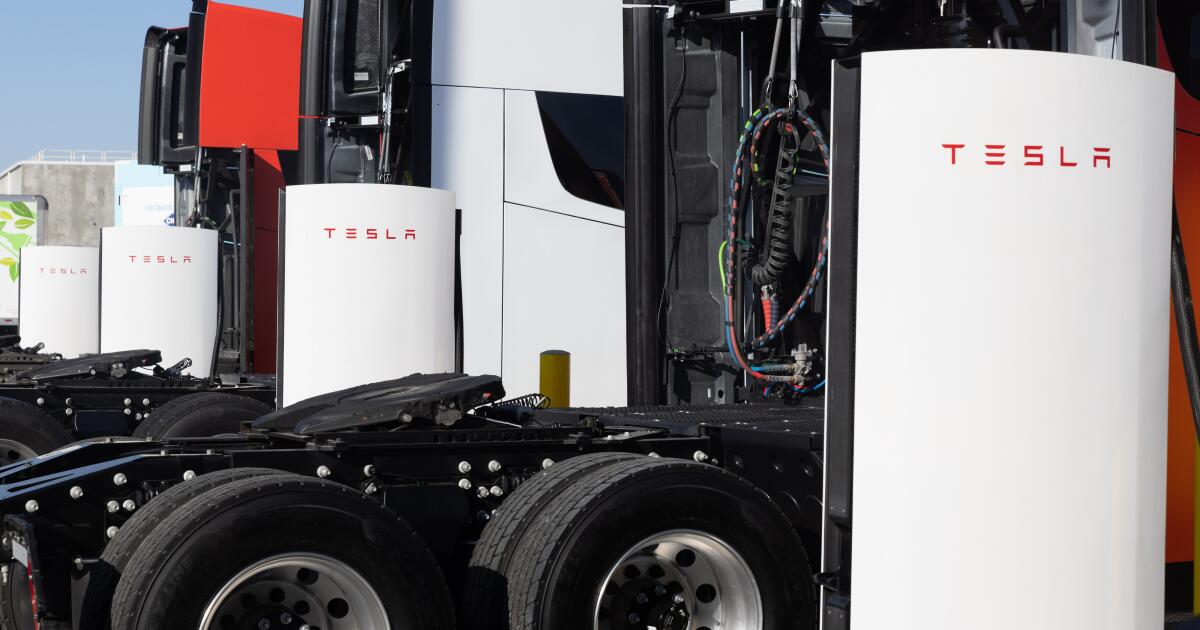
A California clean-air program, designed to rapidly electrify the state’s truck and bus fleets, has recently faced intense criticism for reserving its largest-ever tranche of funding to subsidize Tesla’s all-electric semi-truck, a largely unproven vehicle with a dubious production timeline.
In the past year, the California Air Resources Board (CARB) and its nonprofit partner CALSTART have set aside nearly 1,000 vouchers, worth at least $165 million, to provide commercial fleets with steep markdowns on the long-delayed Tesla Semi, according to state data obtained by The Times. The battery-powered big rig has been advertised as a groundbreaking freight truck capable of traveling up to 500 miles on a single charge.
But the news of Tesla’s windfall outraged some in the trucking industry, who allege the state provided the world’s wealthiest automaker with preferential treatment for a vehicle that is not ready.
Nearly eight years since Tesla Chief Executive Elon Musk unveiled the Tesla Semi as a concept, it still isn’t widely available in stock. It has repeatedly faced production delays and still doesn’t have a publicly advertised retail price.
In fact, some critics argue the Tesla Semi shouldn’t have qualified for government funding at all. At the time Tesla submitted its voucher requests, the vehicle didn’t appear to have the necessary certifications and approvals to be sold and legally driven on California roads.
Still, the 992 state-administered incentives have effectively established the Tesla Semi as the front-runner in the electrified heavy-duty truck class.
“I don’t think it would be an overstatement to say this is market distortion or market manipulation,” said Alexander Voets, general manager at RIZON Truck USA, a commercial electric truck brand. “CARB essentially single-handedly just made Tesla the market leader for electric vehicles for [heavy-duty trucks] without them having [virtually] any vehicles in customer hands.”
Historic funding, murky data
The funding was tentatively awarded through the Hybrid and Zero-Emission Truck and Bus Voucher Incentive Project (HVIP), a state program aimed at reducing pollution and greenhouse gas emissions in the goods-movement sector and in public transit. Since its creation in 2009, the program has dedicated over $1.6 billion — a mix of state funding and incentives from local ports — toward helping fleets purchase electric, hydrogen and other low-emission vehicles.
The state program aims to solve an outsize problem: Heavy-duty trucks make up only 10% of vehicles on U.S. roads, but they produce 45% of smog-forming nitrogen oxides and 58% of lung-aggravating soot.
But experts say that the state program has lacked thorough oversight and accountability, allowing a small group of manufacturers to exploit the program’s robust endowments.
Since The Times began raising questions about Tesla’s vouchers, the state’s public data for the HVIP have drastically changed, reflecting lower funding amounts for Tesla and other major automakers. State officials had reserved the maximum amount for which the vehicle qualified — a number much higher than the retail price. In late January, officials revised the publicly accessible data so that the numbers no longer included local port funding that was awarded through the program — making it appear that Tesla received tens of millions less in funding.
CARB officials also noted that EV incentives from local utilities — not administered through the state voucher program — helped subsidize the Tesla Semi orders and ultimately lessen grant funding awarded by the state.
An analysis of earlier data by The Times showed that Tesla may have been poised to receive up to $202 million, roughly a third of all funding allocated during 2025 and 2026. The Tesla vouchers had each been worth from $120,000 to $430,000 but now are listed between $84,000 and $351,000.
Even after the revisions, Tesla is still poised to receive about $165 million, significantly more than any other single auto manufacturer. New Flyer, a Canadian bus manufacturer, secured the HVIP program’s second-highest funding, about $68 million, less than half that of Tesla.
Though its retail price has still not been publicly disclosed, state documents obtained by The Times show that the Tesla Semi generally sells for around $260,000 for the standard model with 300-mile range and $300,000 for the long-range model with 500-mile range.
The price has been one of the greatest selling points, as the average cost of a zero-emission big rig was $435,000 in 2024, according to CARB.
The state voucher program offers up to a 90% discount on the list price for private fleet operators.
Tesla’s questionable qualifications
To qualify for a voucher, manufacturers must obtain a zero-emission powertrain certification showing the vehicle meets certain performance standards. Each model year of the vehicle also needs to receive written approval from CARB, and the vehicle must be listed in the HVIP catalog.
The 2024 Tesla Semi was listed as an eligible vehicle by CARB, despite not having powertrain certification registered on CARB’s website. No subsequent model years were displayed as eligible before Tesla applied for government incentives.
“I still haven’t seen any proof that Tesla has been able to satisfy the requirements,” said a senior official at another EV manufacturer, who feared reprisal from state officials if they spoke out publicly.
“That is really concerning to me, because these are rules that I have to follow. So, how are they getting around this? And how has CARB not caught this?”
Tesla did not respond to multiple requests for comment. CARB officials did not directly answer how Tesla secured state funding.
“The process for vehicle or engine certification includes the review and processing of confidential business information, thus the certification status of any truck is confidential,” a spokesperson said in a statement to The Times.
However, CARB insisted that Tesla would not receive any state-administered funding until requirements are met and vehicles are delivered to customers.

A WattEv Transport Inc. Tesla Semi electric truck sits parked next to BYD electric trucks by a charging station at the Port of Long Beach in April.
(Patrick T Fallon / AFP via Getty Images)
That provides little consolation to other manufacturers.
Even if Tesla fails to deliver the trucks and doesn’t eventually receive government incentives, it prevents other automakers — with EVs in stock — from utilizing the funding more immediately. Losing out on these funding opportunities could be critical for some smaller EV companies.
“That hurts the rest of us,” said Peter Tawil, director of sales and marking at RIZON and longtime promoter for the EV industry. “Our trucks can be delivered tomorrow.”
“If this doesn’t get corrected, our whole industry will just go down the toilet.”
A lifeline for EV makers
Tesla’s funding surge came two years after state officials quietly eliminated the limit of vouchers a single manufacturer can secure at one time, a key guardrail intended to prevent major automakers from hoarding California’s clean-transportation funding and stalling the deployment of electric vehicles.
Typically, auto dealerships secure purchase orders from private or public fleet operators interested in buying their zero-emission vehicles at the lower rates facilitated by the state incentives. Then, the dealerships submit voucher requests — for up to 20 vehicles at a time for most businesses — to obtain those incentives.
The state vouchers are awarded on a first-come, first-served basis, creating stiff competition for funding. During the funding cycle that began on Sept. 9, for example, there was about $335.6 million available. Within two days, 68% of that amount had already been allotted.
The program’s structure has enabled some companies to quickly capture a large portion of funding, over 1,000 vouchers in some cases, without having the inventory or production capacity to deliver those vehicles in a timely fashion. It also left their competitors unable to provide similar discounts.
For years, a single manufacturer generally was allowed to secure a maximum of only 100 state vouchers at a time, until it delivered those orders to customers. That rule was designed to prevent any entity from monopolizing state funds for vehicles that weren’t ready for production and to provide a level playing field for smaller manufacturers.
A CARB spokesperson acknowledged that the state program ended the 100-voucher limit because the policy unintentionally prevented customers from buying some of the most popular trucks and buses on the market. The state had also regularly granted waivers for customers to bypass the voucher limit for popular vehicle brands.
“The original intent of the manufacturer cap was to ensure [manufacturers] were not holding vouchers for an extended time,” a CARB spokesperson said. “Instead, it had the unintended consequence of limiting zero-emission vehicle choices for fleets.”
But, without those limits, large manufacturers, including Tesla, have been able to dominate the voucher program. The policy change has intensified competition in the state voucher program at a time when the EV market has entered its most uncertain period in recent memory.
The Trump administration has eliminated federal tax credits for EVs and invalidated California’s zero-emission vehicle targets. As a result, California is losing traction in its quest to eliminate pollution and greenhouse gases from the state’s robust shipping sector.
The medium- and heavy-duty segment, in particular, had already greatly consolidated as automakers have struggled to electrify — and monetize — delivery vans, buses and big rigs in the U.S.
California’s voucher program had provided electric truck and bus manufacturers with a lifeline. But Tesla’s expansion into the heavy-duty market has become a flash point, triggering calls for reforms to how incentives are distributed.
Paragon or prototype?
Ironically, Tesla CEO and former DOGE chief Elon Musk had publicly advocated against government incentives for EVs, boasting that eliminating these subsidies would bolster Tesla’s standing in the industry.
Meanwhile, Tesla has worked to secure millions in state and local funding for its Semi, while many in the trucking industry question whether the vehicle’s uneven development timeline justifies such heavy public investment.
In November 2017, Musk unveiled the Tesla Semi prototype at a SpaceX facility in Hawthorne. He touted it as a revolutionary all-electric truck that would help phase out diesel-powered models and reduce emissions from the nation’s shipping industry. Musk said it would deliver 500-mile range at maximum, a 0–60 mph acceleration in 20 seconds and 30-minute charging via solar-powered “Megachargers.”
Production was initially scheduled to begin in 2019 in Tesla’s Gigafactory in Nevada.
But, since then, early customers, such as food and beverage giant PepsiCo, have waited years for their orders to be fulfilled amid a series of manufacturing delays.
It’s unclear how many Tesla Semi models have been sold. According to state data, Tesla has received payment from CARB’s voucher program for only five Semi models thus far, all of which were delivered last July to Nevoya Transportation LLC.
State officials said they expect many of the Tesla orders will be fulfilled in late 2026, based on conversations they’ve had with Tesla representatives.
But there are still serious questions about its performance and design.
As the Tesla Semi was tested at the Port of Long Beach last year, a major design flaw became apparent. The big rig has a panoramic, wraparound windshield providing exceptional visibility and a futuristic appearance.
But it was clear that drivers were unable to roll down the window to present the necessary paperwork at the gated entry.
For skeptics, it was yet another sign the truck is still not ready for the road.
This story originally appeared on LA Times

