


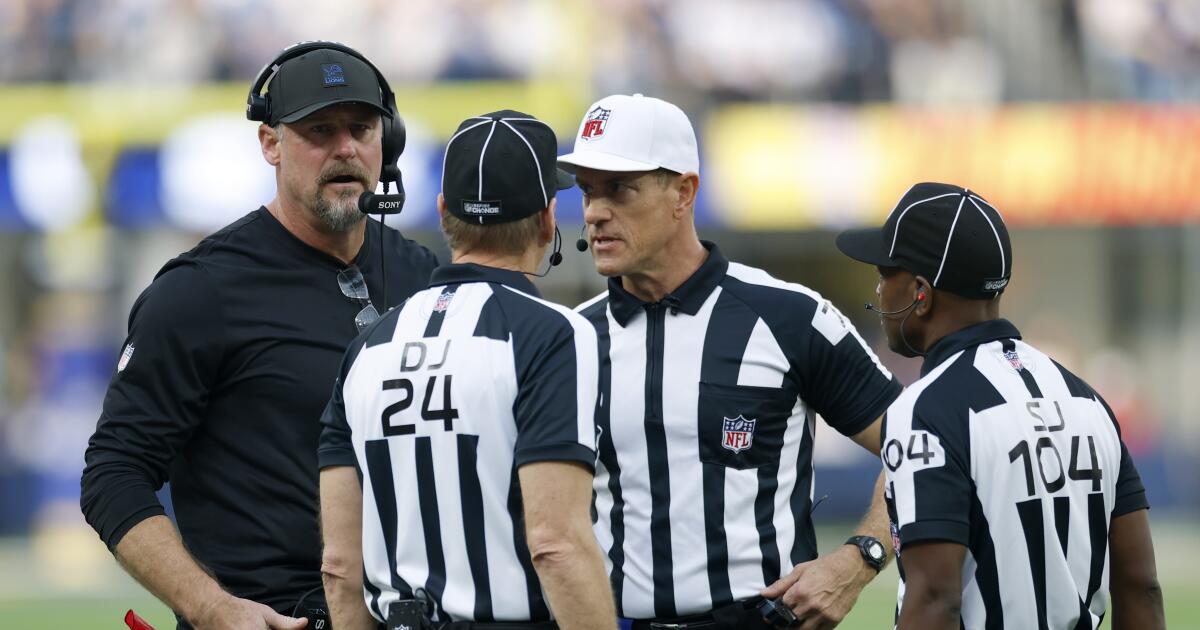
PHOENIX — With the NFL and referees union at a negotiating impasse, the league has put in place a safety net in case replacement game officials are required for the upcoming season.
Team owners approved a rule Tuesday allowing the league to intervene from its New York headquarters and correct officiating errors in real time using replay technology. The rule would be in effect for one year only and would be triggered if the NFL and NFL Referees Assn. cannot agree on the fundamental issues of accountability, compensation and working conditions.
“There is frustration among ownership about the state of the negotiations,” said NFL executive Jeff Miller, responsible for overseeing the league’s communications and public affairs. “What we’ve been crystal clear on is that this is an opportunity for us to improve the state of our officiating.”
The NFL and officials’ union have been working on a new labor agreement for nearly two years, and the current pact is set to expire May 31. The officials are looking for a substantial pay increase; the league wants compensation tied to performance and wants more of a say ensuring the best officials are on the field during the postseason, as opposed to the existing collective bargaining agreement which factors in seniority when doling out postseason assignments.
According to individuals with knowledge of the negotiations but unwilling to speak publicly about the private talks, the NFL has offered a 6.45% annual growth rate in compensation over a six-year deal, but the NFLRA wants a 10% annual raise for officials plus $2.5 million for marketing fees.
In a written statement issued Monday, NFLRA executive director Scott Green took issue with widespread reports of those terms, and argued NFL game officials are underpaid compared to their counterparts in other professional sports.
“Apparently league sources are continuing to put out false and misleading information instead of wanting to meet at the negotiating table,” Green said.
“We had high-performing officials who worked this year’s championship games and the Super Bowl who were paid less for those games than what they were paid for a regular-season game. That certainly isn’t rewarding performance.”
Among the other changes the league wants are an extended probationary period for new officials, mandatory development for low performers, more access to officials after the Super Bowl — the so-called “dead period” now extends through May 15 — and a practice squad of sorts, an increased number of game officials to develop a deeper bench.
In the coming weeks, the NFL intends to begin hiring and training replacement officials, hoping to avoid a situation similar to 2012 when a stalemate led to a 110-day lockout and fill-in officials, many unprepared, were pressed into action.
That set the stage for the “Fail Mary,” when a “Monday Night Football” game in Seattle ended on a winning Hail Mary pass by Seahawks quarterback Russell Wilson — even though replays clearly showed Green Bay had intercepted the pass. That sparked a national outcry and hastened the end of the lockout.
One replacement referee signals touchdown while another signals touchback during the infamous “Fail Mary” play between the Seattle Seahawks and Green Bay Packers on Sept. 24, 2012.
(Stephen Brashear / Associated Press)
“Nobody wins in this,” said Mike Pereira, longtime Fox rules analyst and former NFL head of officiating, of the current situation. “I don’t care who it is.”
The new rule, which would be put in place if there’s a work stoppage, would allow the officiating department in New York to step in and correct obvious errors made by replacements. Rich McKay, chairman of the NFL’s competition committee, said the league has the infrastructure to intervene and help out in those situations.
“The communication that’s going on between the officials in the crew and New York and in the booth in the stadium is ridiculously smooth and quick,” McKay said. “And so we have proven that we can do replay assist. And we’ve told the coaches, if we don’t give a replay assist within 20 seconds of the play clock, which is, you know, winding down, we don’t do that. We’re not doing it. And yet, we did 170, 180 replay assists this year, so I think we’ve proven we can do that.”
It seems officiating is perpetually in the spotlight and the focus of critical debate. Former NFL coach Bruce Arians said officials have a problem with consistency.
“There’s no accountability,” he said. “Each crew called the game totally different. This week it’s, hey, if you touch the quarter(back), you’re getting fined. Next week, you hit him upside the head, this guy’s not calling anything.
“We had to do more scouting reports on the officials than we did the other team.”
Arians, who became a member of the competition committee late in his coaching career, has discussed the situation with NFL commissioner Roger Goodell and is an advocate of making officials full-time league employees.
“They’re part-time employees deciding the outcomes of a billion-dollar industry,” Arians said. “They answer the game as much as anyone next to the players, and they’re part time.”
Green, in a guest column for SI.com, said the notion that current officials are anything but de facto full-time employees is a myth — even though most hold down other careers while continuing to work NFL games.
“The time, effort and schedule that professional NFL officials work do not justify calling them anything other than full time,” he wrote.
Arians argued that making the officials full time would make everyone “answerable to the shield.” It would give the NFL more power to remove or retain the people calling the games.
“If they were under that umbrella,” he said, “we could take them off the field, maybe retrain them a little bit, get them back up to speed.”
Team owners on Tuesday approved a related measure allowing league headquarters to intervene on potential disqualifications for flagrant football or non-football acts, even if they aren’t called on the field.
The optics of a work stoppage are not good for anyone, Pereira said.
“The public’s never going to support the officials,” he said. “High school officials will. College officials will. But I would just hope there’s a way to resolve this before it happens because it’s not going to end up pretty.”
This story originally appeared on LA Times

