


In 1966, “Star Trek: The Original Series” didn’t just introduce audiences to an intriguing, optimistic sci-fi future, but it also served as a groundbreaking showcase of diverse characters in mainstream television. Nichelle Nichols, who portrayed Nyota Uhura, was a trailblazer. Uhura’s prominence on “Star Trek” and overall legacy in the franchise can be partially attributed to Dr. Martin Luther King Jr.
In a 2011 talk with NPR, Nichols reflected on her career prospects at the time “Star Trek” was on the air. While she was gaining notoriety for the series, she initially intended to leave after its first season to pursue opportunities on Broadway. Nichols spoke with Gene Roddenberry about her intention to leave the series, which disappointed him greatly, leading him to suggest that Nichols reconsider. “And that — on Saturday night, I went to an NAACP fundraiser, I believe it was, in Beverly Hills. And one of the promoters came over to me and said, ‘Ms. Nichols, there’s someone who would like to meet you. He says he is your greatest fan.'”
That fan was none other than Dr. King, whom Nichols recalled identifying himself as a Trekkie. “I thanked him, and I think I said something like, ‘Dr. King, I wish I could be out there marching with you,'” Nichols said. “He said, ‘No, no, no. No, you don’t understand. We don’t need you on the — to march. You are marching. You are reflecting what we are fighting for.'”
MLK is responsible for Nichelle Nichols sticking with Star Trek
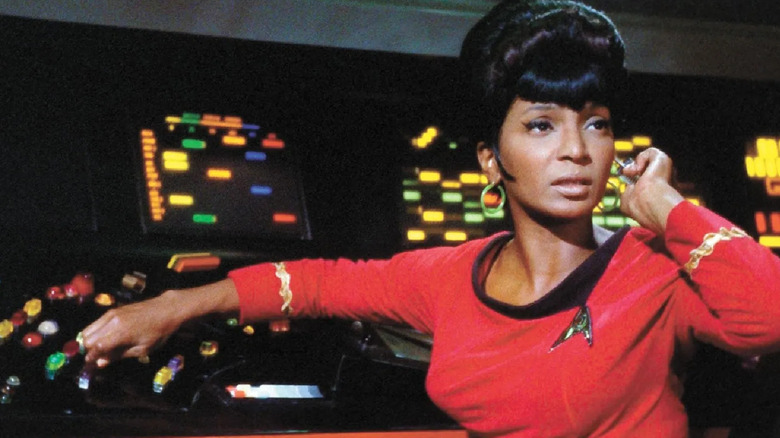
When Nichelle Nichols told Martin Luther King Jr. about her plans to leave “Star Trek,” “his face got very, very serious,” she recalled. “And he said, ‘What are you talking about?’ And I said, ‘Well, I told Gene just yesterday that I’m going to leave the show after the first year because I’ve been offered’ — and he stopped me and said: ‘You cannot do that.’ And I was stunned. He said, ‘Don’t you understand what this man has achieved? For the first time, we are being seen the world over as we should be seen.’ He says, ‘Do you understand that this is the only show that my wife Coretta and I will allow our little children to stay up and watch?’ I was speechless.”
Nichols understood Dr. King’s advice. By virtue of visibility as a Black woman as part of the main cast in “Star Trek,” her presence alone served as a statement in and of itself. In sticking with the series for the remainder of its run, as well as appearing in its theatrical films, she served as an early beacon of representation in sci-fi, television, and the broader media.
Nichols remembered meeting Whoopi Goldberg, who portrayed Guinan in “Star Trek: The Next Generation.” Goldberg was 9 years old when she watched “The Original Series,” which served as a major inspiration for her to pursue acting. “And that did something to my heart,” said Nichols. “So I knew that I had made the right decision, because as Dr. King said, ‘You have been chosen.'”
This story originally appeared on TVLine

