


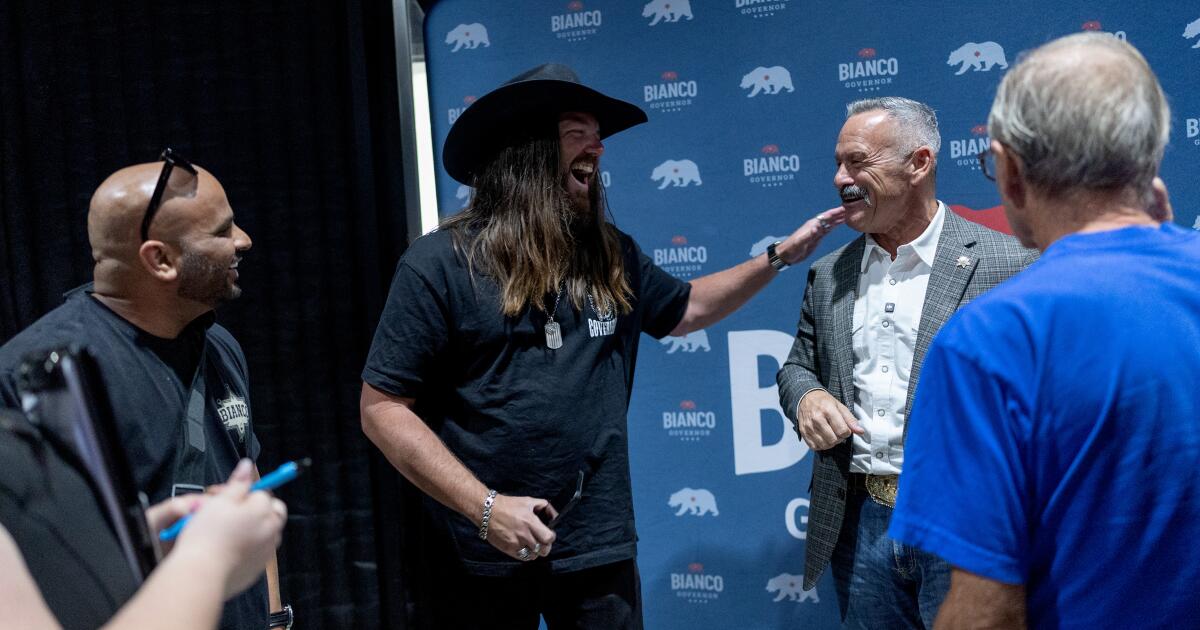
Chad Bianco couldn’t fly to Mar-a-Lago, wreathe President Trump in honeyed words, bestow the Riverside County Peace Prize upon him and hand-feed him his favorite dish — a Big Mac? — from a platter of 24-karat gold.
Security, logistics and all of that.
So the Republican candidate for California governor did the next best thing: He confiscated hundreds of thousands of ballots from last November’s special election in a trumped-up investigation of supposed voting irregularities. Never mind the complete lack of evidence or the fact Proposition 50, the subject of Bianco’s investigation, was approved by a clear-cut majority of voters.
The intent of Riverside County’s grasping sheriff was as transparent as a pane of glass. It’s all about trying to win the endorsement of Trump — he of phantasmagorical election-fraud claims — in California’s neck-and-neck-and-neck gubernatorial contest.
Bianco, fellow Republican Steve Hilton and a passel of Democratic hopefuls are bunched together in a contest that remains utterly wide open just weeks before voters start receiving their ballots in the mail.
“Trump’s endorsement would be huge,” said Jon Fleischman, a conservative strategist and former executive director of the state GOP.
“Actually,” he went on, ‘I think it would be determinative” — virtually guaranteeing either Hilton or Bianco finished in the top two in the June 2 primary, ushering them past the rope line into November’s runoff.
If there’s an inside edge in the Trump Endorsement Sweepstakes, it would seemingly go to Hilton.
He’s familiar to the president as a former Fox News host. He’s interviewed Trump several times and the two occasionally text and talk on the phone. Bianco has no such personal connection, which might explain his ballot-seizing stunt.
Steve Hilton could have the inside track on a Trump endorsement, given their personal relationship.
(Allen J. Schaben / Los Angeles Times)
(The Democrats’ nightmare scenario is both Republicans making the runoff, icing the party out of the governor’s office for the first time since Arnold Schwarzenegger left in January 2011. More on that in a moment.)
A Trump endorsement comes in all sorts of flavors.
As The Downballot recently noted, “His bag of tricks includes dual endorsements, triple endorsements, pre-endorsements, Election Day endorsements, yanking endorsements … belated endorsement of a candidate after initially endorsing just one candidate [and] non-endorsements after promising to endorse.”
There was also the time Trump endorsed “ERIC” when Republicans Eric Schmitt and Eric Greitens faced each other in Missouri’s Senate primary. (Schmitt won and is now the state’s junior U.S. senator.)
Trump’s backing still counts a good deal, even as his approval ratings sink to sub-basement levels. The president remains popular with Republicans and, critically, the kind of GOP loyalists who vote in primary contests, which is why both Hilton and Bianco would welcome a presidential laying on of hands.
There’s good reason, however, to think Trump might pass on endorsing in the governor’s race, or opt to deliver one of his dual he-and-him endorsements.
The GOP’s best — and perhaps only — hope of winning the governorship is the Democratic-freeze-out scenario. So, tactically, Trump’s wisest move may be to bless neither Hilton nor Bianco. Or support both. That would avoid elevating one over the other, which could make it easier for a Democrat to finish among the top two and advance past the June primary.
“I think Trump’s people are smart enough to know that there’s a reason why he may not be served by endorsing a candidate,” Fleischman said. “I wouldn’t be surprised if the prevailing wisdom there is we better not endorse anybody, because we don’t want to tilt this one way or the other.”
If Trump were to back Hilton or Bianco, it’s not hard to imagine Democratic interests seizing upon the president’s benediction and putting significant money behind an ad blitz promoting the president’s favorite in hopes of boosting him — and him alone — into the top two.
The move comes from a well-thumbed political playbook, seeking to elevate a preferred opponent, that was used most recently in California by Democratic Sen. Adam Schiff. He helped lift Republican Steve Garvey into the November 2024 runoff to keep from having to face a tougher opponent, fellow Democrat Katie Porter. Schiff easily defeated Garvey.
In this case, Democrats would aim to tee up one of the two Republicans who would almost certainly go on to lose in the fall.
Which is what happened the first time Gavin Newsom ran for governor.
In 2018, his main rival was fellow Democrat Antonio Villaraigosa. Two major Republicans were also in the race, John Cox and Travis Allen. There was no real concern about those two nabbing both spots in the June primary. Rather, Newsom and Cox had a shared interest in boxing out Villaraigosa.
Newsom ran a TV spot attacking Cox and tying him to Trump, which raised Cox’s profile and boosted him among GOP voters. The Newsom and Cox campaigns opened a private back-channel, trading gossip, swapping insights on the race and even sharing some empirical data. One poll, showing Cox getting a bigger boost from a Trump endorsement than Allen, passed from Democratic hands in hopes it would reach the White House and nudge the president into supporting Cox.
Though there’s no proof the survey ever reached Trump, the president eventually threw his support behind the San Diego County businessman, lifting him past Allen in the primary. Cox went on to lose handily to Newsom in November.
This time, with more than a half dozen plausible candidates and no obvious path to victory for any one, it’s every man and woman for themselves.
The same goes for Trump, who may do himself the most good in California, politically, by doing nothing at all.
If he can only resist.
This story originally appeared on LA Times

