


We may receive a commission on purchases made from links.
The trailers and footage released thus far to hype the DCU’s “Lanterns” — premiering on HBO this August — do not in any way evoke the neon, zippy, outer space energy of the 2011 film starring Ryan Reynolds. This iteration of the “Green Lantern” mythos has Kyle Chandler and Aaron Pierre driving — not flying — around in rural, fly-over-state environs. Chandler’s Hal Jordan looks less like a Christmas tree ornament and more like a dude at the townie bar you definitely don’t want to play a round of darts with.
How could these two projects possibly be adaptations of the same superhero? Surely the Reynolds movie is comics-accurate and this newfangled iteration from showrunner Chris Mundy, Tom King, and Damon Lindelof is some kind of post-modern deconstructive edgelord fiasco?
Not necessarily.
Calling Green Lanterns space cops with power rings is probably an oversimplification, but it’s not wrong. Brash former pilot Hal Jordan — Reynolds and Chandler’s character, the most well-known Green Lantern of the bunch – has been around since 1959; Architect and ex-Marine John Stewart — Pierre’s character, the Green Lantern who joins the team in the 2000s “Justice League” animated series and, therefore, the primary Green Lantern in the minds of folks who came up on those cartoons — arrived in 1972. Naturally, they’ve both appeared in oodles upon oodles of stories set in far-flung planetary systems and engaged with various vivacious extraterrestrial threats — but some of the most prominent tales in all of “Green Lantern” lore happen to land closer to “No Country for Old Men” than “The Fifth Element.”
Some of Hal Jordan’s most important adventures are entirely Earthbound
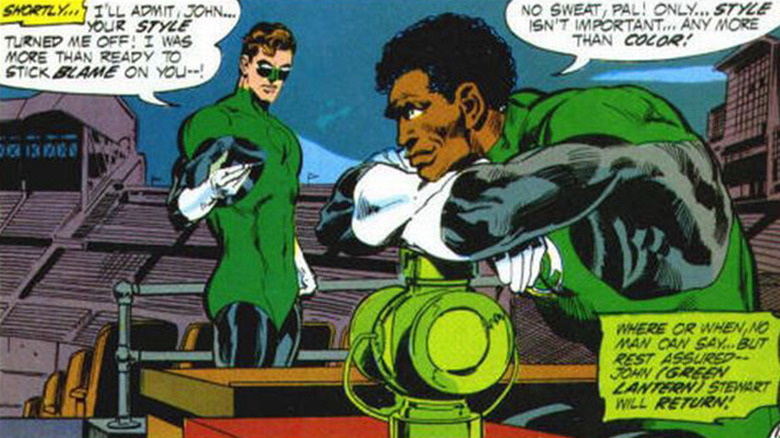
In the early 1970s, writer Dennis O’Neil and artist Neal Adams kept Hal Jordan mostly grounded throughout one of the GOAT arcs in all of DC superhero comics, sometimes referred to as “Hard-Traveling Heroes.” In “Green Lantern” #76 (1970), conservative Hal obliviously interjects himself into a conflict between a rough-looking teenager and a despised slum lord — onlookers pelt him with garbage for his efforts. Lefty Oliver Queen shows up to bluntly inform his Justice League colleague that bounding around the galaxy has left him woefully out of touch with regular people, and after a scolding from an old Black man in danger of eviction, Hal decides to direct his attention towards more mundane forms of injustice than the Flash Gordon ridiculousness to which he is more accustomed.
Hal and Ollie head out — in a truck, no less — on a cross-country, wrongs-righting journey. In their adventures, which are not entirely without sci-fi elements, our heroes battle the exploitation of Native Americans, racism, crooked cops, pollution, hippie cults, and — most famously of all — the scourge of drug addiction when Ollie’s sidekick Roy Harper is discovered using heroin. Check just about any “Top Green Lantern Comics” list and, more often than not, you’ll find O’Neil and Adams’ tenure with the character among the most influential and widely read.
Also of note: John Stewart first appears in “Green Lantern” #87 (1972) when the Guardians of the Universe need a new Lantern to fill in for an injured Guy Gardner (Nathan Fillion’s character in “Superman”). Hal initially questions John’s ring-worthiness, but once he comes around, the pair exposes a U.S. senator’s attempt to start a race war and ride the upheaval into the White House.
Absolute Green Lantern gets nice and dark and weird
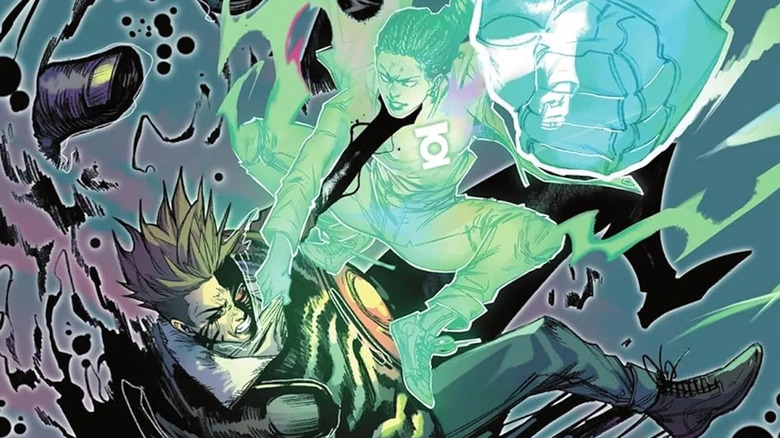
If you’re looking for a more contemporary instance of “Green Lantern” stories with a connection to the everyday troubles of everyday folk, look no further than Evergreen, Nevada, in the Absolute Universe iteration of the DC Universe. One of DC’s semi-routine continuity reboots, the Absolute timeline features remixed versions of the major characters minus one or more of their traditional defining aspects — for example, Bruce Wayne is a construction worker instead of a billionaire and Martha Wayne is still alive.
On the one hand, writer Al Ewing and artist Jahnoy Lindsay’s “Absolute Green Lantern” (2025) spins decades of “Lantern” lore into an overarching saga of cosmic horror and existential dread — but there’s also a focus on how people dealing with divorces and financial difficulties might react if, let’s say, a very imposing space alien with god-like powers appeared in their middle-of-nowhere hometown, used inexplicable green force fields to cause a bunch of ostensible death and destruction all while insisting that the locals “be without fear.”
Visuals including highways, roadside diners, and ordinary small-town slobs engaging with laws-of-physics-shattering forces beyond their comprehension make up the first few issues of the Ewing and Lindsay series. In other words, on a basic level, it looks a little like what we’ve seen of the HBO show.
So next time you hear someone say something like HBO’s “Lanterns” “isn’t Green Lantern,” remember that there’s more to “Green Lantern” than the Ryan Reynolds movie.
This story originally appeared on TVLine

