


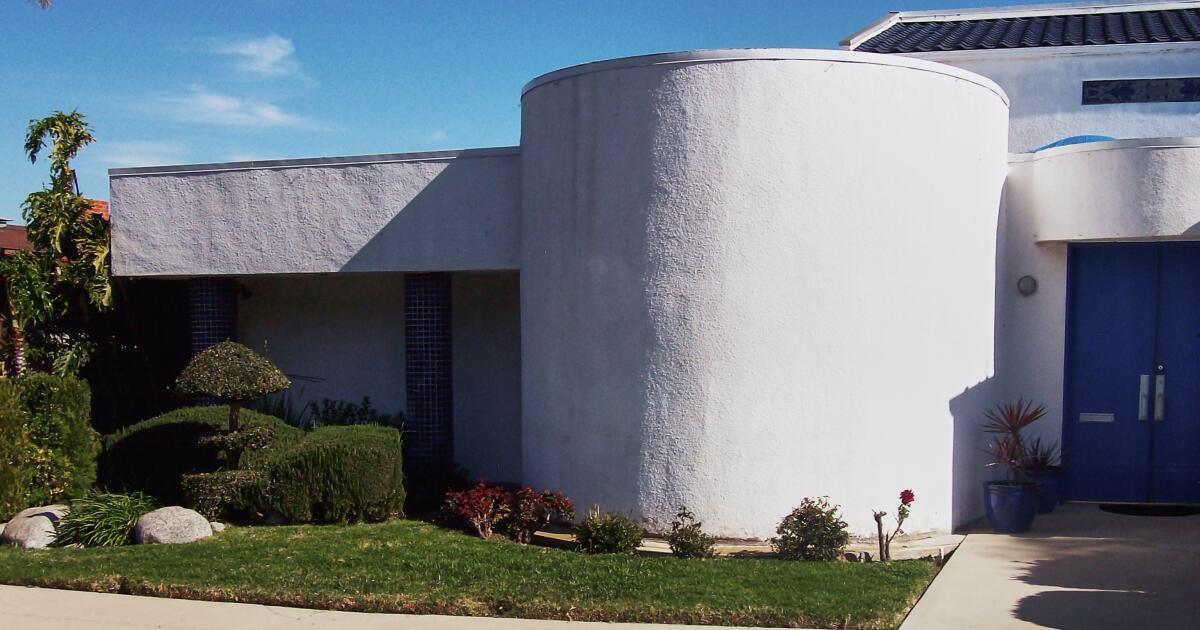
The first time Felema Yemaneberhan invited me over was maybe in 2025. I know it was sunny and warm, but I can’t figure out the season in L.A. from that. Pulling up to Felema’s home in Baldwin Hills Estates, the first thing I saw was a Japanese garden tucked on the right side of the home’s facade. The Black neighborhoods like Baldwin Hills Estates, Ladera Heights and View Park all sit hillside with some of the illest views in the city. Nah, like for real. The white curved walls offset with those two Miami Beach electric-blue mosaic columns, a single rose and an ADT home security sign took my eye. I didn’t even notice the facade was windowless until Felema said something.
The home was developed in 1983 by Edward and Lynn Edward Ivie, and designed and completed by Black builder and Cal Poly grad E. Michael White in 1985, who lived in the home with his family. Felema and her family moved in just five years later. As soon as she told me the crib was built by a brother I said, “Yo, is this some Black postmodernist architecture?”

Felema Yemaneberhan in front of her family home in Baldwin Hills.
I won’t assume y’all know what that postmodern design is. Emerging in the late ’60s and hitting its stride by the ’80s, postmodernism is defined as a reaction against that less-is-more, strict-type of modernism that came from Europe. Postmodernism reintroduced that playful, ornamental, whimsical design to everything from homes to shoes to pop culture.
So what is Black postmodernism then?
Walking into that long, blue-hued foyer with the marble floors, built-in planters and the spiral staircase that winds you through the home, left and right, mimics the feeling of descending these same hills. The speckled print on the walls behind the family bookshelf gives that Memphis design energy (or “Afro-Memphis” if y’all hip!). The home feels like a very intentional example of Black postmodernism. Playful, lived in, like a hug made from curved walls and different levels that guide you through the rooms.
I met Felema in 2020, online. She was one of the first Black architects I had ever met. She has designed homes and spaces in the U.S., Africa and Europe, and she has her own design studio, Felemaye, which she describes as “rooted in memory, material culture, and spatial intelligence.” In talking with Felema, it became immediately clear that she is super-knowledgeable about everything concerning the hood. She would tell me about where her family came from, the Eritrean capital, Asmara, and its complex history, rooted in years of Italian occupation and Art Deco infrastructure. In many ways, both subconsciously and intentionally, that Italian Art Deco city must have become the inspiration for not only Felema’s childhood home, but a profession that has driven her to really look at her neighborhood much differently.
A few days after the shoot, I chatted again with Felema. This time along with Rossen Ventzislavov, an educator who brought me out to Woodbury University last spring as a fellow to teach a one-of-a-kind semester on Black modernism in architecture, design and popular culture. All three of us share a focus on researching, archiving and documenting Black modernism and space. Yeah, it’s architecture and design, but it’s also everything from civic awareness to infrastructure, or what I’ve recently been calling, “us and the city.”
At the house with Felema, we looked through family photos, chatting with her sister Delina and playing with her son, Hyabna. She told us about this Amharic word tizita, that speaks to nostalgia, memory and longing. I saw it in her family’s decisions all through the house. Hers too. The crib looks exactly the same as it did in the ’90s. Her father’s mono bloc chair hasn’t moved from the spot it was last in since he passed. I wondered a lot about why her family chose this home in the first place.

Walking into the long, blue-hued foyer with marble floors, and the spiral staircase that winds you through the home, left and right, mimics the feeling of descending the surrounding hills.
Jerald Cooper: To start off, tell us where we are right now.
Felema Yemaneberhan: We are in the heart of the city, 90008 to be exact. We are in a subdivision called Baldwin Hills, or Baldwin Hills Estates. South L.A.
JC: Tell us about the origin story of this space. How did your family end up here?
FY: The home was originally developed and designed between 1983-1985 by father and son Edward and Lynn Edward Ivie alongside structural engineer Ronald Greene. The project was then purchased and completed between 1987-1988 by E. Michael White. When White got the property, only a few rooms were finished. He worked with contractor Travis Randolph to design the interior architecture and finish the home before my family bought it in the late ‘80s. This property’s history represents a rare lineage of design across two distinct chapters. Every hand that shaped this home was Black, an intentional choice that documents a standard of excellence often omitted from the traditional architectural narrative.
My family looked at countless homes throughout Los Angeles, and they didn’t really feel moved by anything, until one day they stumbled upon this. My parents made the transaction immediately, because the house, the views and the intentionality of the way the space was designed just spoke to them both. They are design nerds. They value the preciousness of beauty, be it in a space or an object. They just wanted to make sure that their future family would live in a beautiful and serene place.
Rossen Ventzislavov: Could you tell us about the official designation of your house?
FY: If you’re familiar with the building tradition in Eritrea, it’s not a special or glamorous thing to title a house. So most houses are named after the family. For the purpose of creating a sense of anonymity for our family we call our home “Geza Ḥlmi.” “Geza” is equivalent to villa or casa. “Hil’mi” means dreams. So it’s more of an ode to the feeling, a space to dream.


“I was a dancer my whole life,” says Yemaneberhan. “So even in the way that the body moves, and the movement through the space, there’s compression and there’s release.”
RV: How does the house connect your African existence and your L.A. existence?
FY: We’re not as exotic as we might romanticize it. I’m very much an Angelena. I was born and raised in L.A., but actually, a lot of Eritreans, when they first meet my sister and myself, assume we were born back home. We were raised with English, but we didn’t speak English in this house. We didn’t mix with the diasporic children of Los Angeles. We went back to Eritrea every summer. My parents’ choice to settle down in Los Angeles had to do with climate. It was very important when you looked outside to feel as close to home as possible. This explains the cute parallels around, like the veranda. My parents used to dress us up in our traditional clothes and take photos of us in front of the bougainvillea or the jacaranda tree. If you look at the natural landscape in Eritrea, it’s the same exact atmosphere.
JC: Tell us about some of your earlier memories of the home.
FY: We have countless memories. We used to have pool parties up here with our cousins. We did every major event here, prom, homecoming, all the homies would come here and take photos across the different points of the house. My mom’s incredible cooking. Both sides of our family used to come here, and it was just a beautiful time. And you know, the people who had to come over here due to various reasons, often reminisce on what they had back home. I often wrestled with it as a young adult, if the past had actually been better than the present day. And I could fully, wholeheartedly say, yes, it was a beautiful, charmed childhood, and in a way this home sheltered us from a lot of the chaos that was going on in the ’90s here in L.A. The inner city, gang terror, it’s all not too far from here.
RV: What is the thrill for you living in this house as an architect?
FY: There are many undulations in the space. I was a dancer my whole life. So even in the way that the body moves, and the movement through the space, there’s compression and there’s release. The main atrium, or as I call it the “Hall of Mirrors,” is kind of compressed. Then there are the heights of the house, fluctuating greatly. I also like the specific corners and the way we have created unofficial wings. If you look at the facade, there’s absolutely no windows. So it is basically a house of secrets. There are specific times of day that I particularly love, and then there are other points when I don’t want to be here. I love this house at 10 o’clock because of the cantilever and the shadows. I have my coffee on the balcony, I relax, I write my emails. I don’t really particularly enjoy the house at night. There is a playfulness in the day and there’s a seriousness at night. I also like the idea of creating a permanence in the playfulness. I have a child, and I’m very much a child, and I think it’s a testament to the spirit of this home and my father’s spirit.


JC: One gets the sense that living here triggered your choice of profession? Is that true?
FY: Absolutely! My father had a tremendous influence in terms of my career choice. There’s a beautiful image that my uncle took of us at the kitchen table where I’m coloring. My uncle would say, “Color in the lines.” And my dad’s, like, “No, let her do what she wants to do.” If I wanted to be something, I’d find the proper avenues to make it happen. We didn’t watch TV growing up, there was always an activity. So from seventh grade on, I wanted to be an architect. Which is atypical. If you’re the child of an immigrant family, you go with specific professions. You’re a doctor, a lawyer, an engineer. It’s very rare to be in this field, in the creative arts. But I think it is a testament to my parents saying to me, “OK, you can do whatever you want, just be really good at it. Take all the honest steps, do the hard work, but just be free.” That freedom has allowed me to kind of come in and out of different subsets within architecture, and really handle my curiosity. Because every part of this house, now that I think about it, has had a point of activation of curiosity.
RV: Since Hood Century [a.k.a. Jerald Cooper] has brought us together, I have a question that is consistent with Coop’s own practice. He speaks of Black inhabitation as transformative living, a nexus between design and humanity. What does it mean to you?
FY: I think that architects and designers have to be anthropologists. What is precedence without the people? If anything, Coop studies people, studies groups of folks and systems, and how informal and formal systems of specific societies interact. What are the systems that have been put in place for these people, and what are the organic solutions that the people have made for themselves because they know that the system is not serving them?


“If it’s a well-designed building, you don’t have to do anything. You just have to steward and preserve.”
To your point, I think people feel compelled to make fundamental design moves like the blueness of this house. We put in the skylights this year because we were trying to protect the plants from light exposure and the rising heatwaves. And, if you can have simple and gentle conversations about the modifications, it’s important to consider the original design intent, but also what inhabitants do right in terms of respecting heritage, and what standards we’re using to evaluate their contribution. We have designers in the family and they would come here and give different suggestions. But my argument is, if it’s a well-designed building, you don’t have to do anything. You just have to steward and preserve.
JC: Talking about stewardship and preservation, tell us about your current indexing project of Black homes here in the neighborhood.
FY: The “90008 Index.” It’s an anthropological, architectural and sociological study of the people who’ve lived within the 90008 ZIP Code from 1950 to 2000. It’s important to study and establish provenance. My argument is that there are just as many, if not more, architecturally significant buildings on this side of town, and we need to study them. In the 2000s, the media cast this neighborhood as the Black Beverly Hills. And I’m trying to step back from the exclusive focus on financial affluence. I want to study the people, because there are everyday people who built and lived here. The subtitle I’m using for this project is “L.A.’s Last Enclave of Black Glory.” I want to establish legitimacy for the architects and contractors that created here. I want to honor the families, because the intentional inhabitation of these spaces was an act of resistance. These were some of the movers and shakers of Black foundation, of Black American society. The first of many things — the first person to join the L.A. Philharmonic as a brass player is here, the first judge. These were just really decent people who wanted to make a change in their respective industries. They could have chosen to live anywhere, but they chose to live amongst their own. There was a powerful sense of Black belonging within a larger landscape. I just want to be able to capture a moment that will not be replicated.
Jerald “Coop” Cooper is an artist and founder of Hood Century, a media agency researching, archiving and educating the masses on Black folks lived experience with the city, via architecture, design and popular culture.
Rossen Ventzislavov is a philosopher and cultural critic from Bulgaria who lives in Los Angeles and teaches at Woodbury University.

Words Jerald “Coop” Cooper and Rossen Ventzislavov
Photography Jerald “Coop” Cooper
Art director and editor Savannah Sinhal
Producer and photo editor/retoucher Randy Scott Hounkpe
Videographer Devin Williams
This story originally appeared on LA Times

