


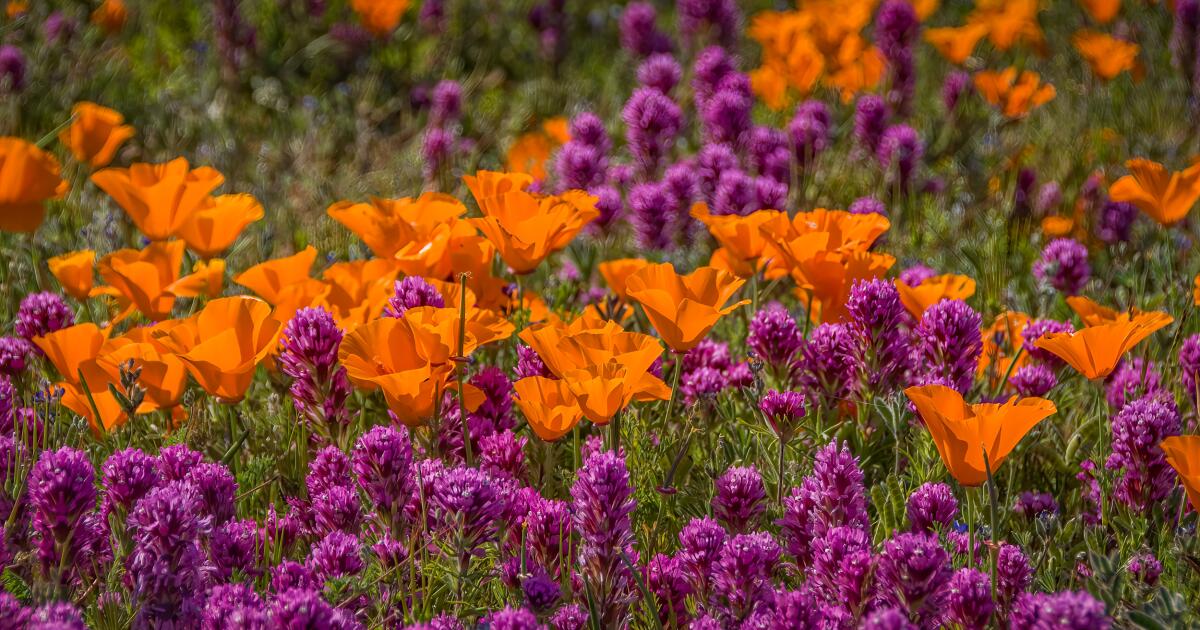
Wildflower expert Naomi Fraga was excited about the prospect of an extraordinary bloom this spring, after a winter of near record rainfall, but this week’s unseasonably hot, dry weather has dimmed her hopes for a superbloom year.
“Superblooms are not guaranteed every year, even after lots of rain,” said Fraga, director of conservation programs at California Botanic Garden in Claremont. “When it happens, it’s extraordinary, but you need all the stars to align, with rain, temperature and timing. We’ve had some of those ingredients, but it remains to be seen if the weather will cooperate to give us a spectacular bloom year.”
California certainly has had the rainfall — it’s been the second wettest season through January that L.A. has seen in 21 years, according to the Los Angeles Almanac. And the rainy weather came at the right time to give SoCal lots of colorful blooms this spring, traditionally around mid-March through April in Southern California, Fraga said.
But wildflowers also need at least six weeks of coolish weather to grow after they germinate. Despite the rain, Southern California had record warm temperatures in November and December, Fraga said, “and we’re seemingly headed that way in January.”
Fields of wildflowers paint the hills yellow, orange and purple along Highway 58 and Seven Mile Road near the Carrizo Plain National Monument on April 1, 2023.
(Laura Dickinson / San Luis Obsipo Tribune)
A surge of hot weather, like what SoCal is experiencing this week, can damage young plants, either forcing them into a lackluster early bloom “that fizzles fast or desiccating emerging buds that won’t make it into production,” Fraga said.
The average high temperature in January for downtown L.A. is 68 degrees, but Wednesday’s high was 83 degrees, said Rose Schoenfeld, a meteorologist with the National Weather Service in Oxnard.
The Greater Los Angeles area isn’t expected to reach record highs this week, but it will get close. The high on Wednesday was just a few degrees shy of downtown L.A.’s record high of 88 degrees on Jan. 14, 1975, Schoenfeld said.
The best hope for a potential superbloom is if SoCal gets some cool, wet weather next week, Fraga said, but the chances of that are iffy. Temperatures are expected to cool some, National Weather Service Meteorologist Mike Wofford said, “but they’ll still be about 5 degrees above normal next week.”
Right now, it’s possible SoCal will see a small amount of rain between Jan. 22 and Jan. 24, Wofford said, but it won’t be a large amount, “maybe a quarter inch.”
Nonetheless, Fraga said she’s still excited to see what kind of bloom SoCal has this spring, especially after last year’s massive fires in the area.

A Plummer’s mariposa lily blooming in Los Angeles.
(Christina House / Los Angeles Times)
Southern California may not get a superbloom this year, she said, but we do have a good chance of seeing spectacular “fire followers,” native flowers that typically emerge after a wildfire such as native snap dragons, dense stands of lupine, whispering bells and one of the most eagerly anticipated, the deep pink, lavender, white and yellow Plummer’s mariposa lily, a species that is endemic to SoCal. (On Instagram, San Francisco Bay-based naturalist Damon Tighe posted some breathtaking photos of the flowers he took in 2022.)
The region has already seen some early wildflower displays in the Anza-Borrego Desert State Park, probably triggered by rain last fall.
Fraga said she hasn’t given up hope of spectacular displays around L.A. this spring.
She has vivid memories of what she considers to be the region’s biggest bloom years over the past 20 years: in 2005, her first as a young botanist, 2016 and 2023, when our hills and fields were blanketed in colorful displays of California poppies, lupine, phacelia, blazing star and other native annuals.
“Obviously the visual displays are incredible,” she said, “but some of the memories that stick with me the most are the smells — the smells you don’t get in a more average year. One year I came cross a population of lacy phacelia in Red Rock Canyon State Park. You see these flowers growing in patches here and there, but this time, I found this huge mass. And this smell was permeating the air. I couldn’t help wondering what it was until I realized it was the plants emanating this perfume, and there were so many pollinators attracted by its scent.”
Sometimes, she said, the scents from these mass groupings have been overwhelming, like the time she and her plant-enthusiast husband came across a huge patch of a rather humble white annual known as linanthus jonesii, which closes its flowers during the day and opens them at dusk to attract moths.
They had been out all day, and were preparing to leave, “when this smell came into the air. I told my husband, ‘I smell Cup Noodles soup,’ and then I looked at the ground and saw all these flowers were opening. The smell had a very umami [vibe], like ramen, but then it got to be too much. And we started running to our car, because the smell was just nauseating.”
The Theodore Payne Foundation’s Wild Flower Hotline is a good way to keep track of where flowers are blooming, but it won’t start up until March 1. So in the meantime, wildflower lovers should keep their fingers crossed for cooler weather.
Fraga said she’s still hopeful for what will be coming this spring. “More moisture and cooling would help a lot,” she said, “but you never know when these superblooms will happen. It could still happen this year because we had lots of rain. So no matter what, I’m excited for the spring, because it’s a great time to enjoy the outdoors and see an incredible display by nature.”
This story originally appeared on LA Times

