


President Donald Trump has lauded the United States’ position in its artificial intelligence race against rival China.
“We’re leading China by a tremendous amount,” he said Jan. 13 in an interview with CBS Evening News anchor Tony Dokoupil.
“The AI is unbelievable, what’s happening there. We’re leading China by a lot,” he said Jan. 16 in Mar-a-Lago. And during his Jan. 21 speech at the World Economic Forum in Davos, Switzerland, he said it again: “We’re leading the world in AI by a lot. We’re leading China by a lot.”
The U.S. has a lead, but it isn’t cozy.
The United States leads China in AI chip production and market control. AI chips are essential — they are tailored to do tasks such as image and speech recognition.
China is a formidable competitor in other areas, including the quality of its workforce and electricity generation that powers data centers.
By some measures, the two countries are neck-and-neck, and recent changes in U.S. export policy may benefit China. But Trump has also whittled down industry regulation, empowering U.S. AI companies to expand with fewer restrictions.
Experts told PolitiFact that China is just months behind the U.S. on AI. White House AI and crypto czar David Sacks said in June that Chinese AI models are “three to six months behind” the U.S.
On Jan. 21 at the World Economic Forum, when asked how he views the AI race now, Sacks said, “I still think that the U.S. is in the lead. I think that our models are better, our chips are better. But they do have other advantages,” including its power generation.
Matt Sheehan, senior fellow at the Carnegie Endowment for International Peace’s Asia program, estimates after a U.S. company releases the “best new model,” a Chinese company will match it in roughly six to 18 months.
Key AI industry leaders have offered similar assessments. In September, Jensen Huang, CEO of U.S. chipmaker Nvidia, said China is “nanoseconds” behind the U.S. Google DeepMind CEO Demis Hassabis said Jan. 20 that Chinese models are six months behind.
How the U.S. leads China on AI chips
President Donald Trump listens as Nvidia CEO Jensen Huang speaks during an event about investing in America in the Cross Hall of the White House, April 30, 2025, in Washington. (AP)
California-based Nvidia dominates AI chip manufacturing, becoming the world’s first company to reach a $5 trillion market value. Under Trump, the U.S. has loosened regulations to allow China access to more advanced Nvidia chips, which could narrow the gap between U.S. and China.
“There’s a really big difference, both in terms of the quality of the chips (the U.S.) can make and the quantity of the chips we can make,” said Chris McGuire, Council on Foreign Relations senior fellow for China and emerging technologies.
U.S. law has regulated exports of certain advanced chips, including banning Nvidia from selling Blackwell, its most powerful chip, to China. In July, the Commerce Department altered its rules, allowing Nvidia to sell China a less advanced chip. U.S. authorities have nonetheless found people smuggling the company’s more advanced chips into China.
On Jan. 13, the Trump administration allowed Nvidia to sell China its second most powerful AI chips, H200s, with restrictions. Nvidia cannot ship more than 50% of the overall chips it sells to American customers. Trump also imposed a 25% tariff on the H200s.
Experts believe the policy change will negatively affect the United States’ lead. Selling H200 chips “erodes some of the U.S. advantage in terms of AI chips,” Sheehan said. “The overall trend toward training larger and more compute-intensive models tends to favor the U.S. because of its remaining advantage in terms of access to chips.”
The Institute for Progress, a think tank, estimated that if more advanced chips like the H200s are exported without restrictions, the U.S. advantage in computational resources would plummet. “I think export controls are the only lever that the U.S. government has to slow China down,” McGuire said.
China has kept pace and may benefit from new U.S. policies
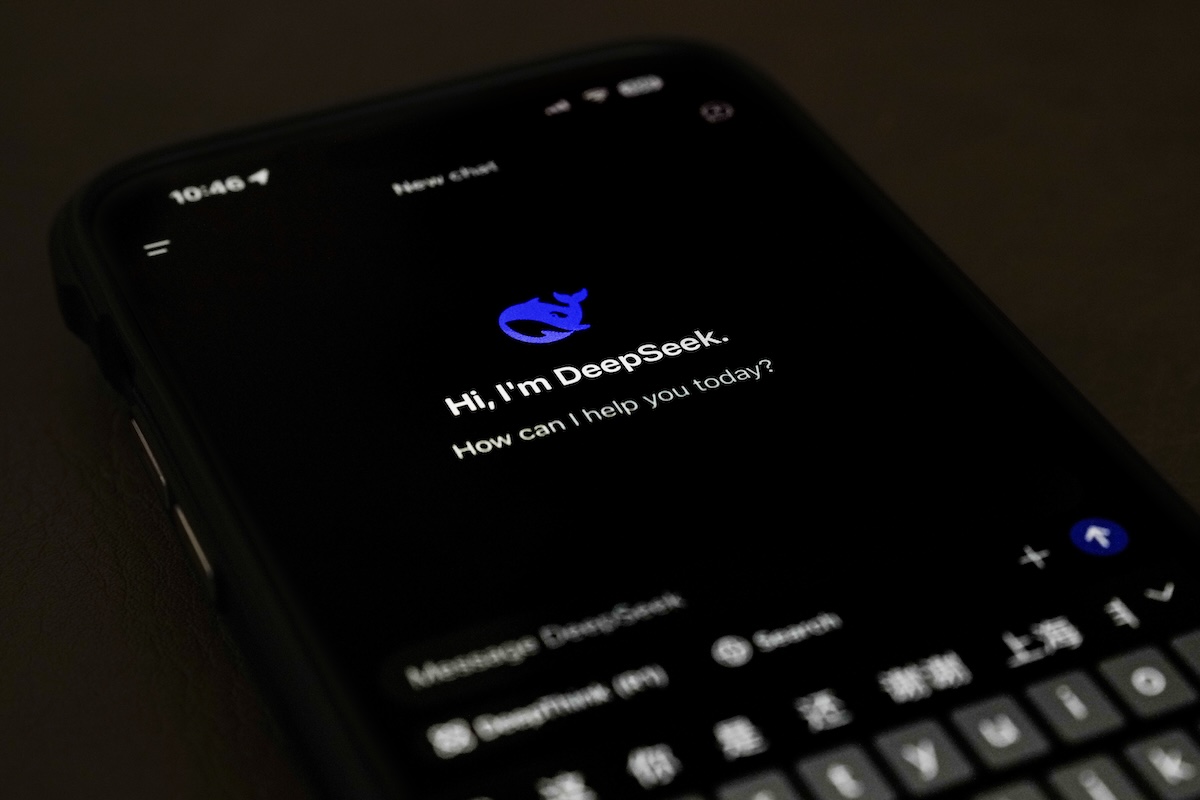
The page for the smartphone app DeepSeek is seen on a smartphone screen in Beijing, Jan. 28, 2025. (AP)
Chinese companies have built competitive large language models — AI models trained to mimic language and perform tasks such as summarization, translation and chat.
U.S. models include OpenAI’s ChatGPT, Google’s Gemini, xAI’s Grok and Anthropic’s Claude. Chinese companies including DeepSeek, Alibaba and Moonshot have released competitive models of their own.
One research institute analysis found that since 2023, Chinese models have trailed U.S. models by seven months on average.
Sheehan pointed to leaderboards such as LMArena, developed by University of California, Berkeley researchers, that rank large language models on how well they respond to text, image and coding prompts. U.S. models dominate the LMArena leaderboard, but Chinese models are not far behind. Ernie 5.0, developed by the Chinese company Baidu, ranked ninth overall, as of Jan. 29.
In terms of adoption, experts said it’s hard to tell which models are most favored by companies seeking to incorporate AI, as the available metrics are generally unreliable.
China has advantages on talent and electricity generation
The U.S. may have a “slight edge” on research talent, Sheehan said, but “China has a large base of domestic talent.” Researchers found that as of 2022, 57% of the most elite AI researchers worked in the U.S. But China is the top country of origin among top-tier AI researchers in the U.S.
“The U.S.’ traditional ability to attract the world’s top talent gives it powerful advantages to train and apply AI models,” said Joseph Webster, senior fellow at the Atlantic Council’s Global Energy Center and Indo-Pacific Security Initiative.
In his second term, Trump cut research funding and implemented a sweeping immigration crackdown that has negatively affected international students.
China also holds the advantage in electricity generation that powers data centers.
“The U.S. power grid poses major and growing challenges to U.S. AI efforts,” Webster said. Insufficient electricity can impede AI training and inference, which refers to running AI models to make predictions based on new data.
China has more open-source AI models, making it easier for companies to adopt models for free, Sheehan said. U.S. AI companies typically charge for access to their premium models.
When it comes to scaling AI, the United States’ relations with other major technology players, such as Taiwan, Japan, South Korea and the Netherlands, give it a boost, Webster said.
But the U.S.’ lead could be eroded. “If the U.S. sells advanced chips to (China), damages its ties with other democracies, prevents top AI talent from entering the U.S., or damages its research universities, it could surrender key technology advantages it has traditionally enjoyed,” Webster said.
Our ruling
Trump said that in AI, the U.S. is “leading China by a lot.”
The U.S. has a lead over China in model capability, but key AI industry leaders and experts say China is only a few months behind.
The U.S.’ lead is sustained by the quality and quantity of its AI chips, which are restricted for sale in China. Recently, the Trump administration loosened those controls.
China has advantages when it comes to talent and electricity for data centers.
The statement is partially accurate but leaves out important details. We rate it Half True.
This story originally appeared on PolitiFact

