


A South Korean court has sentenced former president Yoon Suk Yeol to life in prison after he imposed martial law in the country in 2024.
Yoon was found guilty of abuse of authority and masterminding an insurrection, stemming from his mobilisation of military and police forces in an illegal attempt to seize the liberal-led National Assembly in December 2024, in a case that meant he also faced the death penalty.
The 65-year-old staunch conservative had defended his decree as necessary to stop liberals, whom he described as “anti-state” forces, from obstructing his agenda with their legislative majority.
The emergency rule triggered a national political crisis.
It lasted for around six hours before being lifted after politicians managed to break through a blockade by hundreds of heavily-armed troops and police and unanimously voted to lift the measure.
Prosecutors sought the death penalty in January, saying “his unconstitutional and illegal emergency martial law undermined the function of the National Assembly and the Election Commission… actually destroying the liberal democratic constitutional order.”
South Korea has not executed anyone since 1997 – a move widely seen as a de facto moratorium on capital punishment.
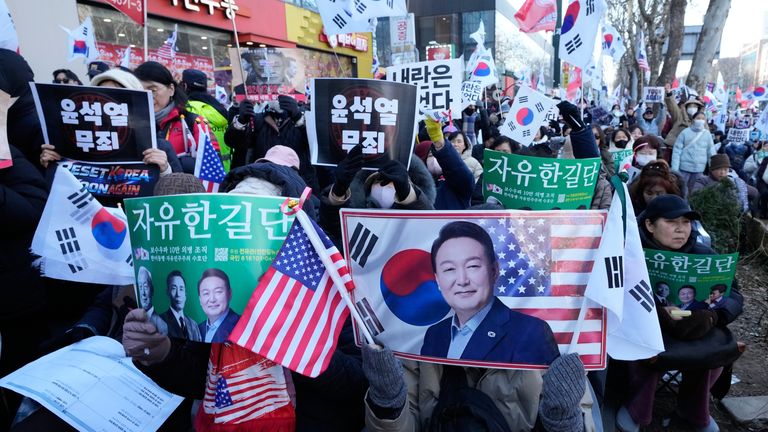
Yoon’s supporters staged a rally outside the Seoul Central District Court.
Pic: AP
The court also convicted and sentenced several former military and police officials involved in enforcing the martial law decree.
Former defence minister Kim Yong Hyun received a 30-year jail term for his central role in planning the measure and mobilising the military.
Read more from Sky News:
British couple sentenced to 10 years in prison in Iran, family say
How US military is assembling within striking distance of Iran
Yoon was sentenced last month to five years in prison for resisting arrest, fabricating the martial law proclamation and sidestepping a legally mandated full cabinet meeting before he declared martial law.
The Seoul Central Court has also convicted two of Yoon’s cabinet members in other cases, including former prime minister Han Duck-soo, who received a 23-year prison sentence for attempting to legitimise the decree by forcing it through a cabinet council meeting, falsifying records and lying under oath. He has appealed the verdict.
This story originally appeared on Skynews

