


It’s Black History Month — and President Donald Trump has put his stamp on the decades-old commemoration.
The White House’s 2026 Black History Month proclamation said Black history “is not distinct from American history.” Black History Month, the proclamation said, has been twisted by “the progressive movement and far-left politicians” who have “sought to needlessly divide our citizens on the basis of race, painting a toxic and distorted and disfigured vision of our history, heritage, and heroes.”
At a Feb. 18 White House event, Trump lauded Black celebrities and closed his remarks with, “Happy Black History Month! Happy Black History Year! And happy Black History Century!”
Since starting his second term, Trump has sought to reshape the government’s portrayal of Black history.
Trump has issued executive orders curtailing the government’s use of diversity, equity and inclusion, or DEI. Since then, federal agencies have taken a number of high-profile steps to remove historical information portrayed through the lens of race.
Some have subsequently been reversed, modified or blocked in court. It remains unclear whether Trump’s executive orders and the removals could have a chilling effect on museums, historical sites and federal agencies going forward.
“No other presidential administration has interfered with these (historical) sites in this way before,” said Leslie M. Harris, a Northwestern University historian and author of five books on slavery in the U.S. “A short-term outcome could be a distrust, even an avoidance, of government sites.”
In response to our request for comment, White House spokesperson Olivia Wales outlined what she said are Trump’s accomplishments for Black Americans spanning both his presidencies, including criminal justice reform, prison reform, opportunity zones, long-term funding of historically black colleges, school choice funding, Trump Accounts and “the largest middle-class tax cuts in history.”
What did Trump’s executive orders say?
Within hours of his Jan. 20, 2025, inauguration, Trump issued an executive order mandating the termination of what it called “all discriminatory programs” including DEI “mandates, policies, programs, preferences, and activities” in the federal government.
A second March 27, 2025, executive order, titled “Restoring Truth and Sanity to American History,” sought to counter what it characterized as “a concerted and widespread effort to rewrite our Nation’s history, replacing objective facts with a distorted narrative driven by ideology rather than truth.”
The executive order specifically addressed the Smithsonian Institution and said people visiting museums should not “be subjected to ideological indoctrination or divisive narratives that distort our shared history.” (In August 2025, PolitiFact visited several Smithsonian museums and rated Trump’s statement that the Smithsonian includes “nothing about success, nothing about brightness, nothing about the future” Pants on Fire. )
The order also directed the interior secretary — whose department includes the National Park Service that operates hundreds of historical sites and interpretive exhibits — to reinstate materials that had been “removed or changed to perpetuate a false reconstruction of American history, inappropriately minimize the value of certain historical events or figures, or include any other improper partisan ideology.”
How have these orders been implemented?
Here are some examples of ways the executive orders have been implemented that are still in place:
The “scarred back” photograph. An 1863 image of a man who escaped slavery and bore deep scars on his back from being whipped was removed from display at the Fort Pulaski National Monument near Savannah, Georgia, Greenwire reported in September 2025. The 1863 photo is well known because of its use by abolitionists and inclusion in modern textbooks.
Statue of Confederate general Albert Pike. Protesters tore down and burned the Washington, D.C., statue during Black Lives Matter protests in 2020, but the National Park Service renovated and reinstalled it in October 2025.
A statue of Confederate general Albert Pike has been reinstalled in a park near the headquarters of the Labor Department in Washington, D.C., in 2025. (AP)
National Park Service gift shops. The Interior Department issued a November 2025 memo ordering its gift shops to remove any items promoting DEI or gender expression, The New York Times reported.
Louisiana landmark designation. Following a multi-year National Park Service review, the Great River Road, an 11-mile corridor in Louisiana with a deep history of slavery, was pulled from consideration for National Historic Landmark designation.
Black Lives Matter plaza. Washington, D.C., Mayor Muriel Bowser removed a mural of the words “Black Lives Matter” near the White House, painted on the street after the 2020 murder of George Floyd by Minneapolis police. The removal followed the introduction of legislation by Rep. Andrew Clyde, R-Ga., to withhold federal funds from the city didn’t remove it.
Other actions were modified or reversed after public backlash, including:
Harriet Tubman web page. The National Park Service initially removed a large photo and quotations from Tubman, an anti-slavery advocate, from a web page about the Underground Railroad, but it was later restored.
Pentagon web pages. Weeks after Trump returned to office, the Pentagon marked tens of thousands of web pages for deletion based on the DEI executive order’s standards. But after an outcry about the removal of a page about Jackie Robinson, the first Black major league baseball player, Robinson’s page was restored. It’s unclear whether other pages were restored and how many that were marked for deletion were formally deleted.
Plantation grants. Two federal grants to the Whitney Plantation in Louisiana, which offers tours and exhibits about the realities of life under slavery, were initially rescinded, but later restored, The New York Times reported.
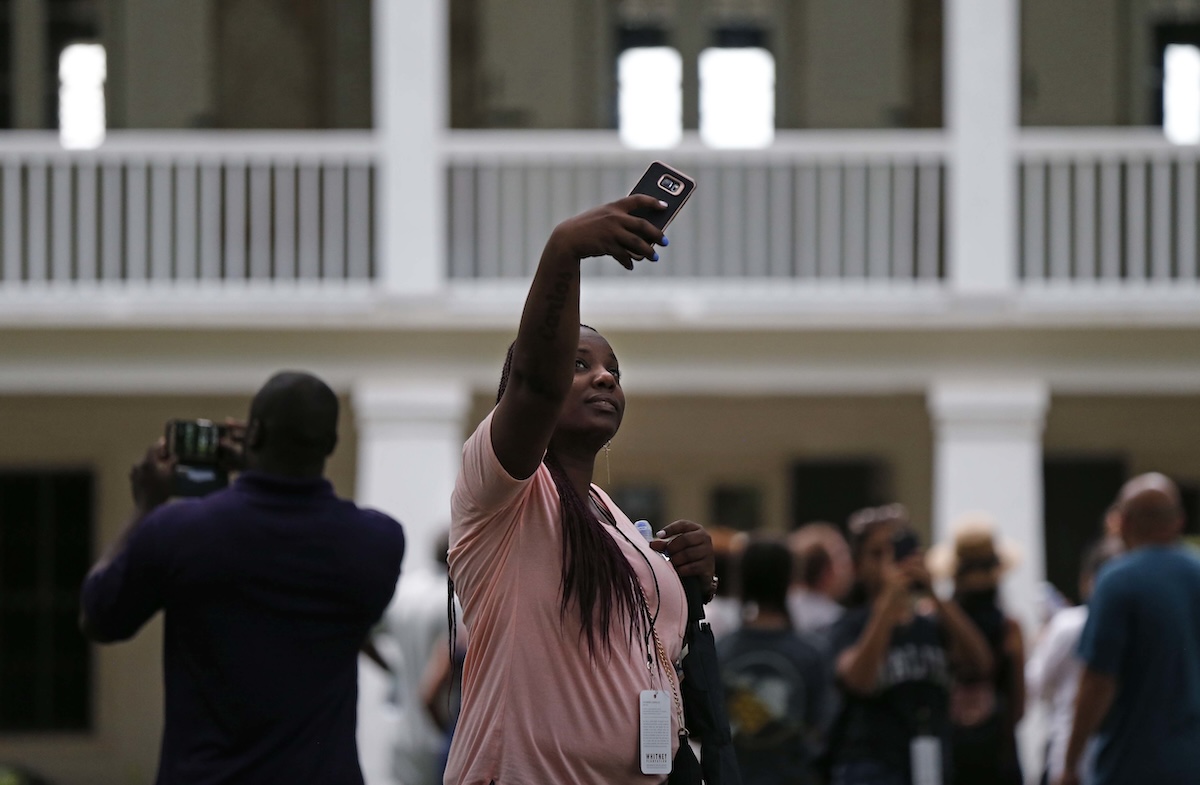
Jennifer Thomas of Los Angeles takes photos outside the main plantation house at the Whitney Plantation in Edgard, La., in 2017. (AP)
In at least one case, the courts have blocked an administration action — the removal of biographical panels about nine people enslaved by the nation’s first president, George Washington, when Philadelphia was the nation’s capital. On Feb. 16, a federal judge ruled that the panels had to be returned; the federal government is appealing.
In a statement to PolitiFact, White House spokesperson Taylor Rogers said the Interior Department “is engaged in an ongoing review of our nation’s American history exhibits in accordance with the president’s executive order to eliminate corrosive ideology, restore sanity, and reinstate the truth.” Rogers said the department’s actions are not finalized and she called the lawsuits “premature.”
On Feb. 17, advocacy groups announced another lawsuit against the Trump administration, targeting the removal of civil rights information, as well as climate change and other subjects, at national parks.
What is the impact?
Historians said the administration’s moves are misguided.
“The removal of this complex history from National Park Service sites is concerning, as these places are an important source of historical information for the general public,” said Harris, the Northwestern University historian.
For example, the removal of the historical panels about people enslaved by George Washington “erases heroic and inspirational American stories of courage and patriotism” by enslaved people, said James Madison University historian Steven A. Reich.
The removal of exhibits or historical information also endangers freedom of thought, a cornerstone of democracy, Reich said.
“How to tell the story of the country’s past, in a democratic society, is as open and fluid as the debate over any matter of public policy,” he said.
For Trump, who has touted his improved performance among Black voters in the 2024 election, the executive orders he’s signed make it “hard to argue that he wants to help Black people,” said Andra Gillespie, an Emory University political scientist.
Staff Researcher Caryn Baird contributed to this report.
This story originally appeared on PolitiFact

