


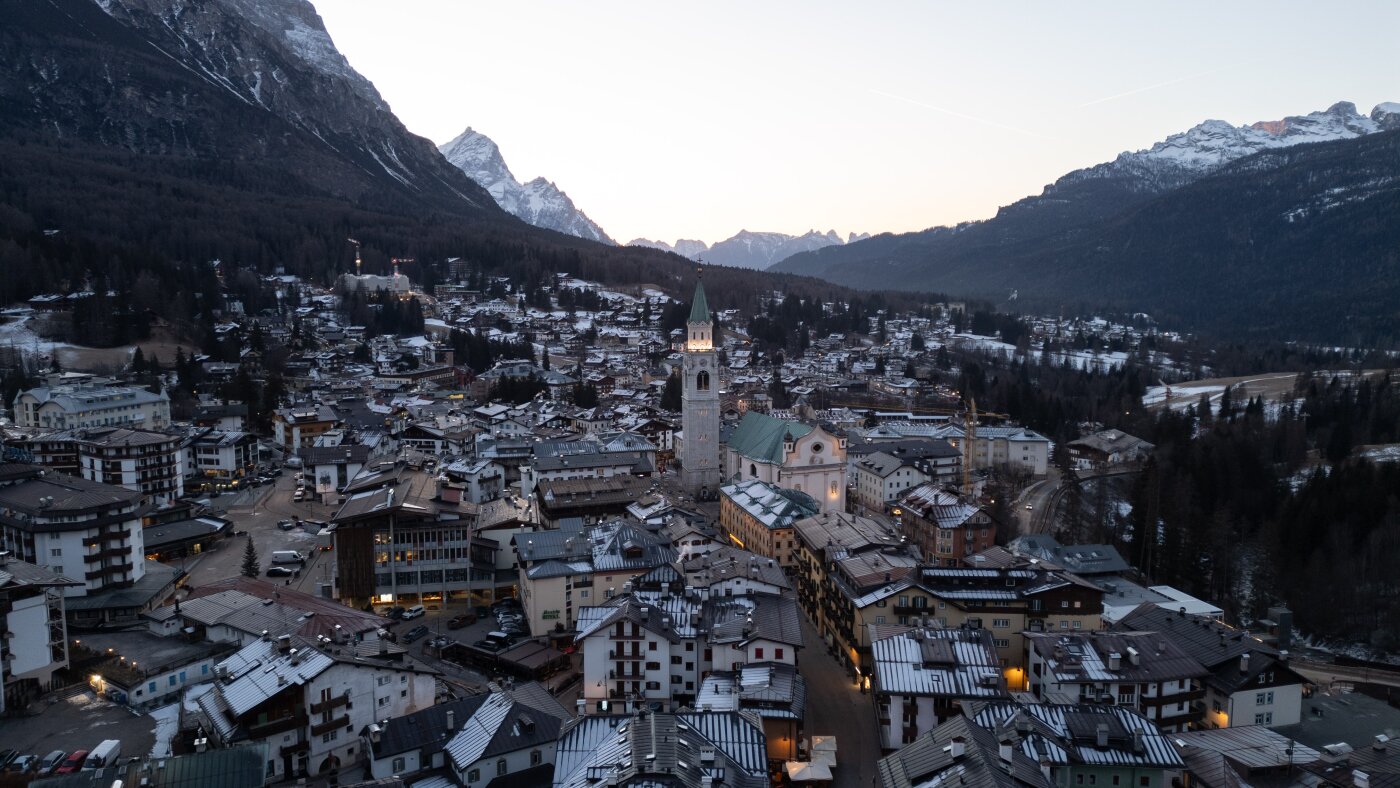
The illuminated bell tower of the Basilica Minore dei Santi Filippo e Giacomo stands at the heart of Cortina d’Ampezzo, Italy, as evening settles over the valley. Once a small village of farmers and shepherds, this storied town has evolved into the “Pearl of the Dolomites,” a renowned luxury destination. Surrounded by the limestone peaks of the UNESCO World Heritage Dolomites, the town’s historic center remains a “living room” for celebrities and high society.
Valerio Muscella for NPR
hide caption
toggle caption
Valerio Muscella for NPR
CORTINA D’AMPEZZO, Italy — Walking the main thoroughfare of Cortina D’Ampezzo is a glamorous experience. It is as if every designer brand has decided it needs to be represented in this small town more than 4,000 feet up in the Italian Alps. In a few short steps, you pass shops for Dior, Fendi, Gucci, Prada and more. Among passers-by, fur coats are in fashion.
Cortina has been in the international spotlight in recent weeks as a host to many of the Olympic and Paralympic Winter Games. But this storied town has a much longer history of fame and fortune that has led to various nicknames like Pearl or Queen of the Dolomites.

A window display for the luxury fashion brand Fendi illuminates a central street in Cortina d’Ampezzo, adjacent to a large outdoor sculpture of a skier. The town’s main thoroughfare is a glamorous hub where premier designer brands like Dior, Gucci and Prada are represented.
Valerio Muscella for NPR
hide caption
toggle caption
Valerio Muscella for NPR
On the mountain slopes nearby, skiers stop for hot chocolate or an alcoholic spritz at an Alpine lodge where they are served by Riccardo Fiore, the grandson of the region’s winter sport champions. His grandmother, Yvonne Rüegg, is an Olympic gold medalist in giant slalom. His grandfather was the trainer of Alberto Tomba — one of history’s greatest Alpine skiers, who learned on these very slopes. “Tomba still stops by here all the time,” he says.

Riccardo Fiore, grandson of Olympic gold medalist Yvonne Rüegg, poses inside his family’s Alpine lodge in the Dolomites.
Valerio Muscella for NPR
hide caption
toggle caption
Valerio Muscella for NPR

American actor Sylvester Stallone (right) and director Renny Harlin on the set of Harlin’s film Cliffhanger.
Leonello Bertolucci/Sygma via Getty Images
hide caption
toggle caption
Leonello Bertolucci/Sygma via Getty Images

A large-scale photograph of Italian skiing legend Alberto Tomba, wearing a traditional fur hat and reading a sports newspaper with the headline “Immenso Alberto,” is displayed in a wood-paneled interior in Cortina d’Ampezzo. Tomba, one of history’s greatest Alpine skiers, learned to race on these slopes under the guidance of local trainers, further cementing the town’s status as a historical cradle of international winter sports.
Valerio Muscella for NPR
hide caption
toggle caption
Valerio Muscella for NPR
For Fiore, there’s nothing unusual about serving drinks to famous individuals. He names well-known Italian politicians, actors and singers he has spotted in the lodge. And there are international names who visit Cortina, too — Sylvester Stallone, who filmed scenes from the 1993 action movie Cliffhanger here, Snoop Dogg, Justin Timberlake and Ridley Scott, to name a few.
“Many celebrities you barely recognize,” he says. “They try to disguise themselves, as they don’t want to attract too much attention.”
Nonetheless, Cortina has earned another nickname — the “celebrities’ living room.” The Hotel de la Poste bar, with its wood-paneled ceiling and walls, was a favorite haunt of American writer Ernest Hemingway. A small plaque honors him on a wall by the corner table he occupied for countless hours in the 1940s. And the hotel has preserved the room he stayed in — visitors can look in to see his typewriter.

“His room is a time capsule,” says Servane Giol, author of The Queen of the Dolomites, a book about the history of Cortina.
“I found some amazing letters from Hemingway explaining how he was a bit against ski lifts, because he believed it was better for the legs to be warmed up by climbing the mountains and skiing down,” Giol says. “This really made me laugh; to think that somebody could be against ski lifts.”

Servane Giol, renowned expert in Venetian art and lifestyle, poses in the historic wood-paneled Stube of the Hotel de la Poste. Giol, who has dedicated her work to preserving the cultural and aesthetic heritage of the region, sits beside an old painted pendulum clock, a symbol of the hospitality and Ampezzo tradition that the hotel has represented since 1804.
Valerio Muscella for NPR
hide caption
toggle caption
Valerio Muscella for NPR

American writer Ernest Hemingway, wearing a hunter waistcoat, stands behind a bar counter and pours gin in Cortina d’Ampezzo in 1948.
Archivio Cameraphoto Epoche/Hulton Archive/Getty Images
hide caption
toggle caption
Archivio Cameraphoto Epoche/Hulton Archive/Getty Images

Members of the U.S. Olympic teams walk during the procession into Cortina’s huge ice stadium for opening ceremonies launching 11 days of competition in the 1956 Winter Olympics.
Bettmann Archive/Getty Images
hide caption
toggle caption
Bettmann Archive/Getty Images
Giol says Cortina, once a small village of farmers and shepherds, became famous in the 1920s, when it was visited by the then king of Belgium, who loved to climb the jagged limestone Dolomite peaks that surround it. His daughter then married an Italian crown prince. “Between the 1920s and the 1940s, Cortina was actually the chicest place to be. You’ve got very glamorous royal families,” she says.
It became a destination for Italy’s wealthy. And then in 1956, Cortina hosted the first-ever Winter Olympics to be televised. Archive footage shows grainy black-and-white images of the opening ceremony, described by the news anchor as the “spectacle of peace.” Olympic participants from 32 countries took part in the Games that saw athletes speeding down the mountain slopes or shooting down the bobsled track built at the edge of the town.
The television broadcasts internationalized Cortina’s fame. Hollywood films were shot here — including the first Pink Panther movie, as well as the 1981 film For Your Eyes Only, with actor Roger Moore as James Bond. It includes a high-octane chase, as Bond skis down the mountainside pursued by assassins on motorbikes who shoot at him, the bullets zinging past as he slaloms and performs a somersault on skis.

English actor Roger Moore poses as 007, with a Lotus Esprit Turbo, on the set of the James Bond film For Your Eyes Only in Cortina d’Ampezzo, Italy, in March 1981.
Keith Hamshere/Moviepix/Getty Images
hide caption
toggle caption
Keith Hamshere/Moviepix/Getty Images
Today, the Dolomites are a UNESCO heritage site and their beauty attracts celebrities and huge numbers of other tourists — many lured by images shared on social media of the turquoise Alpine lakes and stunning peaks.
And more crowds came in February and March to watch the Olympics and Paralympics. This time, the Games relied almost entirely on artificial snow. As winters become shorter and warmer because of climate change, there are also questions about the future of this ski resort town.

Ludovica Rubbini, co-founder of the Michelin-starred restaurant SanBrite, inspects a wheel of artisanal cheese inside the establishment’s aging cellar. The “agricucina” project emphasizes the traditional preservation and maturation of local dairy products, showcasing the deep connection between the restaurant’s kitchen and its own farm production in the Dolomites.
Valerio Muscella for NPR
hide caption
toggle caption
Valerio Muscella for NPR

A table setting awaits customers at SanBrite restaurant.
Valerio Muscella for NPR
hide caption
toggle caption
Valerio Muscella for NPR

A waiter provides tableside service for guests in the dining room of the Michelin-starred restaurant SanBrite. The establishment, known for its “agricucina” philosophy, combines a refined mountain atmosphere with traditional Cortinese architectural elements, emphasizing a direct connection between local ingredients and high-end hospitality in the heart of the Dolomites.
Valerio Muscella for NPR
hide caption
toggle caption
Valerio Muscella for NPR
But Cortina is changing, too. More people come for summer hiking and for unique fine dining, like that offered by Ludovica Rubbini and her husband, Riccardo Gaspari, whose restaurant SanBrite has earned a Michelin star, as well as the guide’s “green star” for the sustainable agricultural and locally grown ingredients the couple uses on its farm.
In the cozy restaurant, where dried flowers hang from the walls and lights include lamps used during the 1956 Olympics, waiters tell guests at this fine-dining restaurant about the cows that provided the home-churned butter that is served in large pots for sourdough bread.
The dishes are inspired by the mountains and woodland of the area. They include a Jerusalem artichoke cigar served on a bed of moss and filled with the cream of the artichoke, mushrooms and marinated shallots. And a dessert made to look like a frozen lake, with a panna cotta base and layer of frozen water and elderflower, and yogurt powder as a dusting of snow.
“We were out for a walk, and Riccardo crouched by the frozen lake tapping it and examining it,” Rubbini says, remembering the day her husband was inspired to develop this perfect winter dessert.

The snow-capped peaks of the Tofane massif are framed through a window of a rifugio, a kind of traditional mountain hut, decorated with typical heart-patterned Ampezzo textiles. These high-altitude lodgings serve as essential rest areas for skiers and hikers, offering a blend of rustic hospitality and panoramic views that define the winter experience in the Dolomites.
Valerio Muscella for NPR
hide caption
toggle caption
Valerio Muscella for NPR
This story originally appeared on NPR

