


As he rolled up in front of my Van Nuys duplex, his teal Ford Tempo shimmering in the speckled fall sun, a wave of first-date excitement flooded my system.
Leaning across the center console, he flung open the passenger door.
“Sorry,” he said brightly, “I threw up in that seat on the 405 yesterday, but I think I mostly cleaned it up.”
I paused, looked at the seat and then back at his hopeful, earnest face.
“I ate vitamins on an empty stomach then sat in traffic,” he said with a shrug.
Well, I thought, at least it was just partially digested vitamins and not a carne asada burrito. It could be worse.
Deciding to be the cool girl, I slid into the not-quite-clean seat and took a deep breath.
Brian was 6 feet 4 and a moppy-haired brunette musician with magnetic stage presence. We’d met through a mutual friend from his band, a guy who made me laugh by drawing inappropriate images on my spiral notebooks in my theater classes at Cal State Northridge.
The week before, I’d watched them play a show in Calabasas and felt something shift. Onstage, Brian closed his eyes when he sang, swaying slightly offbeat as his wild waves caught the light. I was smitten.
Our first date unfolded on a stylish vintage couch in a cafe rumored to have once belonged to someone from punk-rock band NOFX. We sipped tea. This man had never had a sip of alcohol in his life, by choice, which felt both bizarre and wildly exotic to me at the time. I worried the absence of cocktails might make the night awkward. Instead, we talked for hours, our words tumbling over each other like we’d been rehearsing for years.
Within six months, he’d moved into my apartment. From there, we leapfrogged to Venice, then Marina del Rey and finally to Mar Vista, where we bought our second home and planted ourselves like people who understood picket fences. Two extraordinary children later, we had built something that looked, from the outside, like a Hallmark movie with much better music. I would stand in our kitchen at dusk, the marine layer settling in, peaceful as I loaded the dishwasher in a life I hadn’t necessarily seen for myself.
Then life, because it always does, began to press.
In 2019, my mother-in-law suffered a stroke and moved into our home while she recovered. I love her deeply and was grateful we could care for her. However. Caregiving inside a tiny West L.A. “bungalow” (as my MIL kindly referred to it) magnified everything from love to exhaustion. We survived it, yet hadn’t fully exhaled when the COVID-19 pandemic arrived like a cosmic reminder of how life loves a dramatic arc.
Suddenly, we were always home. Always in each other’s line of sight, always negotiating space that didn’t exist. I would often escape to our tiny yard for another DIY project, clutching coffee or whiskey like a flotation device and internally screaming in his direction: “Why are you always here?”
My chronic illness flared, and fear hovered over me like smog. Both sets of our parents were aging rapidly and reminding us of our own mortality. Grief layered itself over everything, but we kept the children steady and the house functioning. We kept showing up as best we could.
Yet somewhere along the way, large pieces of ourselves went missing.
In 2023, I fled to Mexico City with a friend. In photographs from that week, I barely recognize the woman staring back at me. She was heavy, pale; her eyes dulled and vacant. I realized I had become a highly efficient machine for other people’s needs and had lost track of my own.
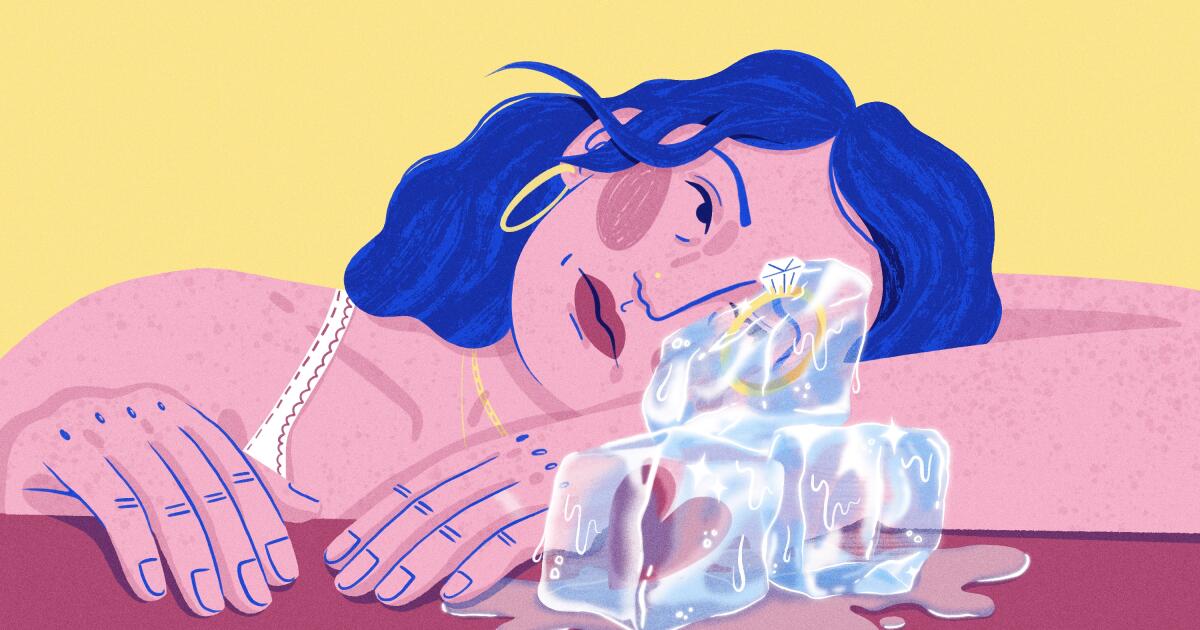
Months later, on a routine mental health walk near the Mar Vista park, I heard a podcast clip that stopped me in my tracks. “Life is a melting ice cube,” Mel Robbins said casually.
I physically froze on the sidewalk.
A melting ice cube.
Every time I passed that corner I thought about it, how this life was dripping away whether we were awake inside it or not.
That night I told Brian something had to change. I didn’t know what it meant. I just knew I could not continue living a version of life that felt like survival instead of participation.
As the friend he has always been, he listened.
Over the next year, we experimented. We tried reshaping our marriage into something more expansive. We tried an open relationship. We tried to rediscover the spark that had once felt effortless. What we discovered instead was that the truest thing between us had always been friendship.
So we separated.
Here’s the part people don’t expect to hear: It didn’t destroy us.
Somehow, without the pressure of being everything to each other, we became better. We are kinder and more honest. We parent as a team who spends holidays together and we will head to Coachella soon to complain about the bus lines amid total exhaustion yet again.
I turned 50 in the middle of the unraveling, sandwiched somewhere in the chaos of a second painful surgery and my mother’s death. To mark the end of a massive season in my life, I went to Spain for two months. I walked unfamiliar streets with music carrying me on its wings, ate dinner at 10 p.m. and remembered who I was when no one needed me to be anything in particular.
I came home a different person.
Now, Brian and I date other people. We talk on the phone most days about the kids, life and whatever absurd situation the world has thrown at us. We take it day by day, week by week, like adults who have finally accepted that certainty is an illusion.
Someone recently called our story “so L.A.”
I smiled.
Los Angeles has always been a city of reinvention, of artists and dreamers, and of people brave enough to admit when something needs to evolve. This city taught me how to chase a musician in a teal Ford Tempo. It also taught me how to build a family and how to let go without burning everything down.
Love does not always look the way we expect. Sometimes it transforms and sometimes it softens into something steadier and less cinematic.
Evolution is not failure; it is movement, and movement (even when it hurts) is proof you are still alive inside your life.
In Los Angeles of all places, I know how to begin again.
The author is a Los Angeles–based novelist and essayist. She writes about love, reinvention and modern relationships. Find her on Instagram: @marykathrynholmes.
L.A. Affairs chronicles the search for romantic love in all its glorious expressions in the L.A. area, and we want to hear your true story. We pay $400 for a published essay. Email LAAffairs@latimes.com. You can find submission guidelines here. You can find past columns here.
This story originally appeared on LA Times

