


Image source: The Motley Fool
Warren Buffett is a once-in-a-generation investor. But there’s another company that I’ve been looking at that has a lot in common with his investment vehicle Berkshire Hathaway (NYSE:BRK.B).
The stock is Danaher (NYSE:DHR). It operates in very different industries, but a closer look reveals some deep similarities.
From mortgages to microscopes
Berkshire Hathaway began life as a struggling New England textile mill. It was bought by Buffett, who turned it into one of the greatest conglomerates of all time.
Danaher’s journey is a similar one. It began life as a Massachusetts real estate investment trust (REIT), before being bought by Mitch and Steve Rales in 1984.
Since then, the company’s been on an acquisition journey. It started with manufacturing, then shifted into instruments and, most recently, life sciences and diagnostics.
The crossover however, goes beyond origin stories. In 1985, the Rales brothers made a bid for Scott Fetzer Company – and lost out… to Berkshire Hathaway.
Disciples of the same religion
Nowadays, both companies are serial acquirers with decentralised business models. Neither can be accused of wasting money on office sofas or unnecessary support staff.
There are however, some meaningful differences. Beyond the industries they operate in, they have contrasting acquisition styles.
Buffett’s approach was to buy businesses and leave them alone. Danaher implements its own principles – the Danaher Business System – and looks to improve its subsidiaries.
Interestingly, I think this might be the direction Berkshire’s heading in. Chief exec Greg Abel’s known for being much more involved than Buffett, so change might be on the way.
Acquisitions
Acquisitions are a key part of Danaher’s growth story. But they inevitably bring risks, whether that’s overpaying or challenges with integration.
Last year, the firm recorded its largest asset impairment in over 20 years. This was the result of a $9.6bn deal to buy Aldevron during the 2021 mRNA euphoria.
Including Buffett, even the best investors have deals that don’t work. What separates the great from the good is what they do next. Danaher’s been disciplined in divesting businesses that don’t perform as anticipated. So in some ways, the write-down is a sign of a strong culture, not just a mistake.
What do the numbers say?
Danaher shares are unusually cheap right now. At a price-to-book (P/B) ratio of 2.5, the stock’s close to a 10-year low.
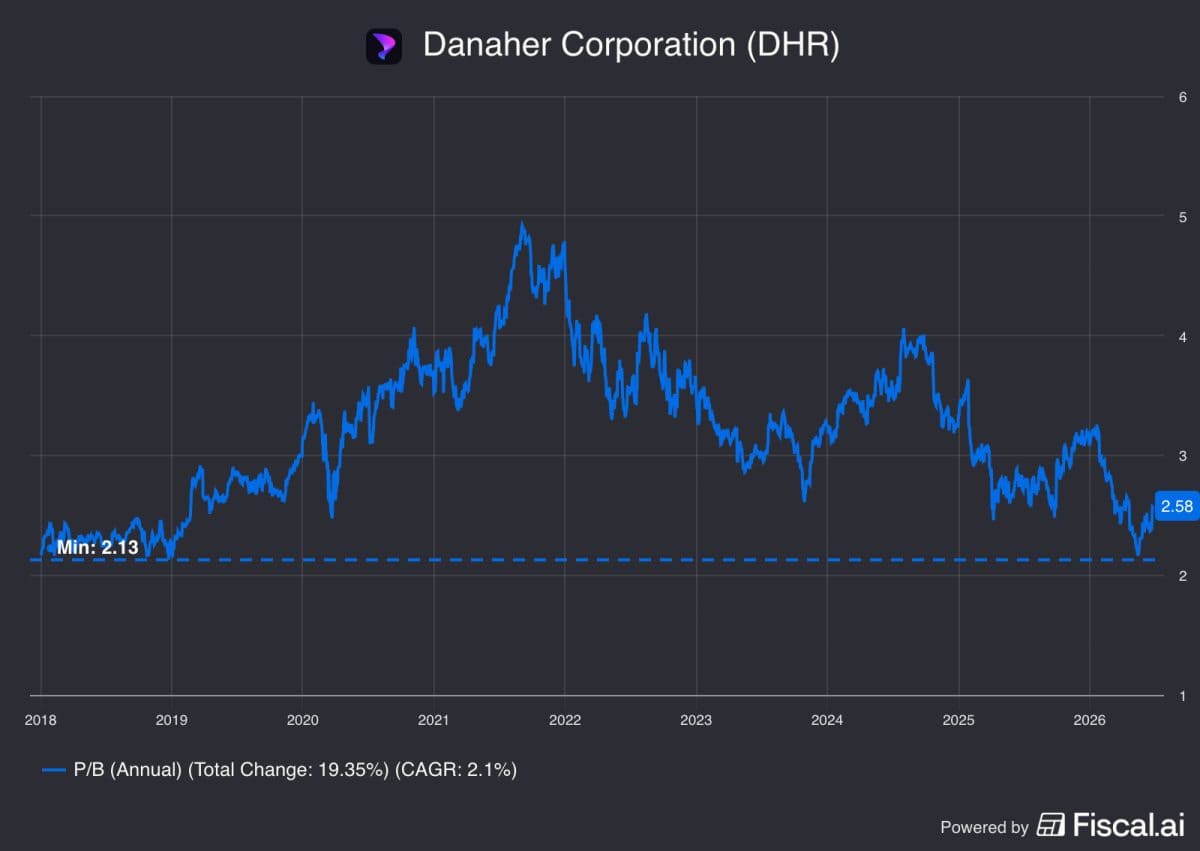
A big reason for that is the decline in demand for bioprocessing equipment after the end of the pandemic. But signs of a recovery are on the way.
As they say in sports, form is temporary but class is permanent. And Danaher’s long-term strengths – its culture and strategy – seem firmly intact to me.
This is why I’ve had the company on my watchlist for some time. But is it finally time for me to make a move and buy the stock?
The next Berkshire Hathaway?
Berkshire Hathaway’s the largest single investment I own. And I don’t expect that to change any time soon. I am however, always mindful of portfolio diversification. So the opportunity to add another company that shares a lot of Berkshire’s key strengths is an attractive one.
My price target for Danaher is around $163 – a 2.2 price-to-book multiple, in line with the 10-year lows. At that price, I’ll be looking to buy in July.
Should you invest £5,000 in Berkshire Hathaway right now?
When investing expert Mark Rogers and his team have a stock tip, it can pay to listen. After all, the flagship Twelfth Magpie Share Advisor newsletter he has run for nearly a decade has provided thousands of paying members with top stock recommendations from the UK and US markets.
And right now, Mark thinks there are 6 standout stocks that investors should consider buying. Want to see if Berkshire Hathaway made the list?
Stephen Wright owns shares in Berkshire Hathaway.
This story originally appeared on Motley Fool

