


Good morning. You’re reading the Up First newsletter. Subscribe here to get it delivered to your inbox, and listen to the Up First podcast for all the news you need to start your day.
Today’s top stories
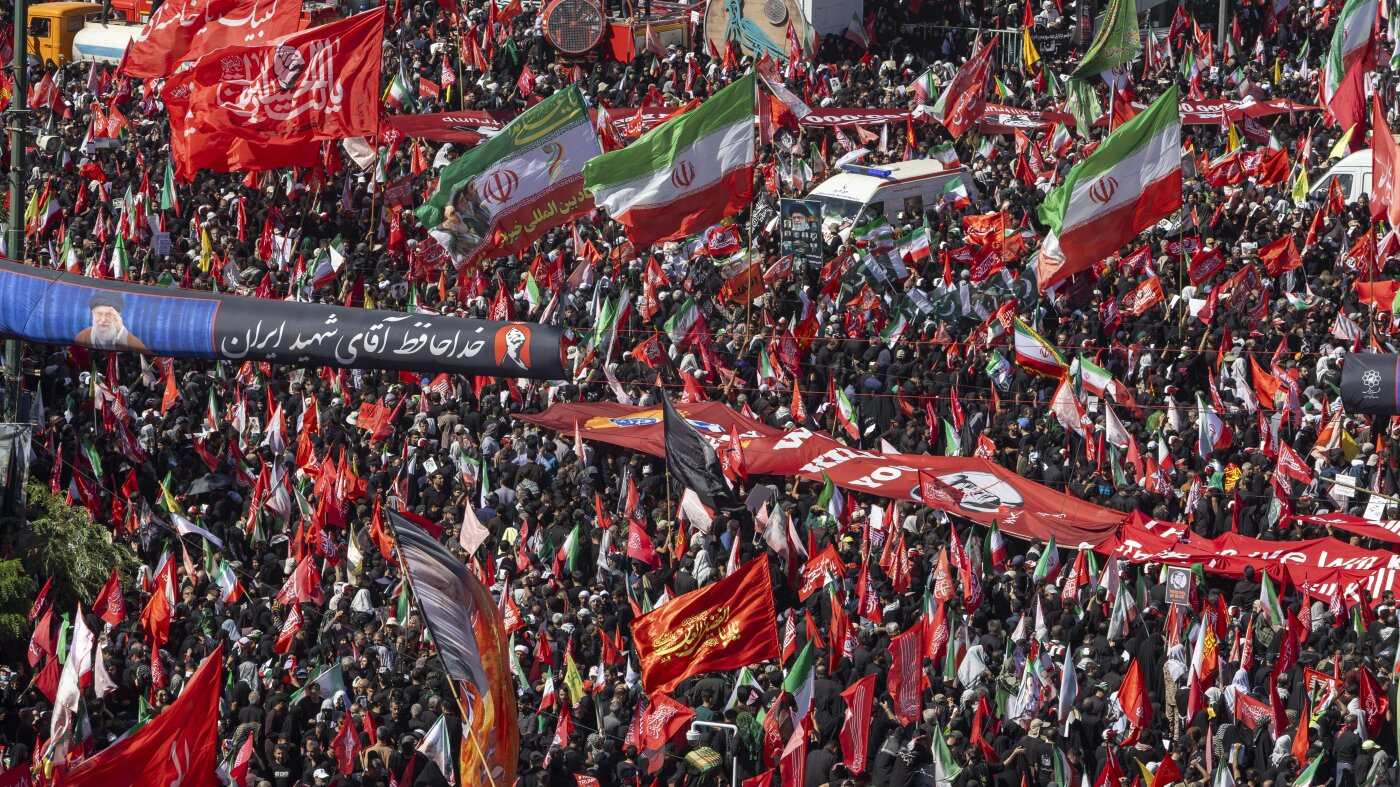
After two days of intense strikes, fighting between the U.S. and Iran appears to have paused. The U.S. says it hit 170 targets in Iran. Iran says it targeted U.S. military bases in the Gulf. The fighting coincided with a weeklong funeral for former Supreme Leader Ayatollah Ali Khamenei and four of his family members killed on the first day of the conflict.
Huge crowds line the streets of the holy city of Mashhad for the burial of Iran’s late supreme leader, Ayatollah Ali Khamenei on July 9, 2026 in Mashhad, Iran.
Majid Saeedi/Getty Images
hide caption
toggle caption
Majid Saeedi/Getty Images
- 🎧 Tensions remain high in the region, NPR’s Carrie Kahn, who is in Tel Aviv, tells Up First. In the recent series of attacks, Jordan intercepted incoming fire from Iran. Iran yesterday threatened the United Arab Emirates. Eyal Zamir, the Israeli armed forces chief of staff, said that the country is prepared if fighting resumes.
Thousands of Haitian and Syrian immigrants with Temporary Protected Status (TPS) are at risk of losing their ability to work in the U.S. due to a recent Supreme Court ruling. The court gave the Trump administration the green light to revoke TPS for more than 300,000 people. TPS allows immigrants to legally reside in the United States when conditions in their countries make it unsafe to return.
- 🎧 Many immigrants’ work permits are tied to their TPS and their driver’s licenses are linked to those permits, says reporter Kathryn Mobley of NPR network station WYSO. Reporting from Springfield, Ohio, home to a large Haitian community, Mobley says some immigrants are staying home, while others are reaching out for help. Local nonprofits are encouraging people to apply for asylum, though the process is lengthy and offers no guarantee of protection from deportation. Some Springfield residents say they have already lost manufacturing jobs following the ruling.
President Trump dismissed the remaining members of the bipartisan U.S. Election Assistance Commission, drawing criticism from Democrats and voting rights advocates. A White House official said that Trump can take this action due to the Slaughter decision. Last month, in the Slaughter Case, the U.S. Supreme Court ruled that a president has greater flexibility in removing members of independent federal agencies.
The U.S. brokered a ceasefire between Israel and Hamas last year, but nine months later, that agreement has stalled. The deal called for an Israeli withdrawal from Gaza, new governance in Gaza and Hamas’s disarmament. Instead, Israeli forces have expanded their control from about half of Gaza at the start of the ceasefire to nearly 70%, according to Israeli officials and NPR’s analysis. Israeli Prime Minister Benjamin Netanyahu says that the military is tightening its grip to surround Hamas. For Palestinians, that has meant more displacement, shrinking access to aid and another cycle of grief. More than 1,000 Palestinians have been killed since the ceasefire took effect, according to Gaza’s Health Ministry. In a new report, NPR’s Anas Baba and Aya Batrawy document what daily life looks like for families trapped between expanding military zones, with shelling at night, gunfire by day and nowhere safe to go.
Deep dive

Andy Burnham smiles during a campaign visit to Ashton-in-Makerfield before a by-election, in Manchester, England, on June 9. Burnham is expected to succeed Keir Starmer as the U.K.’s Labour Party leader and prime minister.
Jon Super/AP
hide caption
toggle caption
Jon Super/AP
Nominations opened yesterday in the Labour Party election to succeed Keir Starmer as the U.K.’s next prime minister. Former Greater Manchester Mayor Andy Burnham, 56, is widely expected to be the next person to take on the role. Analysts say that Burnham’s upbringing and experience as mayor have influenced his politics and could help Labour win back working-class voters who have shifted toward right-wing parties in recent years. Here are some moments that have defined his career so far:
- ➡️ In 2009, as secretary of state for culture, media, and sports, Burnham launched an inquiry into the 1989 Hillsborough disaster after victims’ families challenged the official account. The inquiry later found that police failures, not the victims, who were labeled as hooligans, caused the disaster.
- ➡️ Burnham entered Parliament at age 31, serving 16 years and ran twice for Labour leader before being elected as mayor of Greater Manchester in 2017. There he gained a national reputation.
- ➡️ During the COVID pandemic in 2020, Burnham gained national attention after clashing with the government over new lockdown restrictions during a live television news conference.
Weekend picks

In Alice and Steve, Jemaine Clement and Nicola Walker play long-time friends who turn on each other after he gets involved with her 26-year-old daughter.
Lara Cornell/Disney+
hide caption
toggle caption
Lara Cornell/Disney+
Check out what NPR is watching, reading and listening to this weekend:
🍿 Movies: Moana returns in Disney’s new live-action remake, featuring Dwayne Johnson as Maui and Catherine Laga’aia as Moana. The film includes a new song by Lin-Manuel Miranda.
📺 TV: Hulu’s Alice and Steve is a six-part British comedy about two longtime best friends in their 50s who turn against each other when Steve starts a relationship with Alice’s 26-year-old daughter.
📚 Books: Ten new book releases for July include titles by Colson Whitehead, Sigrid Nuñez, Daniel Mason and Nathaniel Rich. Plus, award-winning journalists deliver some nonfiction reads.
🎵 Music: NPR Music’s New Music Friday podcast is highlighting their favorite albums released today, featuring artists such as Jack White, Baby Rose and Suki Waterhouse.
🎭 Theater: The Black Opera Project is commissioning three original operas that celebrate and showcase the Black American experience. The first production, Lalovavi, will make its world debut this week in Cincinnati. (via WVXU)
3 things to know before you go

Former U.S. Olympian David Hearn (left) walks with his attorney Norman Eisen to speak to reporters and protesters gathered after his arraignment at the Superior Court of the District of Columbia in Washington, D.C. on Thursday.
Finn Gomez/Getty Images
hide caption
toggle caption
Finn Gomez/Getty Images
- Former U.S. Olympic canoeist David Hearn pleaded not guilty on Thursday to a charge of destruction of property of the Lincoln Memorial Reflecting Pool in D.C. Superior Court.
- Mountain bike enthusiasts are working on making The Velomont, a multi-use trail that will span the length of Vermont, user-friendly for everyone.
- The Trump administration is proposing changes to Biden-era environmental rules aimed at reducing pollution from heavy-duty vehicles, including buses and large trucks.
This newsletter was edited by Majd Al-Waheidi.
This story originally appeared on NPR

