


Good morning. You’re reading the Up First newsletter. Subscribe here to get it delivered to your inbox, and listen to the Up First podcast for all the news you need to start your day.
Today’s top stories
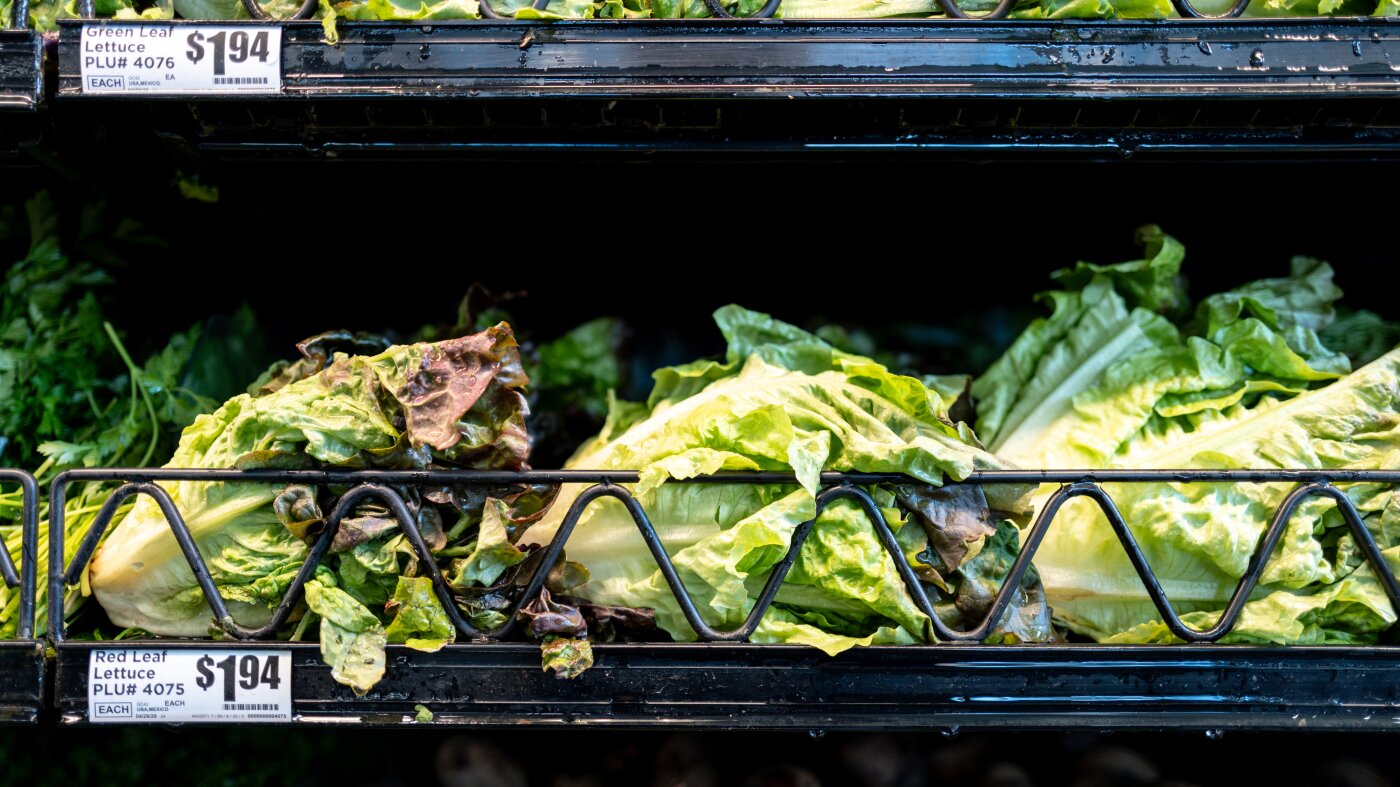
Inflation eased slightly last month. Consumer prices in July were 3.4% higher than they were a year ago, according to a new report from the Labor Department. It’s a smaller annual increase than in May or June. Rent and airfare prices rose while gasoline and grocery prices fell. In particular, lettuce prices plunged 16% after a deadly Cyclospora illness outbreak led to a recall of iceberg lettuce from Mexico. Retailers responded with deep discounts on various lettuce products in an attempt to win back anxious shoppers.
Falling grocery prices helped to keep inflation in check last month. Lettuce prices dropped sharply in July after an outbreak of food-borne illness was traced to the leafy greens.
Justin Sullivan/Getty Images North America
hide caption
toggle caption
Justin Sullivan/Getty Images North America
- 🎧 Produce prices often fluctuate depending on growing conditions and other factors, and lettuce prices are expected to rebound once the food scare passes, NPR’s Scott Horsley tells Up First. The lower prices contributed to about 0.1% decline in grocery costs last month, but overall grocery prices are still up about 2.7% over the past year. This week’s cooler inflation report may lead the Federal Reserve to monitor whether inflation will continue to moderate rather than raise interest rates, Horsley says.
Rescue teams in Colombia are urgently searching for survivors of Monday’s 7.4 magnitude earthquake, which killed more than 260 people. Nearly 500 people remain missing, and the chances of finding survivors decrease each day.
- 🎧 It’s still possible for search and rescue teams to find survivors amid the rubble at this point in their efforts, says reporter John Otis. Otis is in Cali, one of the hardest-hit areas by the quake. It’s been three days since the deadly quake, and he spoke with rescue workers from other disasters who have successfully pulled people from collapsed buildings after six days. The warm weather in Cali can help trapped individuals survive, he says. Even so, Colombian officials know that they are racing against the clock. Cali’s mayor has called for residents to avoid the disaster zone to give rescue teams room to work and the silence their listening devices need to detect signs of life.
Immigration and Customs Enforcement plans to equip its officers with high-tech gloves that deliver electric shocks to people they are trying to detain, according to plans posted by the Department of Homeland Security this week. The devices, known as the G.L.O.V.E., or Generated Low Output Voltage Emitter, could cost DHS as much as $20 million. It delivers an electric shock upon contact with the skin when the wrist button is activated. Demonstrations indicate that the gloves inflict pain. Naureen Shah, ACLU’s director of policy and government affairs for immigration, raised concerns about whether ICE officers are adequately trained to handle such devices, especially with the agency’s effort to rapidly hire more than 12,000 officers within a year.
- ➡️ The Trump administration also recently awarded a no-bid $158 million contract to the controversial anti-human trafficking group Our Rescue to provide legal services for unaccompanied migrant children, according to a notice from the U.S. Department of Health and Human Services. It’s unclear if the organization employs immigration lawyers, though its website says it offers “legal support to help prosecute offenders.”
Karoline Leavitt is exiting her role as White House press secretary at the end of the month to spend more time with family, President Trump announced yesterday. She will continue to serve as an outside adviser. Leavitt, 28, was the youngest person to take on the role of White House press secretary. She recently returned from parental leave following the birth of her second child in May. Leavitt’s departure comes as the president and his party face challenges with voters over his handling of the economy and rising prices amid the Iran war.
Watch this

Congressman Ro Khanna sits for an interview with NPR’s Newsmakers.
Michael Zamora/NPR
hide caption
toggle caption
Michael Zamora/NPR
Go face-to-face with the person of the moment. NPR’s Newsmakers video podcast brings the biggest names in politics, business, sports, arts, and culture out of the headlines and into the interview chair to discuss the mark they’re making on the world. Follow the Newsmakers podcast or subscribe to NPR’s YouTube channel to get new episodes as soon as they’re available.
Rep. Ro Khanna, D-Calif., is seriously considering a presidential run in 2028. He described the race as a “breaking point in America.” While he may not have the same name recognition as other Democratic contenders like former Vice President Kamala Harris and California Gov. Gavin Newsom, Khanna has gradually raised his profile through actions on issues like the Epstein files and a wealth tax. His potential candidacy comes at a critical moment for the Democratic Party, as center- and left-wing candidates grapple with ideological differences within the party. In an interview with Morning Edition’s Steve Inskeep, Khanna discusses why Democrats should nominate a progressive candidate and shouldn’t be scared of being labeled a communist.
Watch or listen to the interview or read the article about their discussion.
Picture show

The moon completely covers the sun during a total solar eclipse as seen from the Javalambre Astrophysical Observatory in Arcos de las Salinas, near Teruel, Spain, August 12, 2026. REUTERS/Christian Hartmann
Christian Hartmann/REUTERS/REUTERS
hide caption
toggle caption
Christian Hartmann/REUTERS/REUTERS
Millions of people across Europe flocked outside yesterday to catch a breathtaking sunset paired with a solar eclipse. The eclipse’s path of totality dazzled viewers as it swept through portions of Greenland, Iceland and Spain. The celestial show brought people together to witness nature’s beauty, and luckily, you don’t have to miss out on the spectacle. NPR has gathered the best photos from the solar eclipse.
3 things to know before you go

Genesis worker
Handout photo from The Last Mile
hide caption
toggle caption
Handout photo from The Last Mile
- In 2007, Dr. Raj Panjabi used the $6,000 he received from guests at his wedding to help co-found Last Mile Health, an initiative that provides healthcare to people living in remote areas of Liberia. Now, the organization has won a $3 million prize for the Conrad N. Hilton Humanitarian Prize, the world’s largest humanitarian award to a nonprofit group.
- In this week’s installment of Far-Flung Postcards, NPR’s Fatima Al-Kassab sends greetings from her trip to Lençóis Maranhenses National Park in Brazil, where she experienced a sight like no other: pristine white sand dunes.
- Zhu Rongji, former premier of China, has died of an illness at 97. He was renowned for his economic reforms in the 1990s, which aimed to shift China towards a more global, market-oriented financial system.
This newsletter was edited by Suzanne Nuyen.
This story originally appeared on NPR

