


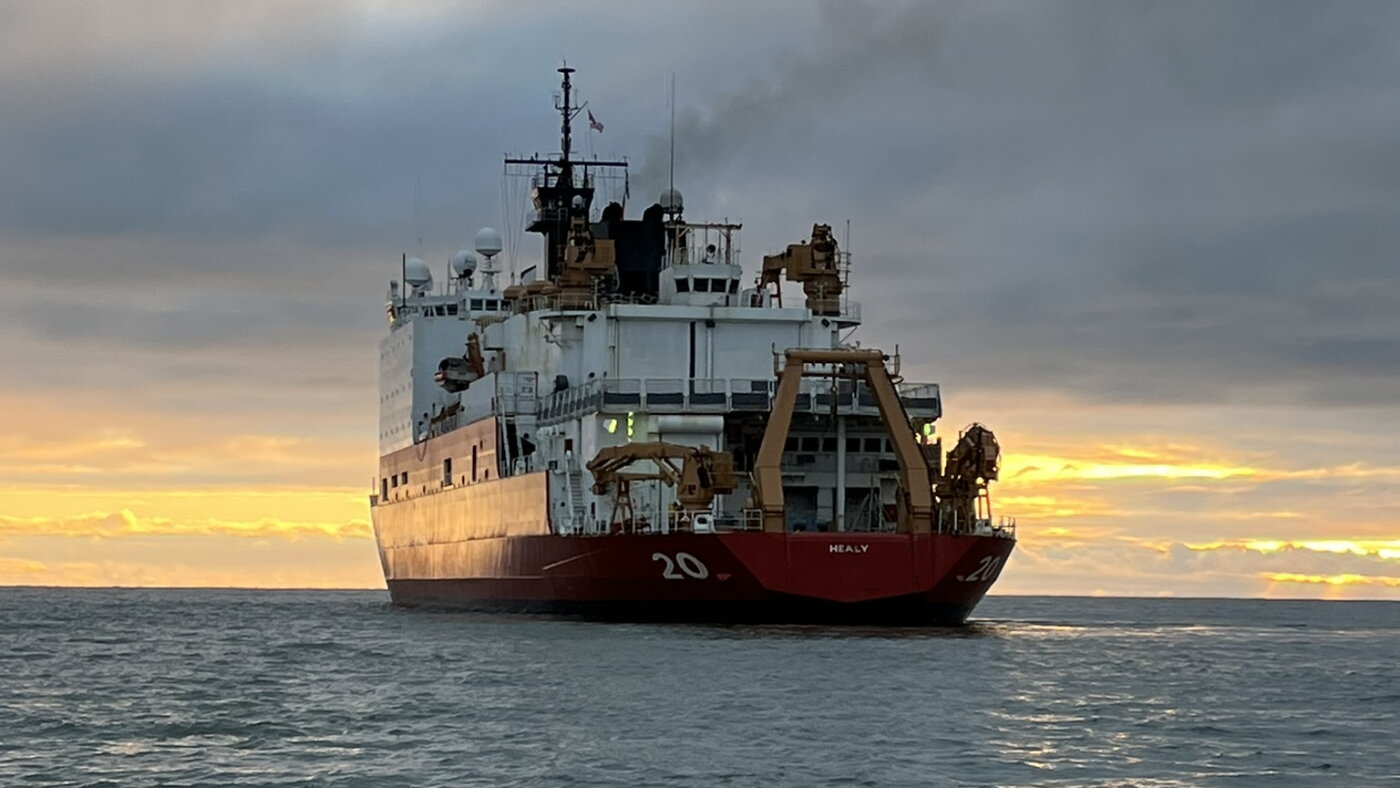
Rana Foroohar reports from the USS Healy (pictured above) in Sea Change.
Crown
hide caption
Crown
As polar ice melts in the Arctic, shipping lanes are opening up, making the region a new zone of superpower competition. Writer Rana Foroohar got an up-close look aboard the USS Healy, a Coast Guard icebreaker. She says that traversing the North Pole by ship — once a “largely conceptual” route — is now becoming a “real possibility” for two or three weeks a year.
“If you are taking one of these Arctic routes, you can save as much as 40% of the time it would take you to go from the Atlantic to the Pacific, and depending on the price of oil, that’s a heck of a lot of money,” she says. “China and Russia together are clearly trying to make the top of the world an area over which they have the most interest.”
In her new book, Sea Change: America’s New Great Game in the Arctic Circle, Foroohar makes the case that the “High North” may become as critical to world shipping as the Suez or Panama canals. But she also notes that beneath the Arctic waters are large deposits of oil, natural gas and rare earth minerals, as well as underwater cables, which carry a large part of the world’s intercontinental information flow.
“Undersea cables have become a real touchstone in wars and conflicts around the world,” she says. “So you are seeing a race to lay down new cable, and who can get there fastest, and then who can potentially commercialize and even militarize areas where those cables have been laid.”

Foroohar describes the Arctic Circle as one of the few areas of the globe where countries and companies can still “hunt” for territory and “duke it out potentially with rivals.” And she predicts more conflict in the coming decades as the region continues to warm.
“There is going to be more commerce done through this area. There is gonna be greater military interest in the area, and all of that matters because it really is in America’s backyard,” she says. “I just think that everything in the High North is going to be higher priority for America in the future.”
Interview highlights

On increased international interest in the Arctic
China and Russia together are clearly trying to make the top of the world an area over which they have the most interest. And that’s very interesting because it starts to dovetail with something that’s happening in U.S. policy, which is more of a sense of we need to protect what’s close to home. And so if you look at things that way, then you have the U.S. and China coming into much closer geographic conflict. Whether or not it would ever be a hot conflict, I hope not, but certainly competition in that area.
On the debate over rights to resources in international waters
There’s some debate over that. There is something called the United Nations Convention on the Law of the Sea, which governs maritime activities, including those in the Arctic. It has … rules about where you can mine, how you can mine, who gets what. But the U.S. never signed on to that convention. Various presidents from Clinton to Bush [to] Obama did support it, but key Republican senators opposed it, basically on ideological grounds, the notion that no international body should have sovereign right over what the U.S. does. … And so it makes it much more of a free-for-all as to who gets what in the Arctic. And then you throw in the fact that Russians and Chinese don’t always play by the U.N. rules either.
On how Arctic power struggles are part of a larger global trend
It’s kind of part and parcel of a bigger collapse of international rule and a pendulum shift from globalization to something that is much more about regionalization and spheres of power … and influence, which is exactly what’s happening in the Arctic, which to me is so interesting, not only just for itself, but because it’s a mirror into what’s happening in other parts of the world. Some of the same conflicts over territory and mineral rights and ports that you see in the Arctic now are also happening in Latin America or West Africa or parts of the South China Sea. So it’s a bit of a bellwether for geostrategy more broadly. …

And then there’s this — kind of largely theoretical up until now, but becoming more realistic — trans-polar route where right now it might be a couple of weeks that you could consider going right across the pole, but if global warming continues the way it seems to be going in the next decade or two, that could turn into a month, two months, three months. And so who’s going to control that area? This is what’s up for stake now.
On what it’s like to be onboard an Arctic icebreaker
You begin to feel and hear the ice as it is being broken by the ship. And I remember being down on the mess hall, which is a couple floors down from the waterline, and I was sitting eating my lunch and you begin to hear this shhhhhh kind of sound, like something traveling through sound, and then it becomes squeaky, like fingers on chalkboard, and you can kind of feel vibration and it gets louder and louder and you’re like, “Wow, there are only 12 inches of reinforced steel between me and death.” That’s very sobering.
On the region’s changing climate
I actually touched base with some of those scientists several months after we had come off of the Healy, and they were starting to go through that data and look at it. And there is some real scientific data showing that these areas are changing. They are warming. They are becoming different than they have been in the past. And that affects all kinds of things. It affects the kind of fish that could live there. It affects wind and wave patterns that you might get, which could in turn affect things like the Canadian boreal forest fires that I experience in my home in Brooklyn, New York. You would think that has nothing to do with the Arctic, but it actually has everything to do with what’s happening in the High North.
Therese Madden and Susan Nyakundi produced and edited this interview for broadcast. Bridget Bentz, Molly Seavy-Nesper and Beth Novey adapted it for the web.

This story originally appeared on NPR

