


Jensen Huang has begun discussing ways to return to the leadership of Nvidia, and his allies have formed a “war room” to make it happen, Fortune’s Jason Ma reports.
A petition to reinstate him as CEO of the chipmaker had 175,000 signatures at the time of writing, including Tesla and SpaceX chief Elon Musk, Epic Games chief executive Tim Sweeney, Atoms CEO (and Uber cofounder) Travis Kalanick, and thousands of Nvidia staff.
It is slowly dawning on the AI ecosystem that an Nvidia without Huang may be less enthusiastic about doling out money to back startups and suppliers. If interim CEO Colette Kress chose to scale back Nvidia’s investing it could remove more than $50 billion from the market, according to an estimate by UBS’s Timothy Arcuri.
One example: Neocloud Nscale is hoping Nvidia and others will financially support a $45 billion data center it needs for Anthropic in West Virginia, according to the WSJ.
They face an uphill battle. On Sunday, Treasury Secretary Scott Bessent questioned whether Nvidia obeyed the law prohibiting it from selling chips to China, while under Huang’s leadership.
“Was it a low-level fail? Was it in the middle, or was it up in the C-suite? And who knew? These shell companies were obvious, they were being investigated, and did Nvidia use them as a workaround to sell chips to the Chinese?” he told Fox News. “Were they pressing these seemingly illicit sales to goose their revenues and their earnings?”
“If this were a bank and they hadn’t complied like this, the OCC would be in there right now, and a lot of the executives would be removed,” Bessent said, referring to the Office of the Comptroller of the Currency. “I think we need answers in the next 10 days from the board and from the outside counsel.”
Bessent also suggested that Nvidia may have been less than honest in its accounting practices. He mentioned a surge in sales from companies registered in Singapore that happened while its sales to China fell. Nvidia stopped reporting its Singapore sales last year after it became obvious that an unusually large number of sales were going through the small city-state.
And even if Huang were to return, it would not stop multiple investigations into the company’s relationships with China-linked entities. Nvidia contacted Taiwanese officials after one of its employees there was charged in July 2026 by prosecutors with aiding smugglers in getting AI chips into China, Bloomberg reported.
That followed a call in 2025 by General Counsel Tim Teter to the Commerce Department bureau that enforces export bans to China to ask whether the U.S. had a hand in the detention of Alice Huang, the former Megaspeed executive who reportedly formed a romantic relationship with Jensen Huang, in Singapore, Bloomberg said.
Commerce Secretary Howard Lutnick will also likely find himself answering questions in front of Congress. On Friday, Bessent accused him of dragging his feet in enforcing the export bans. And Lutnick’s sons, who succeeded Lutnick as the head of Cantor Fitzgerald, arranged billions in financing for companies that were business partners of Nvidia, per CNBC.
MORE FROM FORTUNE
Kai-Fu Lee: Why America’s AI Strategy Backfired | The Extended Cut
Everyone worries Gen Z trusts AI too much. Executives trust it over their own judgment twice as often – Dr. Colleen Batchelder
The resignation of Jensen Huang marks the end of an era. And not the one you think – Gill Whitehead and Vicki Nash
‘I might live forever’: Inside billionaire Larry Connor’s no-email, 5-minute-block longevity routine – Emma Witman
‘A complete reversal’: China once feared becoming roadkill for Western automakers, but a quarter-century after joining the WTO, the tables have turned – Mia Osmonbekov
After Florida voted to slash property taxes, towns looking to fill budget holes may end up relying on the state: ‘The bailout comes with a leash’ – Marco Quiroz-Gutierrez
What a Tiny Chorus of the ‘Bring Back Jensen’ Tech Bros Gets Wrong – Jeffrey Sonnenfeld, Stephen Henriques, Steven Tian, and Bill George
WAITING FOR AI PRODUCTIVITY TO SHOW UP
The economic boost from AI might—might!—be starting to show up in the U.K.
British people were shocked—shocked!—to discover that this year’s GDP growth is almost as strong as the U.S., and well ahead of the other G7 countries. Since Brexit in 2016, the U.K.’s economy has been hobbled by trade barriers with its nearest, largest, and richest trading partner. Brits had gotten used to the idea that their economy was in permanent low-growth mode.
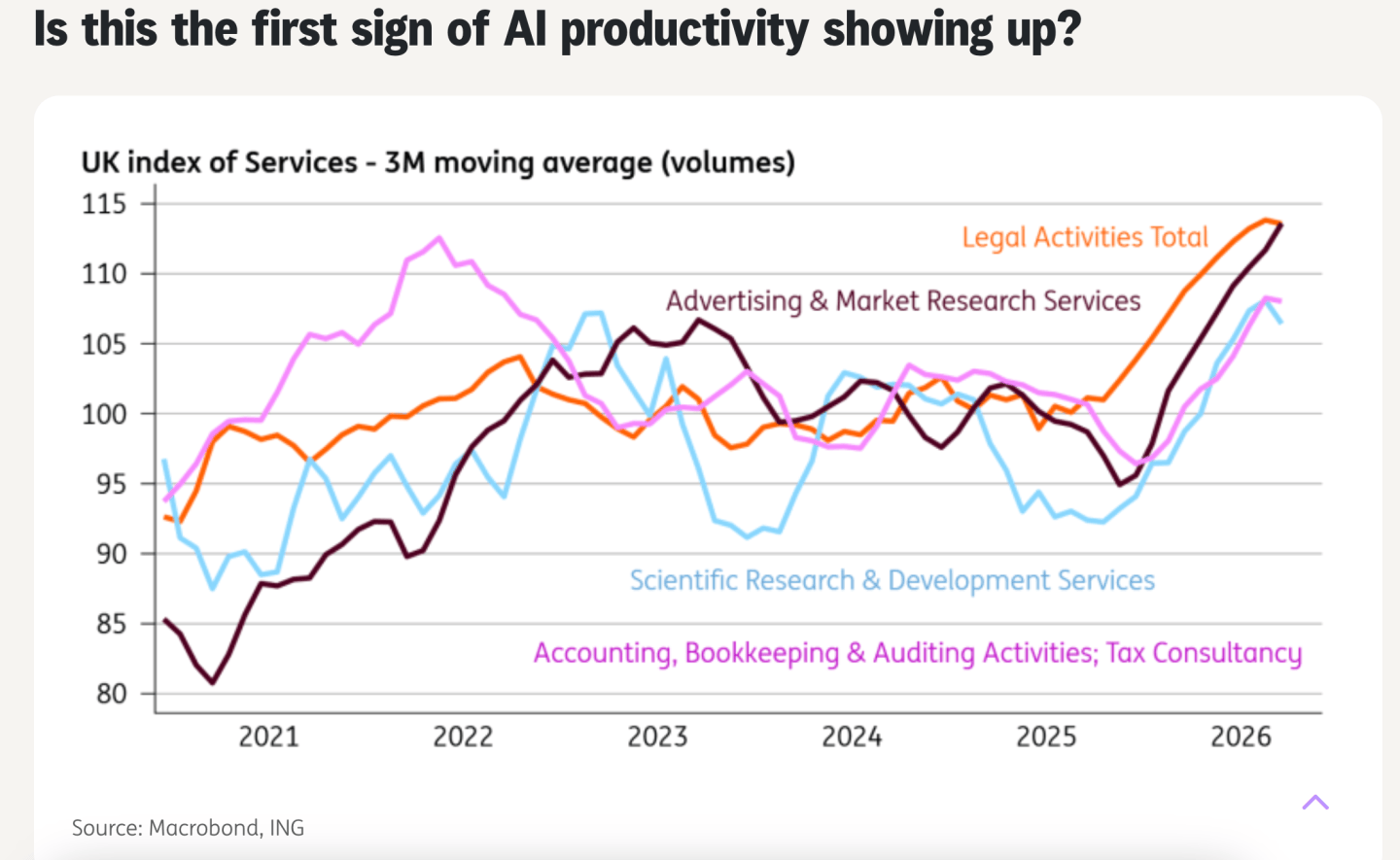
“The global view of the U.K. invariably seems much more bearish than the reality,” Deutsche’s Jim Reid said in an email. And yet, look at this chart:
Is any of this improved activity coming from AI? ING’s James Smith thinks so: “U.K. output across parts of professional services, from law to accountancy, has shot up remarkably quickly this year and in apparent unison. Is that AI productivity coming through? I suspect that is some, though not all, of what’s going on.”
THE MARKETS
A mystery whale won $200 million shorting Nvidia stock
Tech stocks dragged down U.S. blue-chip futures before the open in New York. Nasdaq 100 futures were down 1%. Nvidia stock fell another 2.3% in overnight trading. It’s down 24% over the last month. The company reports Q3 earnings tomorrow—which may change investors’ minds.
U.S. markets seem to be taking their cue from Asian markets, which largely fell today. Europe, less swayed by tech stocks, bucked the trend and moved up.
Not every trader is having a bad day. On October 12, a mystery whale placed an $8 million short bet against Nvidia, and as the stock declined, that position has netted nearly $200 million, the FT reported.
- S&P 500 futures were down 0.3% this morning. The index fell 0.4% in its last session.
- In Europe, the Stoxx 600 rose 0.12% in early trading, and the U.K.’s FTSE 100 rose by 0.32% before lunch.
- Asia: South Korea’s KOSPI was down 3.59%. Japan’s Nikkei 225 was down 2.42%. India’s Nifty 50 was up 0.58%. China’s CSI 300 was down 0.91%.
- Brent crude was $95 per barrel.
- Bitcoin declined to $64,487.
Legacy industry lost its dominance of the S&P 500 in 2011
This chart shows the largest company in the S&P 500 over the last 30 years and its market cap, from Bespoke Investment Group. The inflection point came around 2011, when legacy manufacturers like General Electric and Exxon gave way to tech companies like Microsoft, Apple, and Nvidia.
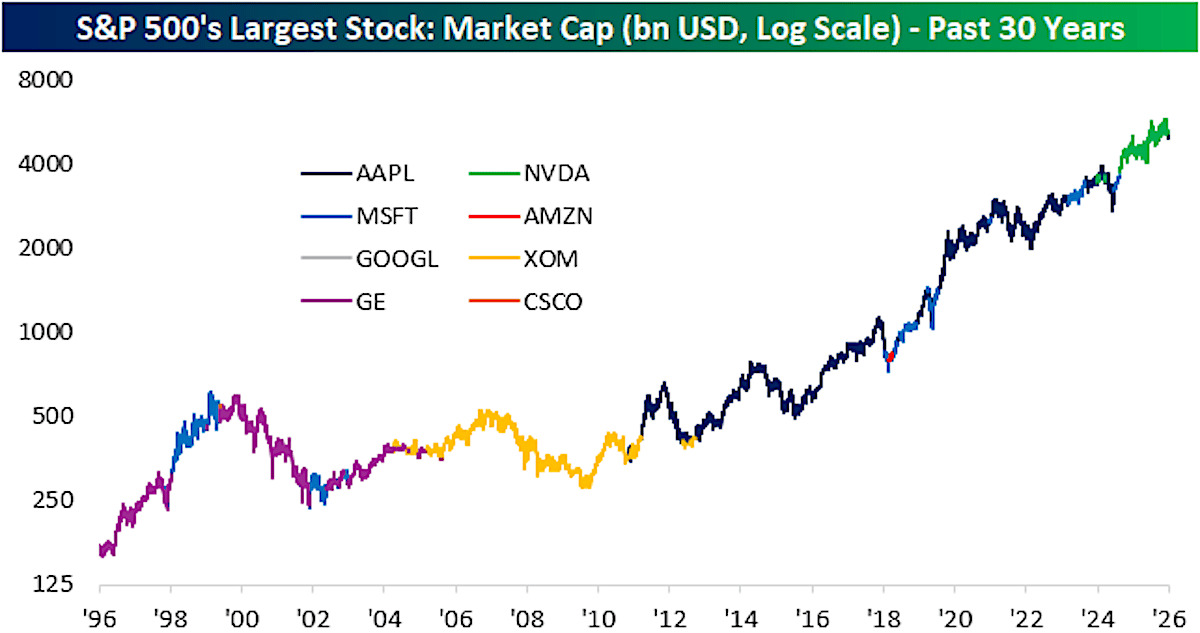
CHART OF THE DAY
Who gets hurt most if there’s a pullback in AI?
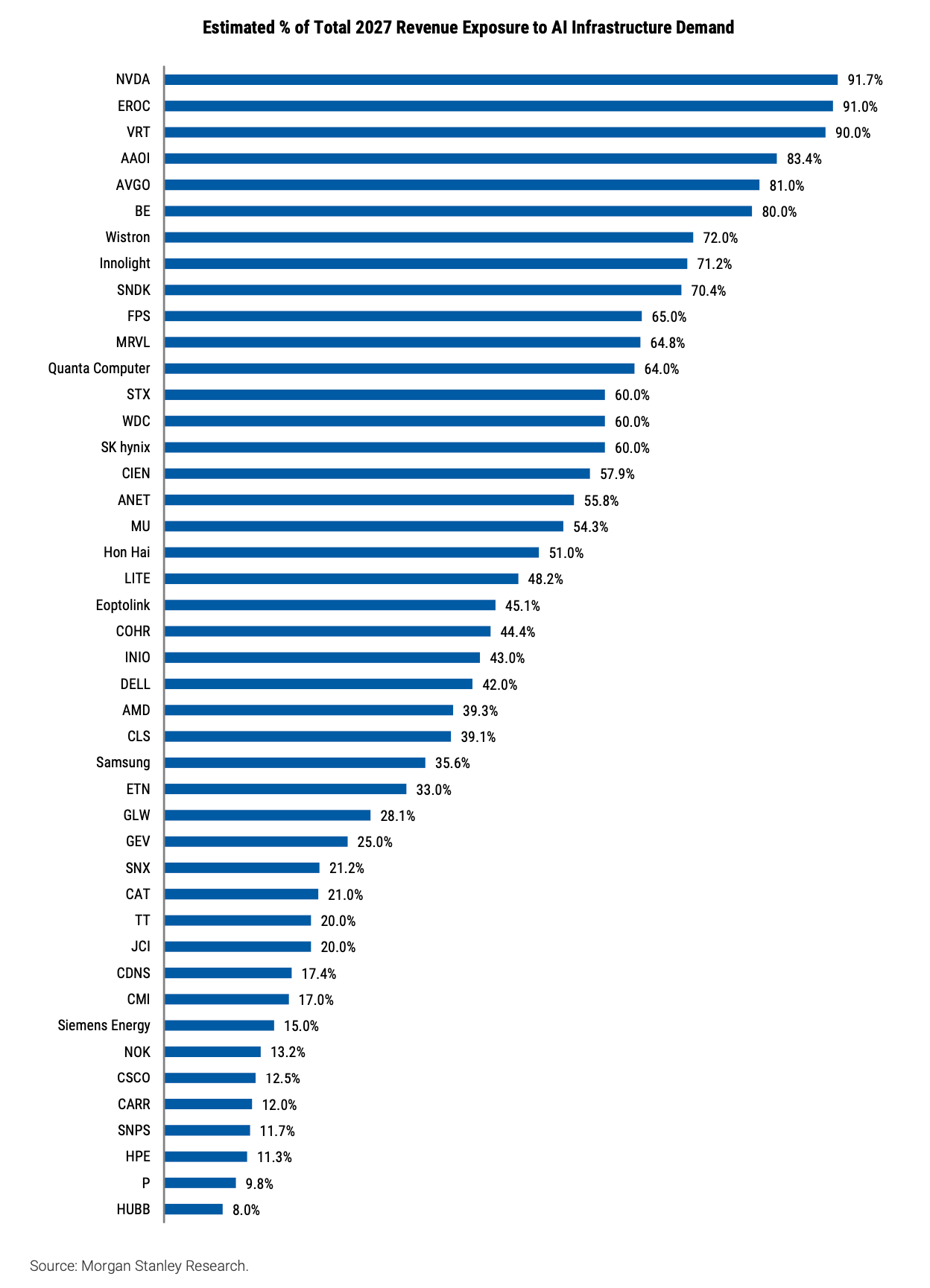
Nicholas Lentini and his colleagues at Morgan Stanley put together this lengthy list of companies ranked by the exposure of their revenues to AI spending. These are the companies whose stock, in theory, would fall the most in the event of a reduction of investment in chips, data centers, and second-order industries like energy and infrastructure construction. Nvidia, naturally, is at the top, with 97% of its revenues dependent on AI. Near the bottom, only 11% of HPE’s sales come from AI.
THE FRONT PAGES TODAY
Yalta 2.0? Trump, Xi and Putin lead Asia’s week of high-stakes diplomacy – FT
Anthropic’s IPO lands as the embattled AI trade looks for a much-needed bright spot – CNBC
Vance is waiting to reveal his 2028 plan – Axios
Sean Duffy Made the Call to Shut Down Flights. Now He’s Making His Case. – WSJ
Ukraine Hits Crimean Bridge in Record Drone Strike on Russia – Bloomberg
A Year On, Canada’s Mark Carney Returns to China a Political Star – NYT
ONE MORE THING
A 19-year-old won an election in Maricopa County, Arizona, and now he’s the boss of 600 staff and a $65 million budget
Sebastian Matta, a sophomore at Arizona State University, is in many ways like other 19-year-olds. He enjoys following Argentinian soccer, playing Animal Crossing, and watching movies. But he’s also about to become the boss of more than 600 employees and oversee a $65 million budget, Fortune’s Preston Fore reports.
In last week’s elections, Matta rode a wave of Democratic victories to win the position of clerk of Maricopa County Superior Court, the seat of the greater Phoenix area. The job puts him at the intersection of local government and the judicial system in Arizona’s largest county—and the fourth-largest county in the country.
Matta knows his age may raise employees’ eyebrows. He told the NYT that “I demand respect like anybody else’s boss.” Even so, “I mean, I understand that it’s very scary to have a 19-year-old be your boss, but I’m not just any 19-year-old.”
- ➡️ Would you like to sponsor this newsletter? Contact advertising@fortune.com for details.
- ➡️ If you would like to receive this information in your inbox every morning before the markets open in New York, sign up here.
This story originally appeared on Fortune

