


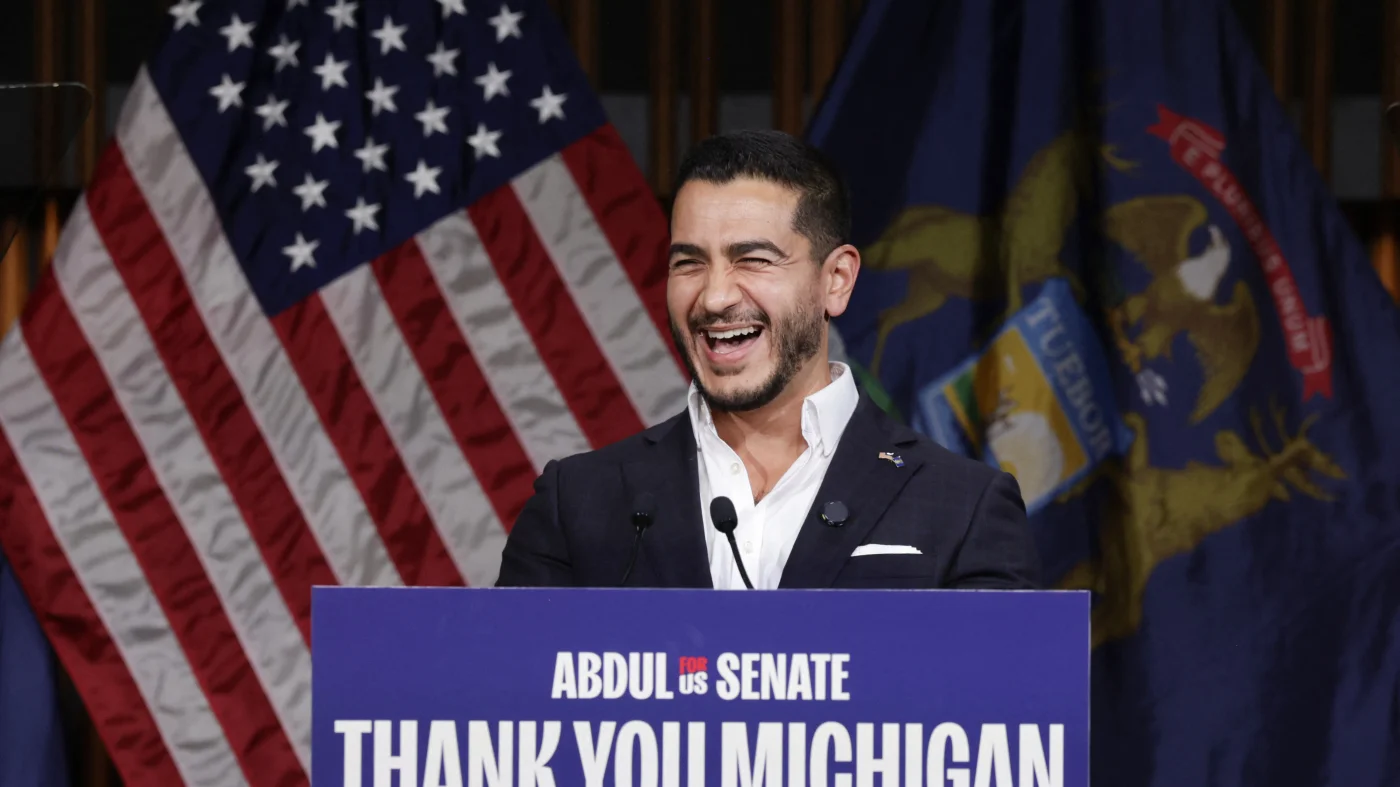
Democratic US Senate candidate Abdul El-Sayed smiles onstage after declaring victory in Michigan’s US Senate race during an election night party on November 4, 2026. El-Sayed used the slogan, “Money out of politics, money in your pocket, Medicare for all” during his campaign.
Jeff Kowalsky/AFP via Getty Images
hide caption
Jeff Kowalsky/AFP via Getty Images
History doesn’t repeat itself, but it does rhyme, as the saying goes. That’s certainly true of the coming fight over “Medicare for All.”
The midterm elections resulted in victories for several candidates who made universal, government-funded health coverage, or some variation thereof, a central pillar of their campaigns, including new Democratic U.S. senators-elect from Michigan, Maine, Iowa, and Texas. They — and many of their soon-to-be colleagues — say they will push the new Democratic majorities in the House and Senate to finally solve the healthcare affordability problem, which so many voters complained about on the campaign trail.
But while virtually every elected official supports making healthcare available and affordable for all Americans, the details of getting there cleaved the Democratic Party the last several times healthcare topped the national agenda. The Clinton health reform effort in 1993-94 fractured over differences within the Democratic majority, as those who wanted a dramatic overhaul like Medicare for All argued with those who saw incremental changes — such as a public option — as more politically feasible. The Affordable Care Act, which despite incendiary politics made incremental reforms, barely squeaked into law in 2010 after similar disputes..


And, so far, it appears history is about to write another stanza of this epic poem.
“It’s cosplay”
So why is something so popular in the abstract so hard to accomplish?
For one thing, most Americans have no real idea what the phrase “Medicare for All” actually means. “It’s cosplay,” said Nicholas Bagley, a law professor at the University of Michigan who has written about health policy for years. “When you say ‘Medicare for All,’ people think ‘Healthcare — good. We should have more of it.'”
Mollyann Brodie — who oversees KFF’s public opinion and survey research program as executive vice president and chief operating officer of the health information nonprofit — points out that in the long history of Medicare for All, support rises and falls dramatically depending on how the policy is described to voters.
“I can move it up to three-quarters [percent approval] if I talk about it being a guaranteed right to healthcare or eliminating insurance premiums and reducing out-of-pocket costs,” she said of survey respondents’ support, on a recent episode of the What the Health? From KFF Health News podcast. “I can plummet that support down to the 20s if I talk about it requiring people to pay more in taxes or threatening the current Medicare program.”
Medicare faces headwinds
A second problem Democrats face is that the Medicare program itself, which covers adults 65 and older and some people with disabilities, is on less-than-firm financial footing. As of this year, the trust fund that underpins the hospital insurance part of the program is projected to become insolvent in 2033.
Costs are rising for Medicare beneficiaries as well. The program requires significant out-of-pocket spending on premiums, deductibles, and coinsurance. At the same time, traditional Medicare fails to cover much-needed services such as dental, vision, hearing, and, most expensively, long-term care. Beefing up Medicare benefits would be expensive and likely require large tax increases, according to most outside estimates.
The new Democratic majorities in Congress will have to decide whether their priority is to reverse the spending cuts made by the Trump administration — both to the Medicaid program for low-income and disabled people and to Affordable Care Act health plans — or to expand coverage and lower costs, turning back time to before President Donald Trump’s second term began.
“Expectations are super high among voters right now, and they are demanding action on healthcare costs,” Brodie said.
There are already indications that Democratic leaders are listening to the Medicare-for-All wing of their party. A day before being officially nominated as the next speaker of the House, Rep. Hakeem Jeffries of New York voiced support for expanding government-funded coverage, including by lowering the age of Medicare eligibility and covering all children.
Of course, even if Democrats can pass legislation to restore what was cut by the GOP, there is every expectation that Trump — who has referred to Medicare for All in the past as “a socialist takeover of our healthcare system” — would veto those efforts. And the new majorities, while large, are not veto-proof.
Finally, Democrats must face a reality that both parties often forget: The larger your majority, the more ideologically diverse it will be. While the next Congress will include more progressives pursuing Medicare for All, it will also have plenty more moderate members from swing districts currently represented by Republicans. It’s the reverse of the splits that plagued the GOP in the current Congress, with conservatives from safe red districts pitted against moderates from purplish ones.
A deeper dissatisfaction?
There is one big difference in the coming Democrat-on-Democrat debates compared with those in 1993 and 2009. One thing that has hamstrung Democrats trying to fix the health system is resistance from a plurality, if not a majority, of Americans who are relatively satisfied with their current health coverage. During the Clinton-era health reform debate, those people were represented in the famous “Harry and Louise” ads sponsored by the health insurance industry, featuring a couple at their kitchen table worrying that proposed changes would leave them worse off financially.
KFF’s September tracking poll found instead that not only was the professed support for Medicare for All at its highest since the organization started regularly asking about it, but also a majority of respondents said they would support the policy even if it meant eliminating the private insurance industry. That’s a first, and a significant change at that. It suggests the public is so fed up with the status quo that they’d rather risk something completely new than stick with what they have.
Of course, that sentiment could change fast when industry opposition revs up its counter-campaign. Still, the survey results suggest the next health reform debate could start with a public ready for something bigger. Now it’s up to the people who could make it happen to get on the same page.
HealthBent, a regular feature of KFF Health News, offers insight into and analysis of policies and politics from KFF Health News chief Washington correspondent Julie Rovner, who has covered health care for more than 40 years.
KFF Health News is a national newsroom that produces in-depth journalism about health issues and is one of the core operating programs at KFF — the independent source for health policy research, polling, and journalism.
This story originally appeared on NPR

