


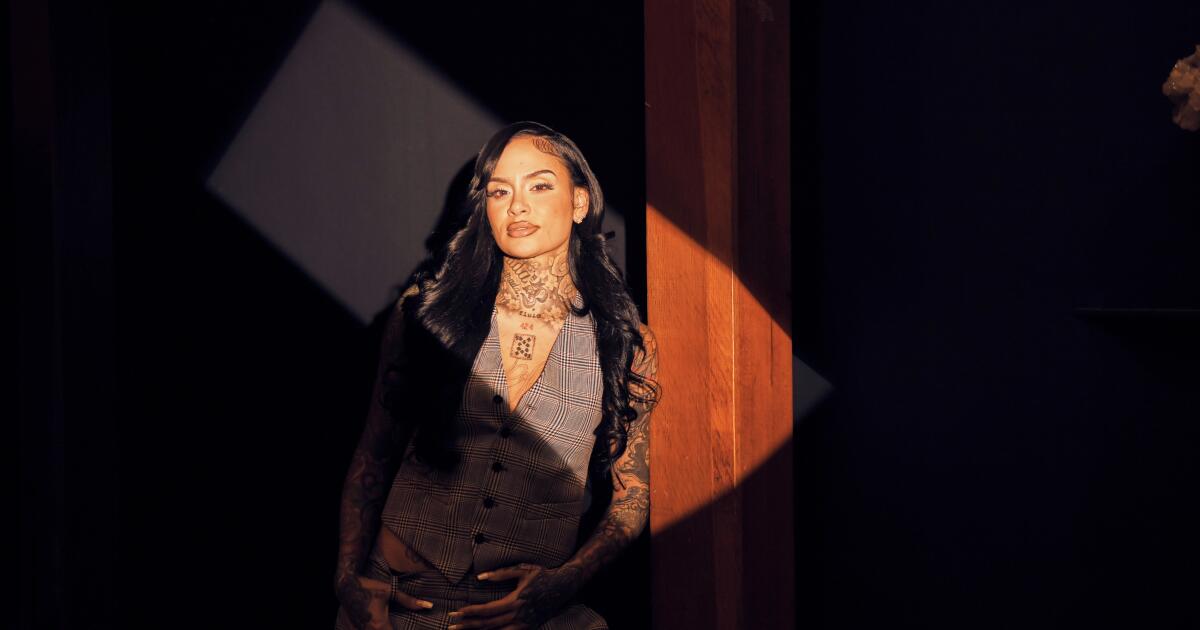
Kehlani has always been told she’s “one song away” from truly making it big.
When the Oakland-born R&B singer came onto the scene in the 2010s with her uninhibited mixtapes, “Cloud 19” and “You Should Be Here,” listeners were immediately charmed by her candid lyrics and her staggering vocal abilities. But once the shimmer of being the “new hot shiny thing” dulled and she settled into her life as a musician, she realized she was being held to a different standard.
“It stopped being about my art. It became a question of ‘Are they keeping up on the charts? Are they getting nominations? Are they getting this cover?’” said Kehlani. “It can really trip you out as a creator. It starts to leak into all of your thoughts. There is a sense of freedom, though. I can just do what I want.”
More than a decade into her career, the 30-year-old singer, whose full name is Kehlani Parrish, seems to have finally landed her long-prophesied “one song away” with “Folded.” Easily identified by its arsenal of classical strings and wishful lyricism, the nuanced break-up anthem, released in June, is her most mainstream track yet — earning two Grammy nominations for R&B song and performance as well as becoming her highest-charting song on the Billboard Hot 100, peaking at No. 7.
Inside Hollywood’s Henson Recording Studios, the singer, despite the unexpected surplus of success and the looming deadline of her forthcoming album, carries herself in a composed, laid-back manner. She explains that the night prior, she had camped out late in the studio working with the Underdogs, the producing duo responsible for much of Chris Brown and Azealia Banks’ early sounds. Then she woke up early that morning for dance rehearsal, with plans of heading back to the studio later that evening. It’s “crunch time.”
“I love working until the last moment. There’s no in between. It either happens when there’s completely no pressure, and you’re floating, making s— and the magic comes. Or sometimes the most exciting things come from pressure at the very end,” said Kehlani, who had cozied up under a furry blanket on a rainy November day.
Though the singer may be currently experiencing the latter with her pending project, its catalyst, “Folded,” was born out of a random surge of inspiration. She and a few producers went to Miami to finish a feature that ultimately fell through. So, instead of having the trip go to waste, they decided to make use of their studio time. They had smoked a bit of weed, weren’t taking anything too seriously and the first beat they played — filled to the brim with whiny guitars and decadent drums — was “Folded.”
“The next day, we were listening to it and we realized, ‘Oh, this is so serious. This is such a crazy song.’ We almost had no idea, because we were just in the zone,” Kehlani said. “It was so natural. There was no deep thought. It just happened.”
“It’s an immature perspective to constantly think that once things are done, they’re done. I used to want to close the door, lock it and throw away the key, or I would stay way too long. I had no nuance in understanding my relationships,” said Kehlani on her song “Folded” and its meaning.
(Irvin Rivera / For The Times)
Though, the singer thinks it could’ve been any song at this point in her life, as long as it had the “right ingredients.”
“It’s less about the song and more about God’s timing. It was God realizing that I’ve taken care of myself over the last two years. I did a lot of the work,” said Kehlani, who was wearing a perfectly tailored plaid suit. “I think God almost saw that I was ready to bear the weight of commercial success in that way. I don’t think that I could have handled this at any other time. I’m susceptible to a lot of craziness with the way my mental [health] plays out.”
She clarifies that she doesn’t mean to diminish the single, “but I think there’s something larger at play in my life.”
Khris Riddick-Tynes, a frequent collaborator and executive producer of Kehlani’s upcoming record, has known the singer ever since she first started uploading music online. He thinks of her new music as “not necessarily a reintroduction, but an introduction of who she’s grown to be.”
“We knew that she was ready to step into the light. We knew this was going to be her time. She’s grown so much as a person, an artist and a writer,” said Riddick-Tynes, over the phone. “She finally accepted and understood that she was ready to go to the next level.”
Upon the song’s release, it quickly fell into the hands of TikTok, spawning viral dance trends and challenges. Given its lyricism, which deals with the complicated emotions of wanting an ex-lover back and layered double entendres surrounding folded clothes, it sparked an internet debacle surrounding what she really meant.
Some thought that the song was purely sexual and came from a toxic place of wanting an ex back. Others were under the impression that this was her way of letting a former lover know that a relationship was over. Instead, Kehlani admits that the track is centered on taking accountability.

“I love working until the last moment,” said the R&B singer. “There’s no in-between. It either happens when there’s completely no pressure, and you’re floating, making s— and the magic comes. Or, sometimes, the most exciting things come from pressure at the very end.”
(Irvin Rivera / For The Times)
“It’s an immature perspective to constantly think that once things are done, they’re done. I used to want to close the door, lock it and throw away the key, or I would stay way too long. I had no nuance in understanding my relationships,” Kehlani said. “As I’m getting older, I’ve realized things aren’t disposable. Relationships don’t really end like that. And if you do close the door, sometimes you end up thinking about it for the next three years.”
This feeling of being misunderstood is something that has followed Kehlani ever since she first rose to popularity. The singer, who got her start on America’s Got Talent in 2011 with her cover group PopLyfe, was recently diagnosed with bipolar disorder, she said. In light of this, she’s come to terms with how sensitive she is to being misrepresented — describing a crippling feeling of anxiety when the public can only attach her to situations from her past, like messy breakups with fellow celebrities and disparaging custody battles ( the singer recently disclosed she won full custody of her daughter).
“I get this massive urge to — I wouldn’t even say defend myself, but rather to explain and be able to have a conversation with someone,” Kehlani said. “You have to be OK, as an artist, knowing that 99.9% of the time that isn’t going to happen. Even in the rare chance where you do get to sit down with someone, you have to be okay with knowing they may walk away committed to their misunderstanding.”
Before receiving her diagnosis, Kehlani had thought the best way to cope was to avoid. There were times when she thought that surfing, meditating and getting a “million tarot readings” were the optimal solutions. But once she was able to figure out what was going on with her mental health, she picked up therapy, found the right medication and learned how to persevere through “apologetic, accountable and uncomfortable conversations.”
“It was all of it, man. A lot of it was wanting to be the 30-year-old that me at 21 would hope for. I wanted to be able to say ‘I finally got my s— together.’ That’s the work I’ve been putting in,” said Kehlani, who emphasizes how important getting a full night’s sleep and going to the gym is for her mentally. “One day when I’m 40, I’ll be able to say, ‘That was a piece of cake.’ But right now, it’s hard, yet rewarding.”
Her diagnosis came after a manic episode she experienced while making 2024’s “Crash” — “the album’s called ‘Crash’ and it sounds like one,” she added. On this record, the singer turned away from her R&B roots to create a mishmash compilation of rock-infused tracks. She says that this mental breakdown was triggered by “one of the craziest tragedies of our time,” referring to the mass violence taking place in the Gaza Strip.
“I completely broke. My brain snapped in half. I’m going from yelling at a camera on Instagram, fully cussing strangers out, to fully paranoid in my house and thinking everybody was coming to get me,” Kehlani said.
After receiving her diagnosis, she embarked on the Crash world tour, where the singer describes struggling to stay focused and falling asleep mid-conversation while adjusting to her new medications. Once she wrapped the tour, she went home, welcomed long periods of solitude and began to make an entirely different album, pre-”Folded.” She noticed that something about her songwriting had changed. It no longer felt like her music was based on impulsive feelings. She was instead able to think deeper about what she was creating — a new sense of maturity had ultimately entered her soundscape.

“I’m in the right place in my life. I just keep telling myself, ‘Kehlani, keep your head on straight, girl.’ That’s it,” the singer said.
(Irvin Rivera / For The Times)
“I don’t look back at [that time] and get any deep, sad feelings. I look back at it and go thank God I made it out. I thank God some art even came out of that time. I was at that point where it got scary for me multiple times, and it could have gone very differently,” Kehlani said. “I’m not really ashamed to say that because I’m in such a different place now. The break had to happen for the rebuild to exist.”
Though a new level of success means a bigger platform and higher stakes. So, when several performances over the last year were canceled due to her political stances, she wasn’t “surprised at all.” It started in April, when she was meant to perform at Cornell University’s end-of-year celebration. The Ivy League’s president canceled due to her “antisemitic, anti-Israel sentiments.” This was in reference to her “Next 2 U” music video, which she opens with a poem from Palestinian American writer Hala Alyan, sings in front of a Palestinian flag and features the phrase, “Long live the intifada.” The phrase is controversial, as it’s used by many pro-Palestine activists in reference to resistance or liberation while others view it as a call for antisemitic violence.
She responded on social media, saying that she’s not antisemitic, but rather “anti-genocide” and “anti the actions of the Israeli government.”
Subsequently, her performance at SummerStage’s Pride with Kehlani in New York was canceled and she was taken off the bill at San Francisco’s Pride celebration, SoSF. The only Pride that didn’t cancel on her was San Diego. But she almost had to cancel it on her own accord because a “very real, very well-planned-out death threat” was sent to the organization.
“It was either I’m holding my breath the entire time, or we cancel, and people think they can punk you out of every show ever for the rest of your life, just by threatening you,” Kehlani said. “Granted, here I am alive today, but it was a very scary moment for me to be in that trailer preparing to walk on stage. Nobody was about to keep punking me — that’s how I felt with all the shows that got canceled. You’re making an example out of me at this new peak of my career.”
At this “new peak,” no matter the noise that surrounds her or the roadblocks ahead, Kehlani’s priority is her health above all. She’s well aware that there have been moments in the past when she’s held the potential for this level of success in her hands, but let it slip through due to her mental health.
“I cannot explain to you how crazy it feels to know I have it in my hands, and to know I just need to keep my fingers closed,” Kehlani said, as she cupped her hands in demonstration. “I’m in the right place in my life. I just keep telling myself, ‘Kehlani, keep your head on straight, girl.’ That’s it.”
This story originally appeared on LA Times

