


“The air is absolutely poison, in the last two years we’ve not had even one single good a day in spite of the monsoon rain,” says Bhavreen Kandhari, an activist spearheading a public movement on clean air.
Hundreds have converged to raise their voice against air pollution at Jantar Matar, a stone’s throw away from the Indian parliament where the winter session is taking place.
“As a citizen and a mother we’ve done every possible thing to highlight our concerns,” says Ms Kandhari.
“We really believed that this time the parliament session will begin with something on air pollution, but unfortunately that didn’t happen.”
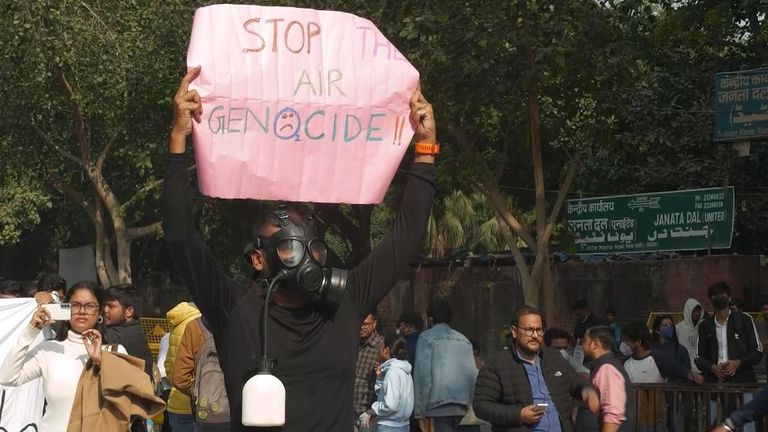
People protest against air pollution in Delhi
A silent killer
Delhi is the world’s most polluted capital, with vehicle emissions, farm fires, pollution from industry, power plants, waste, construction and household energy the main causes for this poisonous air.
A lethal cocktail of carbon monoxide, nitrogen dioxide and other harmful gases – combined with tiny inhalable particles known as particulate matter – blankets the capital and its surroundings.
PM2.5 refers to particles less than 2.5 micrometers in diameter – 30 times smaller than human hair, meaning they can penetrate deep into the lungs and enter the blood stream.
Doctors warn of severe respiratory, heart and reproductive problems, cognitive decline and a reduction in life expectancy.
Since the cold set in here in India’s capital, almost every day the air quality index has been rated very poor, severe, or hazardous, which is many times over the World Health Organization recommended safe levels.
The Global Environment Outlook-7 report released by the UN Environment Programme (UNEP) this month warned that 99% of the world’s population is exposed to some form of air pollution – and more than 90% of pollution-related deaths occur in low and middle-income countries.
According to a 2022 report by medical journal The Lancet, air pollution caused by fossil fuels has claimed 1.72 million lives in India. That’s more than the combined deaths of terror attacks, riots, epidemics and natural disasters.
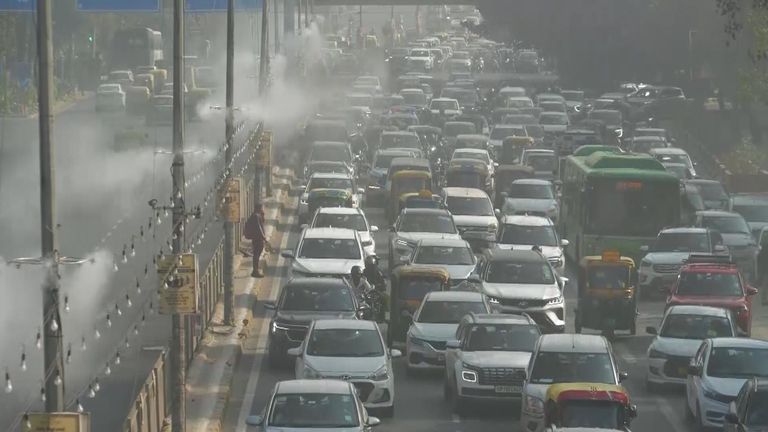
Air pollution is no longer just Delhi’s problem as it is affecting the whole of the Indo-Gangetic plain, with hundreds of millions of people breathing toxic air.
According to the Centre for Research on Energy and Clean Air, 150 cities of the 256 cities monitored in 2025 exceeded nationally recommended PM2.5 levels.
For years governments have ignored this issue in India’s capital, their measures temporary and miserably inadequate, banning polluting vehicles and stopping construction when the air quality index reaches certain levels.
Trucks with water sprinklers are seen moving around Delhi’s 18,000-mile road network trying to suppress matter in the air. The government has also been accused of inconsistent record collection and manipulating data, and spraying water at monitoring stations to influence the readings.
Farm fires – a centuries-old practice by farmers of burning crop stubble to clear land for the next sowing cycle – have been one of the primary reasons for air pollution.
The Supreme Court of India banned this practice, even imposing fines and ordering the arrest of violators.
Lighting the stubble on his field, Ram Singh, a farmer from Haryana, says: “It’s up to the government to arrest us, they can put us in jail.”
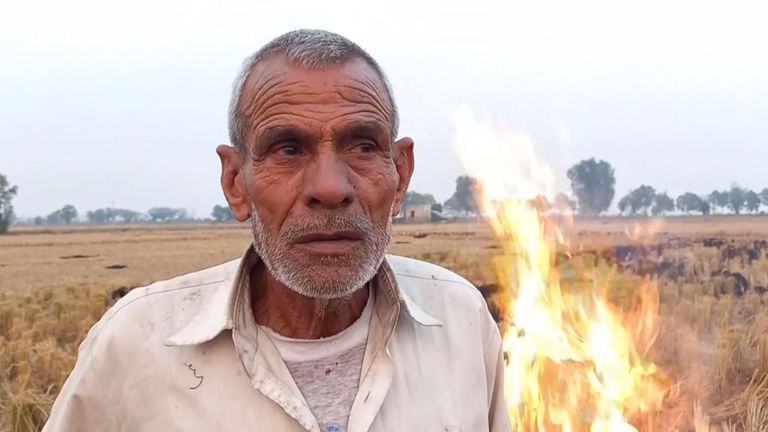
Ram Singh, a farmer from Haryana
“We will eat in jail,” he adds. Our families barely survive on these crops. Nothing is left from it, we do not cause air pollution, it’s all the rich industries that do it, and we get the blame.”
As most of India is associated with agriculture, the government dares not upset the farming community.
‘Not possible’ to escape dangerous air
But that’s no help to Alok Ranjan, a GP at the MMG District Hospital in Ghaziabad. On average, he sees over 300 patients during winter.
He says most come with breathing problems and the numbers increase by 50% due to pollution and the cold.
“Air pollutants have many elements that are carcinogenic, like lead, mercury, cadmium, that can cause cancer – these are toxic and harmful for our bodies and metabolism,” he says, a queue of patients snaking into the hospital corridor.
“Air pollution has an effect on all organs of our body. Our life expectancy has reduced while morbidity increased. All I can say is stay away from bad air, but that’s not possible.”
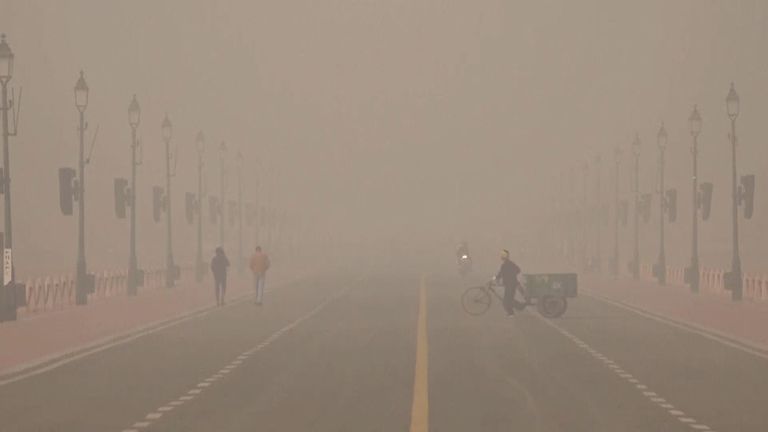
Doctors, health workers and activists have called it slow poison, a silent genocide that is killing millions.
Their urgent pleas for action from government and a parliament that sits just about a mile away are, for now, falling on deaf ears.
This story originally appeared on Skynews

