


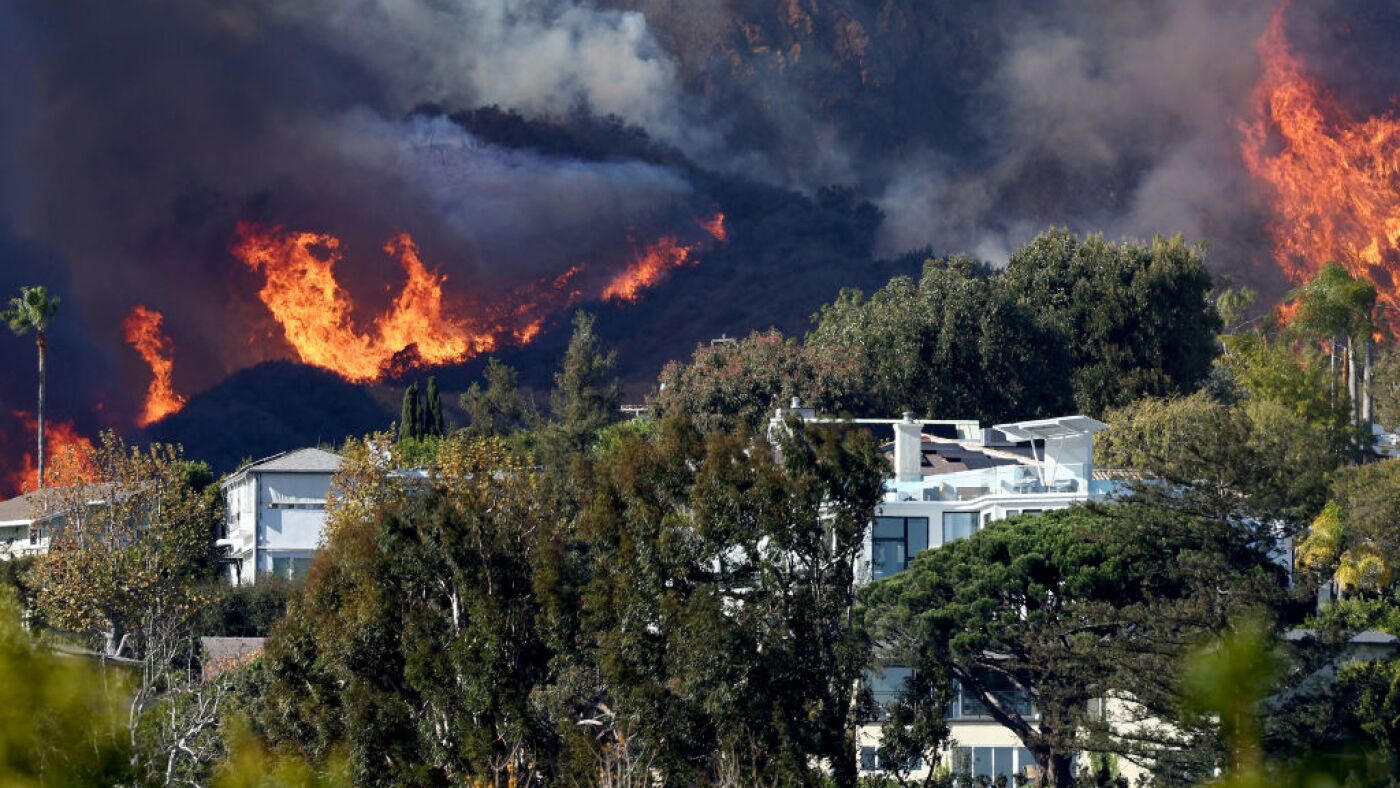
Wildfire experts have found that homes with dense vegetation are at higher risk of burning, like in the Palisades Fire in 2025. New regulations in California require homeowners to manage plants within five feet of a structure.
Mario Tama/Getty Images
hide caption
toggle caption
Mario Tama/Getty Images
As severe wildfires burn across the Western U.S., California has adopted the toughest rules in the country to help protect communities from burning. Homeowners in wildfire-prone areas will be required to limit plants within five feet of their house, a protective measure that wildfire experts say can help prevent homes from igniting.
Research shows that dry, dense vegetation around buildings can cause wildfires to spread. In extreme conditions, high winds carry a deluge of tiny, burning embers far beyond the fire itself. When those embers get caught in vegetation, they can ignite, spreading flames to nearby buildings and homes.
Wednesday’s vote by the California Board of Forestry and Fire Protection comes after years of debate and delays. The state originally considered rules that would have restricted all vegetation within five feet of a house, aside from well-maintained trees. That generated pushback from some communities, concerned about losing greenery in their gardens and the cost of yard maintenance.
California regulators ultimately struck a compromise about plants allowed within the five-foot zone, known as Zone Zero. Lawns, flowers and non-woody plants up to 18 inches tall will be allowed, unless they are located directly under the roofline of a house. Trees will be allowed, though branches must be trimmed five feet away from a structure. The rules will apply to new construction right away, but will be phased in for existing structures, affecting almost 2 million homes in high-risk areas.

State regulators say the rules reflect the new reality of more extreme wildfires, driven in part by rising temperatures from climate change. More than 57,000 homes and buildings have been destroyed in California in the last decade, according to state regulators.
“California’s faced an existential crisis that has affected our health, that has affected our finances related to our ability to buy and sell homes, to insure homes and has put us in a very precarious place,” testified Yana Valachovic of the University of California Cooperative Extension at Wednesday’s hearing, who also advised the state on the new rules.
Growing tensions across Western states
California’s debate reflects growing tensions across the Western U.S. about how communities should prepare for wildfires. Wildfire experts warn even fires that start in open, wildland areas can quickly become urban fires, destroying thousands of homes in neighborhoods that residents never thought were at risk, like in the 2025 Los Angeles fires. This summer, more than 800 homes were destroyed in Spokane, Wash., by three wildfires that burned through dense neighborhoods.
Across several states, homeowners in public meetings have said wildfire regulations threaten private property rights, reduce urban wildlife habitat and require costly maintenance.

“You are about to approve a set of regulations that will cost millions of California homeowners tens of billions of dollars,” testified Dave Lefkowitz, president of the Mandeville Canyon Association, a community group in the Los Angeles hills. “The math is insuperable.”
Vegetation management rules were recently defeated in both Oregon and Washington after strong public pushback, including misinformation that spread online. Some community groups wanted regulators to wait for more scientific research on wildfire spread.
Research shows plants can increase risk
In experiments, researchers have shown that even green plants can ignite in the dry, windy conditions of an extreme wildfire. Analyses of past California wildfires have also shown that homes with vegetation predominantly within six feet of the exterior walls were at higher risk of being lost. Managing vegetation also creates “defensible space” for firefighters, providing better access for defending a structure.
California has long been at the forefront of wildfire policy, pioneering regulations that other states have adopted. For almost 20 years, California’s wildfire building codes have required homes to use fire-resistant materials for construction. A handful of other states recently adopted similar codes. Research shows that while there are no guarantees a house will survive a fire, protections are strongest when homeowners address both building materials and vegetation. Even in some of the most severe wildfires in recent years, some homes made it through.
California regulators say the widespread regulations are needed because voluntary measures don’t provide enough protection. Communities are safest when all homeowners comply, since one home with dense, dry vegetation can spread fire to its neighbors. Insurance companies in California are also required to provide discounts to homeowners that make their homes more fire-resistant.
New rules depend on inspections
While California’s new rules provide more flexibility for homeowners, some wildfire experts say they don’t go far enough, given that any combustible material next to a house could pose a risk. The new vegetation rules will be enforced by local fire departments and state agencies that do home inspections every year. Those inspectors will bear the brunt of educating homeowners and ensuring compliance.

“I want the board to understand what this compromise asks of local inspection programs,” Todd Lando of the Central Marin Fire Department testified at the hearing. “A clean Zone Zero is a five-minute inspection with one question: Is anything combustible within five feet? Easy for the homeowner to understand and take action on.” Lando says the new rules will involve more conditional judgements by inspectors, opening up debate with homeowners that could affect compliance.
California regulators say inspectors will focus on educating homeowners at first, before compliance becomes mandatory. For existing homes, the new vegetation rules will go into effect in 2029 at the earliest.
This story originally appeared on NPR

