


Benedict Cumberbatch might’ve started his career with Richard Eyre’s theatrical revival of “Hedda Gabler,” but the acclaimed actor dabbled in television as early as 2000. Appearing in “Cambridge Spies” and “Tipping the Velvet,” Cumberbatch landed his first major role in “Hawking,” for which he earned a BAFTA TV Award nomination for Best Actor. Eventually, he gained global recognition for playing Sherlock Holmes in the BBC One series “Sherlock,” winning a Primetime Emmy for the role.
The actor’s other TV credits include “Patrick Melrose,” “Good Omens,” and “What If…?,” among others. Cumberbatch also delivered a particularly breathtaking performance in “Eric,” a British psychological thriller about a puppeteer whose son goes missing.
In terms of feature films, Cumberbatch is best known for playing Doctor Stephen Strange in the Marvel Cinematic Universe. He’s also appeared in notable films like “The Imitation Game,” “The Power of the Dog,” “12 Years A Slave,” and “Atonement.”
Cumberbatch brings a distinctive screen presence to all his roles — thanks to a robust background in theater — which is why he is today’s quote of the day.
Quote of the Day by Benedict Cumberbatch
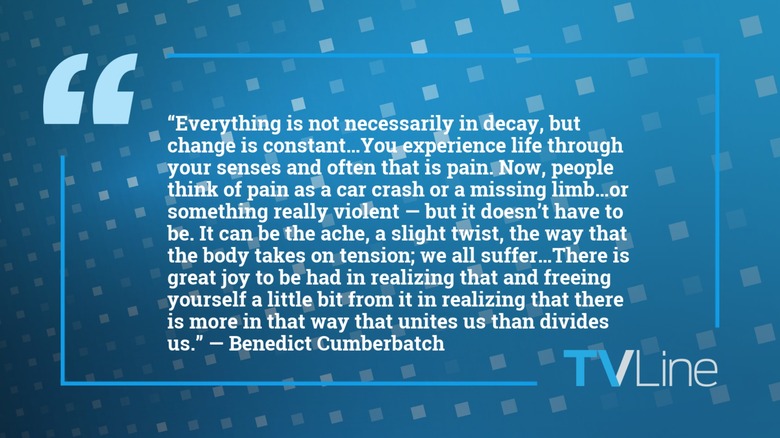
“Everything is not necessarily in decay, but change is constant … You experience life through your senses, and often that is pain. Now, people think of pain as a car crash or a missing limb … or something really violent — but it doesn’t have to be. It can be the ache, a slight twist, the way that the body takes on tension; we all suffer … There is great joy to be had in realizing that and freeing yourself a little bit from it in realizing that there is more in that way that unites us than divides us.”
The above quote is from Benedict Cumberbatch’s 2018 interview with The Talks. When asked about his interested in Buddhist meditation and philosophy, and whether he believes that suffering is the foundation of life, the actor provided a nuanced answer.
“Everything is in flux,” he said, while stating that “pain” doesn’t have to be life-altering or inherently violent.
According to Cumberbatch, to suffer is to be human, but there’s also great joy in realizing that the same pain can be healing. “What comes goes, what goes up, goes down,” the actor added, talking about the ebb and flow of the human condition.
Deeper meaning of Benedict Cumberbatch’s quote — accept the cyclical nature of life
While embracing the ebb and flow of life sounds easy on paper, Benedict said it’s “much harder” to practice. “It becomes very complicated to live by that,” the actor shared, while emphasizing the need to view pain as a part of life. When asked how he practices this outlook, Cumberbatch credited meditation as a tool to achieve some sort of balance.
“Meditation is a tool to access a stillness in the mind which can separate you from your thoughts and can give you enough space to start to relax your body in a way that it needs to get back in a sleeping pattern, or deal with the cause of drugs you are taking,” Cumberbatch explained.
He also said how useful meditation is for an actor with a chaotic schedule. He said: “It definitely helps to rebalance and reboot and go, ‘Oh, that’s where you’re at, that’s what’s dragging you away, how to find your center again.'”
More quotes from Benedict Cumberbatch
- “I feel the most important quality for someone working in the film industry is more than one, but a combination of patience, persistence, and openness. By openness, I mean to realize that this art form is and always will be a collaborative medium, no matter how singular your creative vision is in your chosen field.” — from a 2025 AMA on Reddit
- “It’s all right to knock on some doors. There’s nothing wrong with saying, ‘I really want to try to craft something together.’ It’s all about perception. It’s about becoming comfortable saying, ‘I’m an artist rather than, you know, a bit of meat for hire.’ After all, time is running out.” — from a 2025 interview with Variety
- “I’m easy with promoting my failings, and that I’m just trying to do it and fail better, at whatever it is. Life principals. Advocacy work. Privacy. All of that … I really don’t want to say these things because it becomes about self-appraisal and it sounds like I’m blowing my own trumpet. But I try to keep a balance of certainty in who I am. And also, an empathy for others, to try and be an open human being, I guess.” — from a 2021 interview with Esquire
This story originally appeared on TVLine

