


It’s one thing to make a sci-fi show about aliens and spaceships look cool. It’s another to create an entire future where technology, politics, economics, and geography feel like they belong in the same world. The Expanse nails every detail by understanding that the Solar System doesn’t suddenly stop being complicated because humanity has figured out how to leave the planet. Earth, Mars, and the Belt are the engine driving everything, and that’s why the world-building stands out.
Thankfully, The Expanse isn’t the only hard sci-fi series that gets it right. I’ve put together a list of shows that take world-building just as seriously, whether that means a galaxy-spanning empire, an underground society built on secrets, or an alien planet with its own ecosystem. Some of the shows on this list lean heavily into real science, while others are famous for taking a few speculative swings. But each of them scratches the same itch as The Expanse.
‘Mars’ (2016 – 2018)
A Mars Colony Built With the Same Grounded Logic as the Belt
Watch This If: You loved how The Expanse treats the mechanics of living in space as seriously as the drama itself. Mars, a National Geographic series that premiered on FX, focuses on a scripted 2033 colonization mission and real documentary interviews with scientists and engineers. That combination makes the fictional half feel too real. Every problem the colonists face, from dust storms to oxygen shortages to the physical toll of isolation, is treated like an engineering puzzle. That’s the same kind of grounded world-building that made The Expanse work so brilliantly.
Skip This If: You want your sci-fi series to move fast and lean into bigger, flashier stakes. Mars is a methodical sci-fi series, and the documentary segments, while fascinating, interrupt the momentum of the fictional narrative. It’s a show for people who appreciate footnotes that show how a colony would function in space. It’s not for people expecting a thrilling ride.
‘Scavengers Reign’ (2023)
Vesta Is One of the Most Beautiful (and Horrible) TV Planets
-
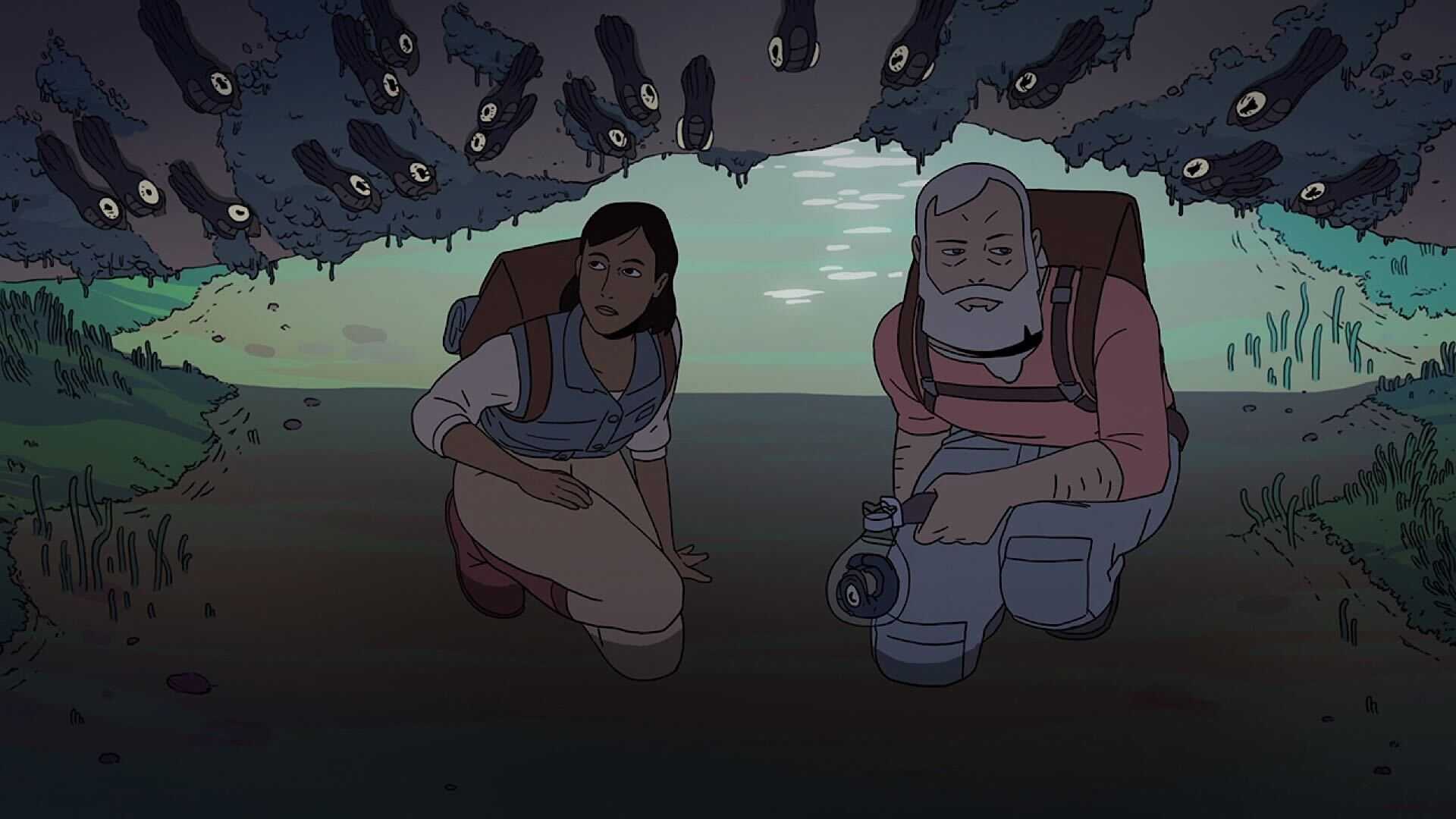
Two people in a cave kneeling down in ‘Scavengers Reign’ Netflix -
 Max
Max
Watch This If: Part of what makes The Expanse’s universe so immersive is how specific every location feels, down to the gravity and the culture. Scavengers Reign takes that idea and applies it to biology instead of politics. The crew of the Demeter 227 crash-lands on a planet called Vesta Minor, and the show builds an ecosystem of symbiotic creatures, parasitic fungi, and plant life that all interact by an internal logic. It’s cool and terrifying at the same time. Overall, while The Expanse makes the Solar System feel like it’s shaped by human expansion, Scavengers Reign presents a world that doesn’t care about humans at all.
Skip This If: You need a show that gives you familiar reference points. This one doesn’t hold your hand, and some of the things happening on Vesta are bizarre. Scavengers Reign also trusts you to piece together how its ecosystem works through observation, while it explores themes of survival and psychology.
‘Planetes’ (2003 – 2004)
It’s About Space Garbage Collectors Doing Unglamorous Work
Watch This If: The Expanse earned a lot of goodwill by focusing on working-class spacers instead of just admirals and politicians. However, Planetes did that a decade earlier. The show follows a debris-collection crew whose job is to clean up junk in Earth’s orbit. In this world, the near-future is so advanced that space travel is not only flawless, but also normal enough that people have mundane jobs related to it. It’s an intriguing premise that focuses on economic and labor details. At the same time, the show can get pretty emotional because it gives characters room to dwell on their ambitions, frustrations, and relationships.
Skip This If: You’re looking for a giant mystery or constant action. Planetes is a beautiful-looking hard sci-fi series that sometimes functions like a workplace drama. It goes deep into human relationships and the practical realities of space travel, which makes it a slow, character-driven anime.
‘Pantheon’ (2022 – 2023)
A Digital World-Building Project Disguised as a Teen Drama

Watch This If: The Expanse’s big questions about technology and corporate power are exciting to you, because Pantheon falls under a similar thematic category. Pantheon starts with a teenage girl receiving mysterious messages from someone claiming to be her dead father. The twist is that her father isn’t pretending. His consciousness has been uploaded to the cloud after an experimental brain scan, creating an uploaded intelligence. The ambition here is genuinely rare for an animated series aimed at a general audience, but the concepts are fun to explore.
Skip This If: Sometimes when watching an animated series, it’s easy to assume you’re getting something cute and lighthearted. Pantheon is neither of those things. It’s a dense sci-fi drama that’s more interested in technological ethics and the implications of uploaded consciousness. While it’s easy to follow, it rewards attention.
‘Foundation’ (2021 – Present)
Isaac Asimov’s Galaxy Is Bigger Than Any Single Character
Watch This If: The Expanse is known for its scale of politics, and if you love that, you’re in for a treat, because Foundation goes even bigger. The series takes Isaac Asimov’s enormous ideas about civilization, power, and humanity’s future and stuffs them into a sprawling space opera. First, it builds a galactic empire spanning centuries and multiple star systems, and then uses fictional science to predict the fall of civilizations. It’s fascinating, but for me, the cloning idea is one of the show’s best additions because it gives the Empire a great contradiction. Overall, it’s better than The Expanse, but the shared appeal is hard to ignore.
Skip This If: You need a tight, contained story that sticks to a small group of characters. Foundation always operates at a huge scale. It jumps across massive stretches of time and multiple storylines at once. You’ll learn new things while keeping track of what came before.
‘Silo’ (2023 – Present)
The Best Thing About ‘Silo’ Is How Much the World Doesn’t Tell You

Watch This If: In The Expanse, the spaceships and battles are compelling, but so are the political systems and social divisions. Silo, Apple TV’s hit sci-fi series, removes that spectacle and puts humanity inside a massive underground structure where 10,000 people live under rules designed to keep them alive. Nobody is supposed to go outside, nobody is supposed to ask why, and the more Juliette Nichols digs, the less things make sense. The world-building of Silo is impeccable because the show presents a functioning society. People have jobs and different levels, information is controlled, and people follow traditions. It’s claustrophobic, but it works.
Skip This If: You get impatient when a show refuses to give answers. Silo is known for withholding information, and some of its best reveals work only because you spend so long wondering what is going on. The mystery is the whole point. If you prefer fast-paced sci-fi, this can be a frustrating watch.
‘Battlestar Galactica’ (2004 – 2009)
Humanity Is Running for Its Life, and Nobody Knows Where to Go

Watch This If: The Expanse owes a real debt to Battlestar Galactica, and when you’ve seen both, you will see it in the plot, in the world-building, in the politics, and in the characters. Battlestar Galactica begins after the Cylons launch an attack against the Twelve Colonies. The Galactica becomes one of the last surviving ships, carrying a battered group of humans who set out to find the mythical lost colony of Earth. The setup gives you a lot to follow: you learn about religion, military hierarchy, artificial intelligence, class divisions, and human survival, all while the characters are trying not to get killed. It’s an intense sci-fi binge.
Skip This If: You’re specifically looking for scientifically rigorous hard sci-fi. Battlestar Galactica uses plenty of grounded military technological ideas, but its mythology and larger mysteries take it well beyond hard science.
‘3 Body Problem’ (2024 – Present)
Suddenly, Humanity Has a Very Big Alien Threat

Watch This If: You simply can’t get over that one moment in The Expanse when the story went from being about local human politics to something much bigger. 3 Body Problem starts with scientists confronting inexplicable events and gradually reveals a threat connected to an alien civilization. The story jumps between 1960s China, present-day Oxford, New York, and other locations as people start to understand what they’re facing. The scale is why it belongs in the Top 3 here. At first, you’re dealing with individual scientists and a string of deaths. Then, the show starts asking questions about physics and existentialism. While it escalates fast, it’s genuinely clever.
Skip This If: You want a show that stays in the present. This one spans decades and eventually leans into mind-bending concepts. The characters also spend a lot of time reacting to discoveries instead of taking action, so the cerebral side of the show really needs to appeal to you.
‘Dark’ (2017 – 2020)
The German Town of Winden Is Small, but Its Timeline Isn’t
Watch This If: The Expanse rewards anyone who pays close attention to its history and politics, and Dark demands the same attention, but for a different reason. The Netflix sci-fi masterpiece builds out a time-travel lore that connects four families across three different time periods. Despite the scale, it stays consistent with its rules, cause, and effect. It’s impressive once you reach Season 3 and see how it all locks together. Also, Winden is an ordinary town with families, schools, police officers, and teenagers. There’s nothing futuristic about it, which makes the bizarre story hit even harder.
Skip This If: You don’t really enjoy keeping track of family trees and timelines. Dark is committed to its mythology, and the third season goes even further with confusing ideas about time and alternate realities.
‘Babylon 5’ (1993 – 1998)
The Show That Built Giant Sci-Fi Universes Before Streaming Made It Common
-
 Michael Ansell / © Babylonian Productions / courtesy Everett Collection
 -
 Craig T. Mathew / TV Guide / ©TNT /courtesy Everett Collection
 -
 Babylonian Productions / courtesy Everett Collection
Watch This If: Long before The Expanse stunned us all with its Earth, Mars, and Belter politics, Babylon 5 was doing something similar. The series is set aboard the titular station, which serves as a center for trade, diplomacy, and conflict between humans and multiple alien governments. It ran for five seasons and was designed around a five-year story arc. The early episodes can look dated, and the CGI obviously belongs to another era. The world-building is still remarkably ambitious, though. Since the show was planned, it looks less like a collection of standalone space adventures and more like a civilization growing and changing.
Skip This If: Old production values are a deal-breaker for you. There is no getting around the fact that Babylon 5 looks like a television show from the 1990s. The early episodes can also be uneven, and the series gets better over time. But don’t judge the entire series by the first few episodes.
‘For All Mankind’ (2019 – Present)
The Space Race Never Ends, and Everything Changes Because of It
Watch This If: For All Mankind starts with one jarring change to real history: the Soviet Union lands the first human on the Moon before the United States. From there, the space race never really ends, and every political, technological, and social development that follows grows out of that change. At first, it looks like an alternate-history NASA drama. Then the timeline starts diverging more and more from ours, and watching it compound season after season is the whole appeal. And because For All Mankind has been running for six seasons now, it has had a lot of time to let its alternate timeline grow.
Skip This If: You want a fast-paced space story. This one is character-driven. It’s interested in the people and politics behind the space program, and some stretches are more grounded and family drama than in the missions. But if you’re willing to stick around, the payoff is mesmerizing.
What’s your favorite sci-fi show for world-building? Let us know in the comments!
This story originally appeared on Movieweb

