


UEFA Nations League will not bring as much significance as the World Cup or the European Championship, but that was never the point.
The competition was created in 2018 in order to replace a low-stake environment of international friendlies with a promotion/relegation hierarchical group stage preceding a knockout competition. And thanks to its foundation, we now have a legitimate competition during an international break and from what we saw in this window — in large part because of scenes in Madrid and Copenhagen — we also have legitimate, passionate drama. That all sets up a pretty packed bracket for the quarterfinals next March.
Now that the group stage of the UEFA Nations League has come to an end – and as we prepare for Friday’s quarterfinal draw – let me just state that this tournament has proven to be a success.
Nations LeagueQuarterfinalists

Draw Will Be Held Nov. 20; Matches To Be Played March 2027
Let’s look back and reflect on some of the European action from this international window and assess the winners and losers from the group stage of the UEFA Nations League.
Winners


This Norwegian spirit is truly something else and on Tuesday evening in Copenhagen, just like this past summer’s World Cup, we saw it once again.
In the last window, Ståle Solbakken’s side had lost three straight matches, which forced a desperate attempt to qualify for the final eight. It needed a victory over its Scandinavian cousin and after going down 2-0, it earned a tremendous 3-2 victory to secure second place in its group.
And once again, it was that man: Erling Braut Haaland. The Man City striker scored a brace, including a 96th minute penalty winner that sent his country into delirium. Haaland now has an astonishing record for the national team — 68 goals in 61 matches — and that’s just simply extraterrestrial numbers. He earned a yellow at the end of the match after taking his shirt, but Haaland won’t care one bit as once again, the rhythm drum came out with captain Martin Ødegaard (who was fantastic on the night) leading the way into the global phenomenon that is the Viking Row. Only this time, it was in enemy territory as the annoying cousin that is Denmark was defeated.
 England Had A Timeless Performance
There is no way that I can exaggerate this sentiment. England’s 3-2 victory over Spain in Madrid at Metropolitano stadium was its greatest performance under Thomas Tuchel and I have to tell you something, due to the nature of the situation and the strength and momentum of the opponent leading up the fixture, I can’t remember a better one in the last 20 years.
It was a collective, aggressive, resilient win that also highlighted the depth of the squad against the World Cup champion—who saw its 43-match unbeaten run come to an end.
There were heroes everywhere. From Newcastle United’s Lewis Hall to stopper James Trafford, who moved to Leeds United this past summer from Manchester City for $60.5 million, making it a club record and one for a British goalkeeper. The move was an excellent decision as Trafford took the starting role over Jordan Pickford and fully delivered in a majestic performance.

England keeper James Trafford made the most of his performance vs. Spain. (Photo by Mateo Villalba/Getty Images)
England now enters the quarterfinal stage as group winners and feeling very confident ahead of the knockout stage in March, who will also host the second-leg.
 Germany Under Klopp Turns A Page
This was an international window where we finally saw Germany flex its quintessential Jürgen Klopp identity as the 3-1 victory over Serbia was followed by an emphatic 5-0 demolition against the Netherlands. It was Germany’s biggest win over its historical rival since 1959.

Jürgen Klopp celebrates with Germany’s midfielder Florian Wirtz. (Photo by Tobias SCHWARZ / AFP via Getty Images)
But that wasn’t the headline. Because to me, the biggest takeaway was that Klopp’s intoxicating philosophy finally came to fruition, and it was exemplified through players such as midfielder Florian Wirtz, who is looking like worth every penny of his record-breaking $157 million fee to Liverpool from Bayer Leverkusen. Wirtz, who scored three goals during this window including a brace over the Netherlands, is a perfect Klopp prototype, able to press, disrupt defensive lines, move with fluidity and lead the line in a high pressing system.
He’s not the only one. Midfielder Brajan Gruda (the 22-year-old on loan at RB Leipzig from Brighton) has also proven to be a revelation. Gruda was magnificent in this window, especially against the Netherlands, giving out an overwhelming performance that just couldn’t be handled by Xavi’s men. Overall in the window, he delivered two goals and three assists and, again, he is just another reason why Klopp is perfect for this evolving German side, who end the window as top of its group.
The new era of German football is here – and it’s a Klopp revolution.
Losers
 One Of The Worst Dutch Showings Ever
It seems almost preposterous to think that a team who wins 7-0 in an international window (against Greece from last Friday) can be filed under this section, but the following 5-0 loss to Germany was extremely worrying from a Dutch perspective because this 12-goal shift seems like manager Xavi Hernandez does not yet have a grip on this team’s mentality.
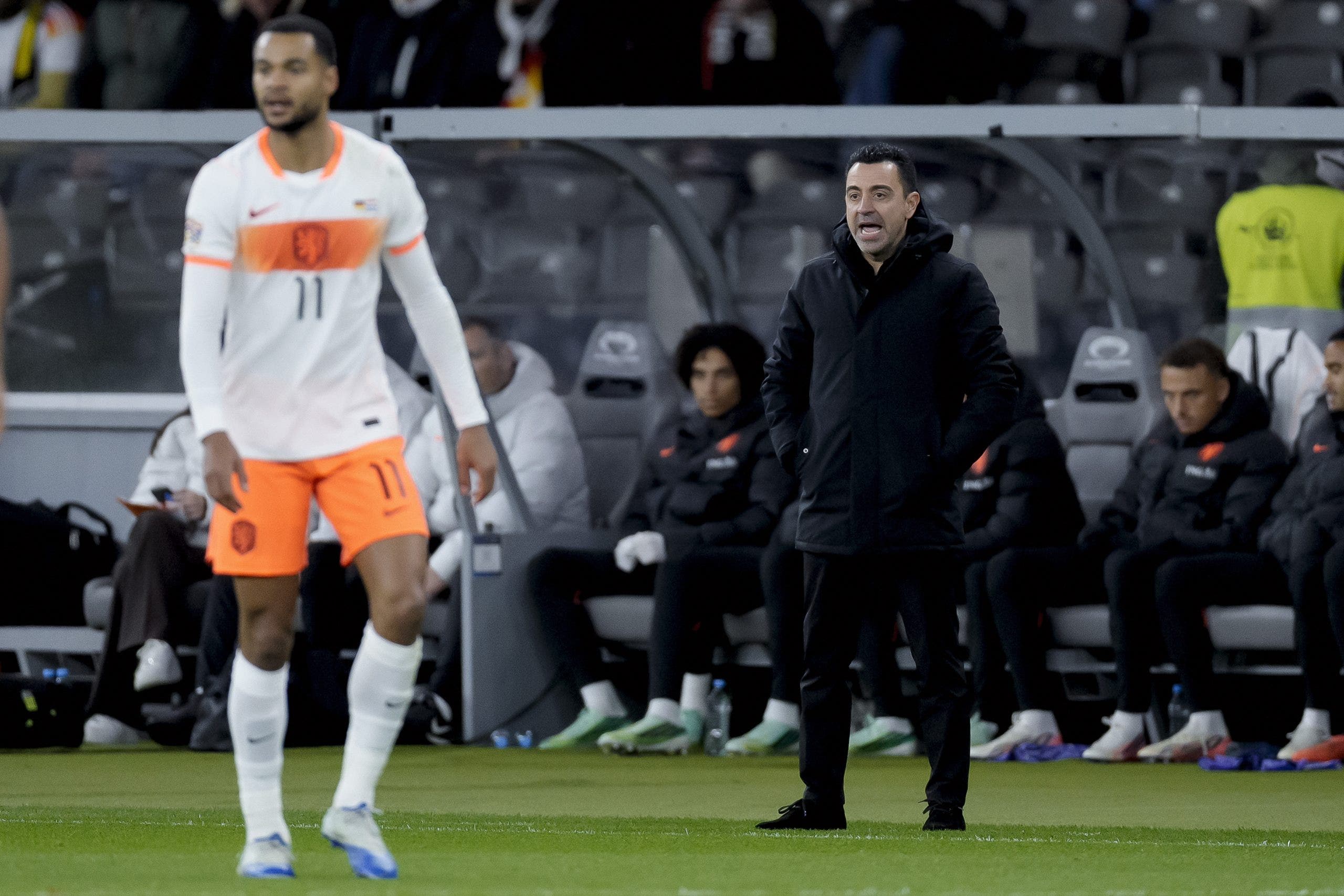
Xavi’s tenure with the Netherlands hasn’t been smooth sailing. (Photo by Geert van Erven/Soccrates/Getty Images)
There were times during that demolition where his players, including experienced talented stars such as Gody Gakpo and Tijjani Reijnders, didn’t even bother to sprint back or track back a man in the latter stages of the match. It was extremely amateurish and a trait the Germans fully exploited. When the problem is tactical, then it’s more tangible and the manager can perhaps see how to solve it. But the loss to Germany was also psychological, so it’s imperative Xavi fixes this in 2027.
The good news for the former Barcelona manager is that his team did reach the quarterfinal stage after coming second in the group. And he has until March to rectify this issue.
How it pans out remains a question, but I do know this. The Netherlands can never approach a fixture like that ever again.
 Party Over For Scotland?
It has not been a fruitful time for Scotland since the departure of Steve Clarke in August as Belgian manager Sebastien Pocognoli has really not had a good time with a squad that became a World Cup darling this summer due to its traveling Tartan Army fanbase.
After their latest loss to Switzerland, Scotland only won against North Macedonia twice in six matches. It consequently missed out on promotion from a playoff spot in 2027 and a better seeding for the 2028 European Championship qualifying draw in December.
This is a tough moment for Scotland, who qualified for the World Cup for the first time since 1998. It’s time for reflection as it looks to the future — one that doesn’t look promising right now.
 Arda Güler Needs More Support
Real Madrid youngster Arda Güler is sadly not enough and this is the current problem with Türkiye, whose only achievement at the World Cup was coming out victorious in a group stage match over co-hosts the United States.
It’s been a chaotic situation, as last month, Sergen Yalcin replaced the Italian Vincenzo Montella in charge. But the 53-year-old former Türkiye midfielder could not stop his side from relegation from League A to League B after losing six straight matches and conceding 15 goals, with only four scored.

Arda Güler after Turkiye’s loss to France on Sunday. (Photo by Lilou Cassin/Eurasia Sport Images/Getty Images)
Losing to the likes of Belgium and France during this window isn’t anything to be ashamed about, but a team that features talent such as Güler shouldn’t have laid a goose egg in the win column. After Greece defeated Serbia 1-0 on Monday, Türkiye was amongst the two lowest-ranked fourth-placed teams and suffered the drop. This was a team that got some love as a World Cup darkhorse this summer – now they limp into the new year with big questions.
This story originally appeared on Fox Sports

