


Air Canada offers a number of fare options for passengers. Some fares are cheaper, but don’t come with a wide array of benefits, while others are more expensive but offer greater flexibility and perks.
Whenever you’re shopping for flights, the best practice is to understand the differences between fares, as the least expensive one isn’t usually the best choice.
In this article, we’ll explore the different fare options for flights with Air Canada, with a focus on shopping for fares with Aeroplan Elite Status in mind.
While most of the discussion will be on cash fares, we’ll also go over some considerations to keep in mind when booking flights with Aeroplan points.
Air Canada’s Fares
When shopping for flights on Air Canada’s website, you’ll notice that there are a number of different options at your disposal for flight fares. You’ll pay a different price for a flight depending on which fare you choose.
For example, let’s say that you’re looking to fly from Vancouver to Toronto, and you pull up the search results. Initially, you see three different prices for a non-stop flight in three classes of service: one for economy, one for premium economy (if available on your flight), and one for business class.
When you click on the price for each class of service, you’ll see the various fare types available for your to purchase.
In this example, when you click on the economy fare, you’ll notice a number of different options (Basic, Standard, Flex, Comfort, and Latitude), with the lowest priced at $200 (CAD) and then incrementally higher prices with each different fare.
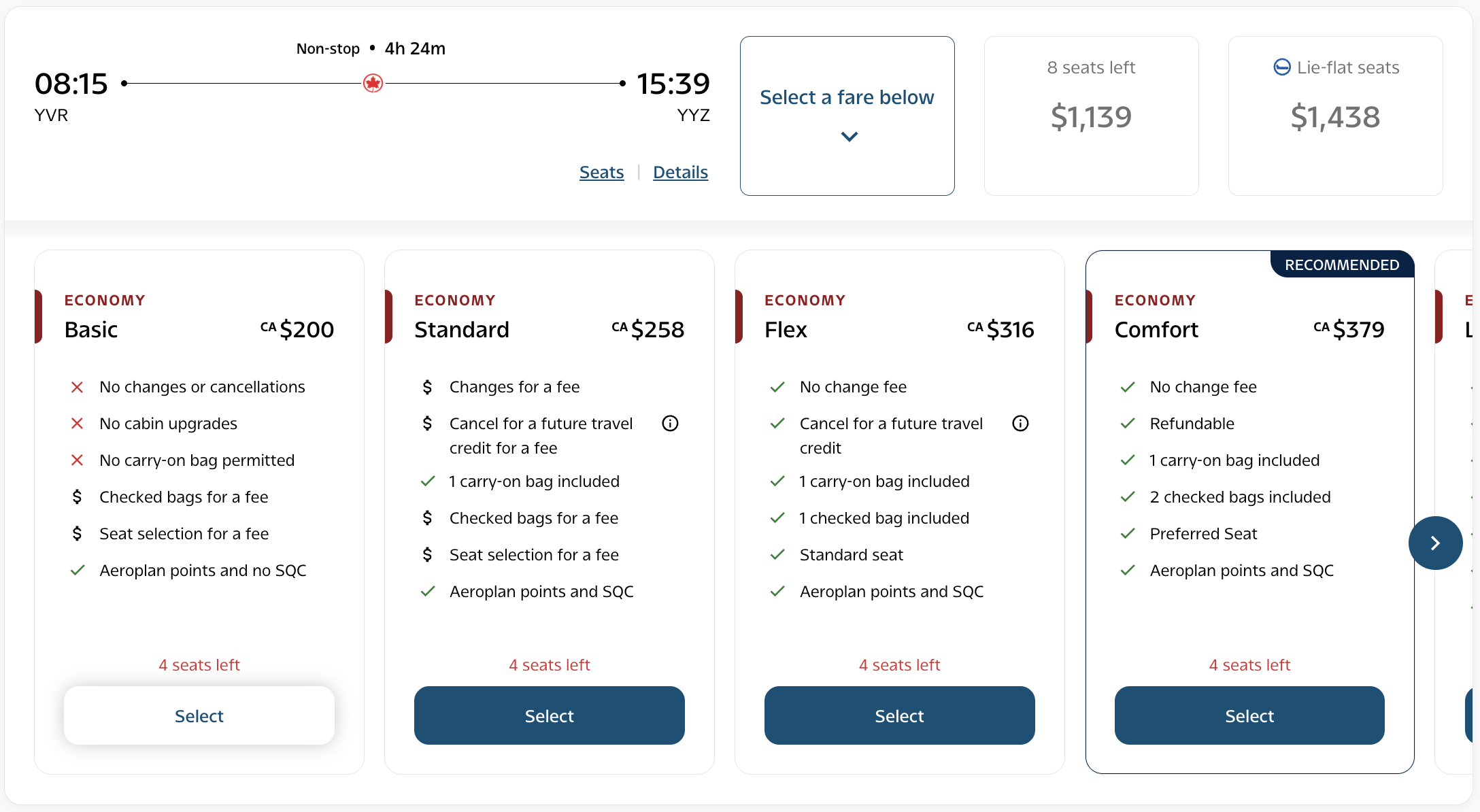 Within each fare option, you’ll see a list of various factors that you’ll want to consider when shopping for a fare. This includes aspects such as refundability, included baggage, accumulation of Aeroplan points, and earning Status Qualifying Credits (SQC) towards Aeroplan Elite Status.
For many people, shopping for the right fare isn’t necessarily a straightforward process. In addition to the price that you’re willing to pay, you’ll want to consider any or all of the following factors when looking for a fare:
- Included baggage (both checked and carry-on)
- Seat selection fees
- Change fees
- Credit card benefits that you enjoy
- Aeroplan Elite Status benefits available to you
- Aeroplan Elite Status qualification
- Number of eUpgrades required
- Amount of eUpgrade add-on fee (if any)
- eUpgrade waitlist ranking considerations
- Fare flexibility
As we’ll show below, the cheapest fare isn’t always necessarily the best deal, since you may wind up paying more in the end if you have to pay out-of-pocket for things like baggage and seat selection that are included with other fares.
At the same time, there’s also no point in paying more than you absolutely have to. If you already enjoy a free checked bag as a credit card benefit, then there’s no point in paying for a more expensive fare just to have a bag included.
For the purposes of this article, we won’t be focusing on the different fare classes within each fare. In other words, we won’t focus on the differences between the different fare codes (represented by different letters) within each fare brand.
Rather, we’ll describe each different fare brand, and then weigh the pros and cons of choosing to book each one, with the majority of the discussion on the different Economy fares.
Economy (Basic) Fares
Economy (Basic) fares are the least expensive but most restrictive fares that Air Canada offers. You can find Economy (Basic) fares on domestic, transborder, and international routes, as well as to Sun destinations. Note that Economy (Basic) fares aren’t available for Aeroplan redemptions.
As the name suggests, Economy (Basic) fares don’t come with bells and whistles. In reality, you get a randomly assigned seat, but you don’t get a carry-on bag (aside from 1 personal item like a purse or small backpack), checked baggage, refundability, or anything else.
Economy (Basic) fares are non-refundable, and if you choose to cancel, you can’t retain the value for a future travel credit. Similarly, you can’t make changes to your booking (even for a fee), and you aren’t eligible for Air Canada same-day standby or Air Canada same-day airport change.
When it comes to earning Aeroplan points on Economy (Basic) fares, you’ll get 1 Aeroplan point per dollar spent on the base fare and carrier surcharges but not on third-party taxes and fees, seat selection, or baggage fees (as is the case with all Air Canada fares).
If you have Aeroplan Elite Status at the time of travel, you’ll get 2–6x points with the Elite Points Multiplier benefit.
With Economy (Basic) fares, you won’t collect any Status Qualifying Credits (SQC) to help unlock Aeroplan Elite Status, and your flight won’t be eligible for Lifetime Qualifying Miles (LQM) accumulation for Million Mile recognition.
eUpgrades cannot be applied to Economy (Basic) fares, so if you’re looking to travel in a higher class of service by using eUpgrade credits with your Aeroplan Elite Status, you’ll want to pay for a higher fare.
With these fares, checked luggage and carry-on bags come with additional fees, and seat assignments are random. If you’d like to change your seat, you will incur a fee if the assigned one isn’t to your liking.
You also won’t enjoy any included ground perks, such as priority check-in or Maple Leaf Lounge access, unless you already enjoy those through a credit card or with your status.
Who should book Economy (Basic) fares?
Despite being the most restrictive fare, Economy (Basic) fares exist for a reason.
This fare is a good option for travellers who pack light, don’t care about unlocking Aeroplan Elite Status, and just want to get from Point A to Point B for the lowest possible cost.
If you’re also prepared to risk the chance of being assigned a middle seat next to the toilet at check-in, Economy (Basic) fare might just fit the bill.
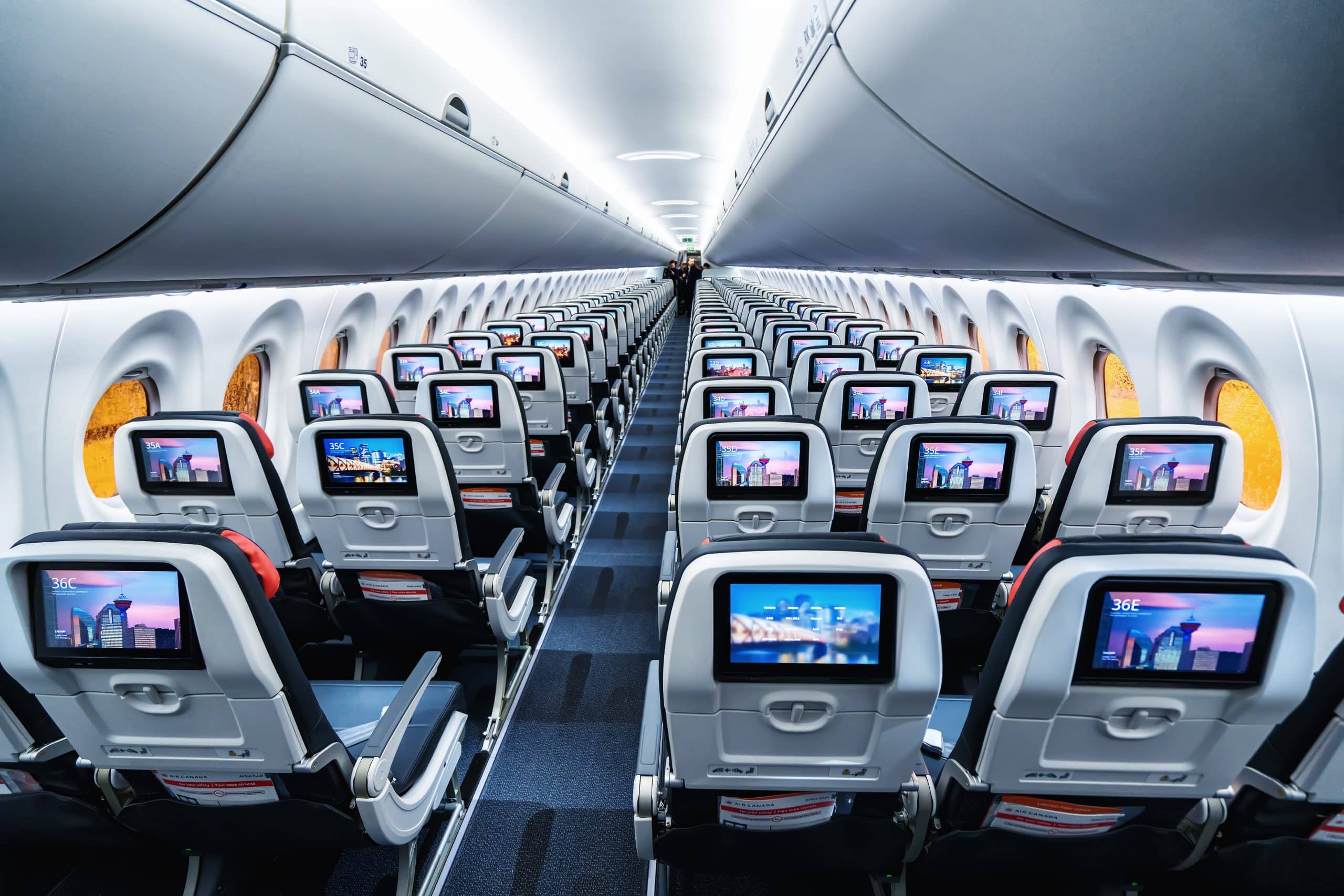
At the same time, if you already enjoy other perks that are included with your status or credit card, such as lounge access, seat selection, priority boarding, and free checked luggage, then Economy (Basic) fares could be right for you, too. Why pay more for a flight if you already enjoy the perks that come with higher fares?
For example, if you have a credit card such as the TD Aeroplan® Visa Infinite* Card, you and up to eight passengers on the same booking get one free checked bag on Air Canada flights.
TD® Aeroplan® Visa Infinite* Card
- Earn 10,000 Aeroplan points† upon first purchase†
- Plus, earn 15,000 Aeroplan points† upon spending $7,500 in the first 180 days of account opening†
- Plus, earn an additional 20,000 Aeroplan points† on renewal when you spend $12,000 within 12 months of account opening†
- Earn 1.5x Aeroplan points† on eligible gas, groceries, and Air Canada® purchases, including Air Canada Vacations®†
- Preferred Aeroplan pricing and free checked bag on Air Canada® flights†
- Minimum income: $60,000 personal or $100,000 household
- Annual fee: $139 (rebated for the first year)
If you’re a family of four simply looking for the cheapest flights, then you could book an Economy (Basic) fare and save on checked baggage fees with an eligible co-branded credit card. At a minimum of $35 (CAD) per checked bag without a credit card, the savings can certainly add up quickly.
On the other hand, if you’re in pursuit of Aeroplan Elite Status, then it’s advisable to look for a different fare with a higher accumulation rate. Since you won’t accumulate any Status Qualifying Credits, Economy (Basic) fares likely aren’t for you if you hope to qualify for or maintain Aeroplan Elite Status, or unlock Milestone Benefits.
Likewise, if you want some peace of mind if your plans change, then you should consider a higher fare that allows you to change or cancel your booking, usually for a fee. For what it’s worth, Air Canada’s Cancel for Any Reason feature isn’t available on Economy (Basic) fares.
Economy (Standard) Fares
The next level up from Economy (Basic) is Economy (Standard). This fare bracket is available to all destinations, including domestic, transborder, international, and Sun Destinations.
Economy (Standard) is also the lowest fare available for Aeroplan points redemptions, making it a popular choice for travellers looking to maximize value with points.
Economy (Standard) fares come with a few more inclusions—you’ll at least have a carry-on bag included—but they’re still more restricted compared to higher fare classes.
You also have the option to select from standard seats once the check-in window opens—perfect for those with quick fingers.
Economy (Standard) fares aren’t refundable, but you can make changes for a fee that varies depending on your destination. On select domestic and transborder routes, Economy (Standard) fares are eligible for complimentary same-day standby, but same-day airport change requests are subject to a $100–120 fee on all eligible routes.
With Economy (Standard) fares, you’ll earn 1 Aeroplan point per dollar spent on the base fare and carrier surcharges, but not on third-party taxes and fees, seat selection fees, or baggage fees.
Economy (Standard) fares get 2 SQC per dollar spent on the base fare and carrier surcharges, as well as any eUpgrade add-on fees. Note that eUpgrade add-on fares start at $125 and increase to up to $900 depending on your desired cabin of service and destination.
When it comes to LQM, you’ll get 100% of the distance flown with Economy (Standard) fares (and all other Economy fares (excluding Basic), for that matter).
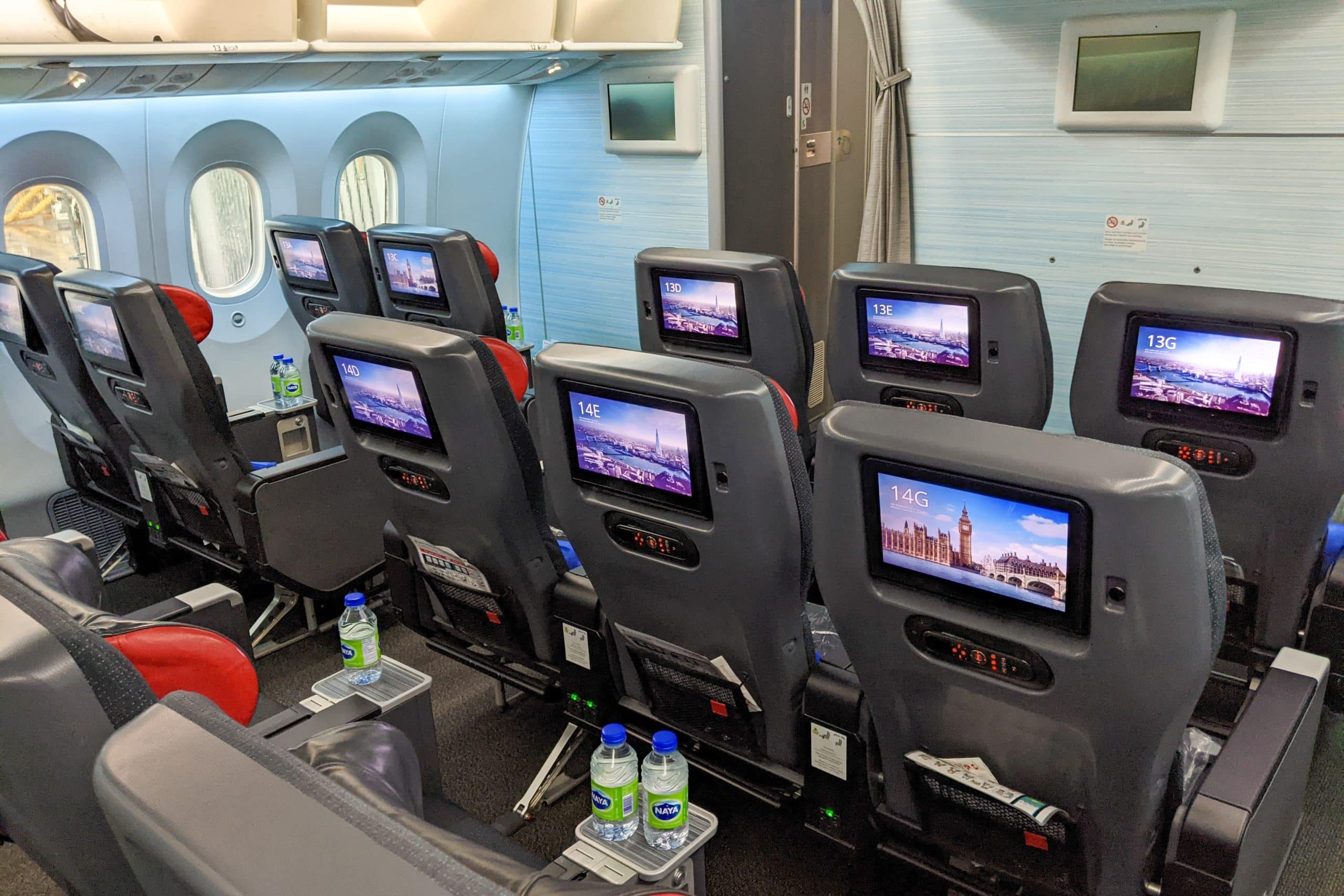
In summary, Economy (Standard) fares offer more inclusions than Economy (Basic) fares (such as the inclusion of a carry-on bag and the ability to select a seat during check-in), but are less flexible than higher fares.
Who should book Economy (Standard) fares?
The main reasons to opt for an Economy (Standard) fare over an Economy (Basic) fare are:
- You need to bring at least a full-sized carry-on and you don’t have other ways to offset baggage fees.
- You care about accumulating SQC in pursuit of Aeroplan Elite Status (see note below)
- You want to apply eUpgrades to your booking (typically with an add-on fee)
- You value the ability to make changes to your booking, even if it comes with a fee.
For travellers without status, Economy (Standard) fares offer a bit more flexibility than Economy (Basic) fares, but not nearly as much as any of the higher fares. If you’re happy to always fly in economy, and if a carry-on meets your travel needs most of the time, then Economy (Standard) fares can often be a practical and worthwhile choice.
Recall that Economy (Standard) fares get 2 SQC per dollar spent on eligible expenses. It’s important to note that Economy (Flex) fares and higher collect 4 SQC per dollar spent on eligible expenses, which is double the rate of Economy (Standard) fares.
Therefore, if you’re in pursuit of qualifying for or maintaining Aeroplan Elite Status, Economy (Standard) fares likely don’t fit the bill, since you’ll basically have to work twice as hard to get SQC.
While you can apply eUpgrades to Economy (Standard) bookings, they almost always come with an add-on fee. If you plan on using them to upgrade to a higher class of service, you’ll want to look at the difference between the total cost of the Economy (Standard) fare plus the add-on fee and a higher fare, which would either come with a lesser add-on fee or none at all.
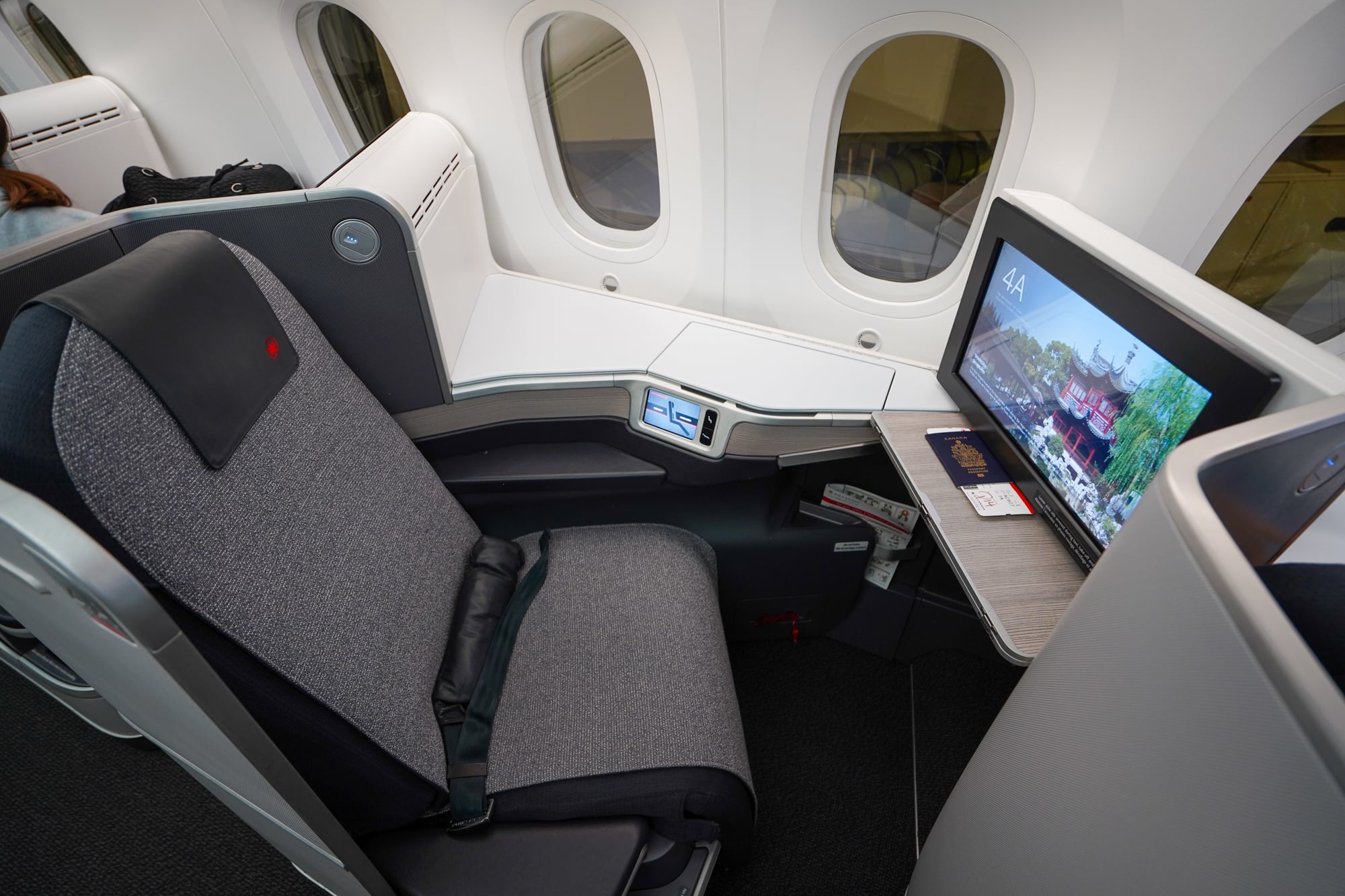
If you tend to make changes to bookings, then you should likely consider a higher fare to avoid paying change fees in addition to the fare difference (if any).
Should you have free checked baggage, Maple Leaf Lounge access, priority airport services, free seat selection, or any other perks through status or credit card benefits, then Economy (Standard) fares are a decent option, especially if you’re happy with flying in economy. Just keep in mind that you’ll get 2 SQC per dollar spent instead of 4 SQC per dollar spent with a higher fare class.
When it comes to Aeroplan redemptions, Economy (Standard) fares have the lowest cost in points. If you’re travelling in economy and have any tier of Aeroplan Elite Status, then booking Economy (Standard) is almost always the best bet, as long as you won’t be applying eUpgrades to your booking and/or won’t change your travel plans.
Economy (Flex) Fares
The next fare brand up from Economy (Standard) is Economy (Flex). Economy (Flex) fares are available across all of Air Canada’s markets, including on Aeroplan redemptions.
Economy (Flex) fares are where we begin to see more meaningful benefits that come with the higher price. In my opinion, Economy (Flex) fares are a great option for many travellers (especially Air Canada frequent flyers).
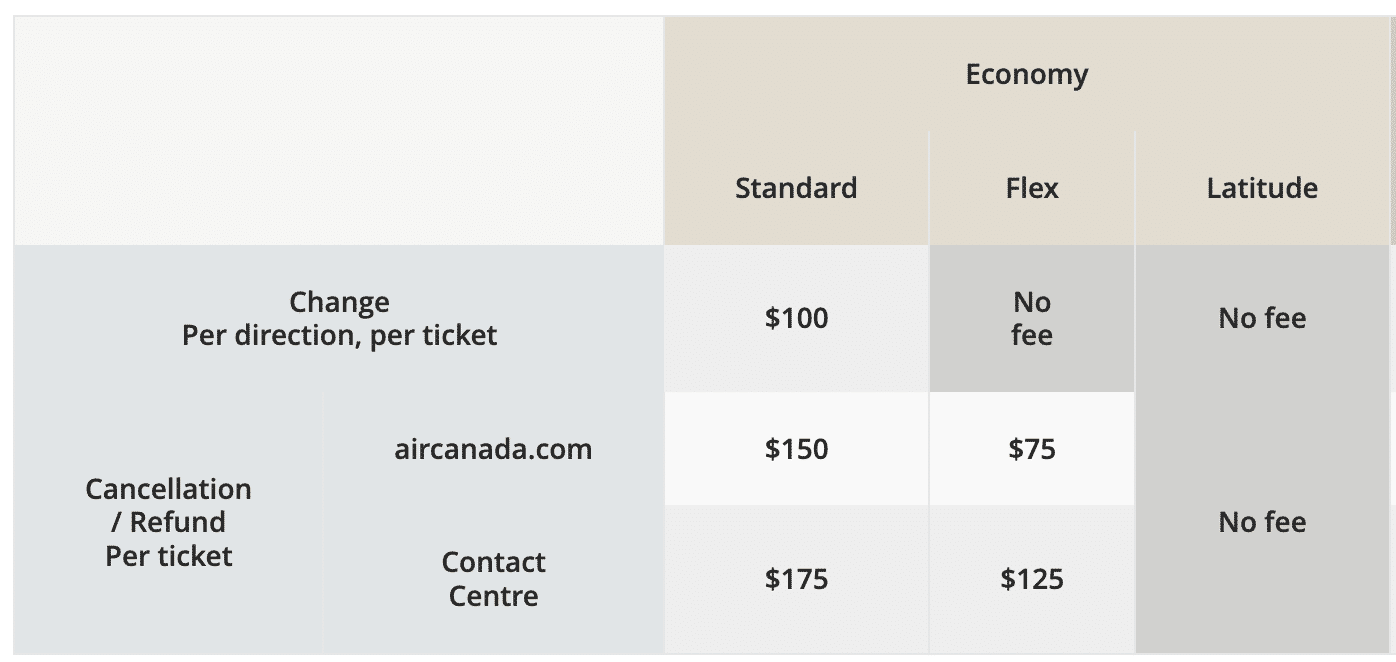
Economy (Flex) fares are refundable for a fee, but can be changed without a fee. Aside from bookings to international destinations, with which you’ll be charged a change fee, you’ll just need to pay the difference in fare (if any) with Economy (Flex) fares for changes.
On Aeroplan points bookings, Economy (Flex) fares can be changed for free (a fare difference in points may apply), but are subject to the standard cancellation fees.
Same-day airport standby is available for free on select routes within Canada and to the United States, and same-day airport changes are available for a $100–120 fee.
You’ll get 1 Aeroplan point per dollar spent on the base fare and carrier surcharges, plus 2–5 additional points per dollar spent on eligible charges if you have Aeroplan Elite Status.
Plus, you’ll get 4 SQC per dollar spent on the base fare and carrier surcharges with Economy (Flex) fares, which is the highest accumulation rate possible for SQC on paid flights. You’ll also get 100% LQM of the distance flown.
Economy (Flex) fares include one free bag, complimentary advance seat selection, and Maple Leaf Lounge access starting at $79 (CAD).
Who should book Economy (Flex) fares?
The main reasons to pay more for an Economy (Flex) fare over an Economy (Standard) fare are:
- Saving on change fees if your plans change
- Having a complimentary checked bag and free advance seat selection
- Unlocking Milestone Benefits and Aeroplan Elite Status
- Accumulating 4 SQC per dollar spent instead of 2 SQC per dollar spent with Standard fares
- Having fewer eUpgrades required
- Having a lower add-on fee for eUpgrades (if any)
If there’s any chance that you’ll need to change your flights, then Economy (Flex) fares are certainly worth considering for peace of mind. This also holds true for Aeroplan redemptions, as you’d only need to pay the difference in points, if any.
Plus, if you need to cancel your Aeroplan booking, Economy (Flex) fares have a lower cancellation fee than Economy (Standard) fares.
Plus, if you care about qualifying for Aeroplan Elite Status and unlocking Milestone Benefits, then Economy (Flex) fares should be the lowest fare that you consider. That’s because it’s the first fare the collects SQC at the rate of 4 SQC per dollar spent (which is twice as many as Economy (Standard) fares).
On flights within North America and to Sun destinations, all Economy (Flex) fares come without an add-on fee for eUpgrade usage. For international flights, you’ll have to pay an add-on fee of $500 on most Flex fares, except for if you’re a Super Elite, book a “B” or “M” fare, or only upgrade to premium economy.
It’s important to note that many of the fare inclusions for Economy (Flex) also come as co-branded credit card benefits and with Aeroplan Elite Status. If you already enjoy free checked baggage or seat selection, and if you don’t plan on using eUpgrades, then the buy-up to Economy (Flex) may not always be worth the extra price (especially if you aren’t in hot pursuit of Aeroplan Elite Status).
This is also the case with Aeroplan redemptions, on which it’s not always worth the extra points to move from Economy (Standard) to Economy (Flex).
One major exception to this is if you need to secure a booking but hope to score a premium cabin redemption on your booking. If this is your strategy, then Economy (Flex) fares would save you a change fee if you’re able to find a higher class of service.
If you plan on using eUpgrades on an Aeroplan redemption, just be sure to weigh the cost of the add-on fee against the number of extra points required on an Economy (Latitude) fare (or Premium Economy fare) to see if it’s worthwhile.
Economy (Comfort) Fares
Economy (Comfort) fares are the next step up from Economy (Flex). You can find Economy (Comfort) fares available on cash fares to domestic, transborder, international and routes to Sun destinations, but not on any Aeroplan booking.
The primary difference between an Economy (Comfort) and an Economy (Flex) fare is that Economy (Comfort) fares are fully refundable at no cost. If you don’t want to risk losing cash if your plans change and you no longer need to fly, then it’s worth considering Economy (Comfort) over Economy (Flex).
You’ll also benefit from greater flexibility, in that you can make changes in advance, as well as request a same-day airport change or same-day airport standby at no additional cost. For same-day airport changes, you won’t incur any additional fees with Economy (Comfort) fares, as long as the flight is operated by Air Canada.
As with Economy (Flex) fares, you’ll get 1 Aeroplan point per dollar spent on eligible expenses for Economy (Comfort) fares (plus additional points if you have Aeroplan Elite Status), as well as 4 SQC per dollar spent on eligible expenses. You’ll also get 100% LQM based on the distance flown.
The price of Maple Leaf Lounge access drops to as low as $59 (CAD) per visit on Economy (Comfort) fares, and you’ll receive free Preferred Seat selection on all bookings.
You’re also entitled to two complimentary checked bags.
Who should book Economy (Comfort) fares?
The main reasons to book an Economy (Comfort) fare over an Economy (Flex) fare are:
If you’re at all concerned that you might need to cancel your trip, it’s worth considering Economy (Comfort) fares, since they’re fully refundable at no extra cost. You’ll have to shoulder a higher fare to begin with, but that’s the price to pay for the added flexibility.
You may want to consider Cancel for Any Reason, if it’s available, and compare the difference in cost.
You’ll also be able to ration your eUpgrades with Economy (Comfort) fares, since you’ll typically expend fewer than with Economy (Flex) and Economy (Standard) fares. Should you be waitlisted for an eUpgrade, you’ll rank higher than anyone booked on a lower economy fare, which could mean the difference between a lie-flat seat and being stuck in the back.
The eUpgrade add-on fees for most Economy (Comfort) fares cap out at $200 (CAD), which is modest when compared to the $500+ (CAD) fees with the lower fares.
Economy (Latitude) Fares
The least restrictive, and therefore most expensive, of Air Canada’s economy fares is Economy (Latitude). Economy (Latitude) fares are available to all Air Canada markets, including with Aeroplan bookings.
Economy (Latitude) fares feature many of the same benefits of Economy (Comfort) fares, just taken to the next level.
Economy (Latitude) fares are fully refundable and may be changed in advance without a fee. You can use the same-day airport change and same-day standby benefits, too.
You’ll earn 1 Aeroplan point and get 4 SQC per dollar spent on eligible charges, as well 100% LQM based on the distance flown.
With Economy (Latitude) fares, you’ll enjoy priority check-in and baggage handling (even if you don’t have status), access to Maple Leaf Lounges starting at $49, two free checked bags, no fee for handling sports equipment, and a free Air Canada Bistro meal on domestic, transborder, and Sun routes.
Who should book Economy (Latitude) fares?
The main reasons to book Economy (Latitude) over Economy (Comfort) are as follows:
- Using the fewest number of eUpgrades on bookings
- No add-on fees for eUpgrade requests
- Not being subject to the eUpgrade clearance window
It’s worth noting that Economy (Latitude) fares can be significantly more expensive than all other economy fares, and in some cases, the cost even rivals business class fares.
Aside from being fully refundable, the main reasons to buy an Economy (Latitude) fare have to do with eUpgrade usage. You’ll expend the fewest eUpgrades on bookings, and you won’t encounter an add-on fee on any routes, but the most important reason is what we’ve coined as the “Latitude Attitude“.
All other economy fares are subject to an eUpgrade clearance window, which means that you can only instantly confirm a space-available eUpgrade within a certain timeframe prior to departure.
Meanwhile, Economy (Latitude) fares aren’t subject to a clearance window at all, which means that as long as you tick all of the boxes (by checking for eUpgrade availability and having eUpgrades available in your account valid for the date of travel), you can instantly confirm a seat in business class immediately after booking, having paid for economy.
While this remains one of the most valuable ways to redeem Aeroplan points for Air Canada business class, it can also come in handy for cash bookings when you’d otherwise pay for a business class seat.
Plus, cash Latitude fares have access to a greater inventory of eUpgrade space than Aeroplan bookings. This is great news, too, if you have an Air Canada annual worldwide companion pass available…
For example, consider the cost of a flight from Toronto to London. In this instance, an Economy (Latitude) fare costs $2,170 (CAD) and a Business Class (Lowest) fare costs $2,845 (CAD).
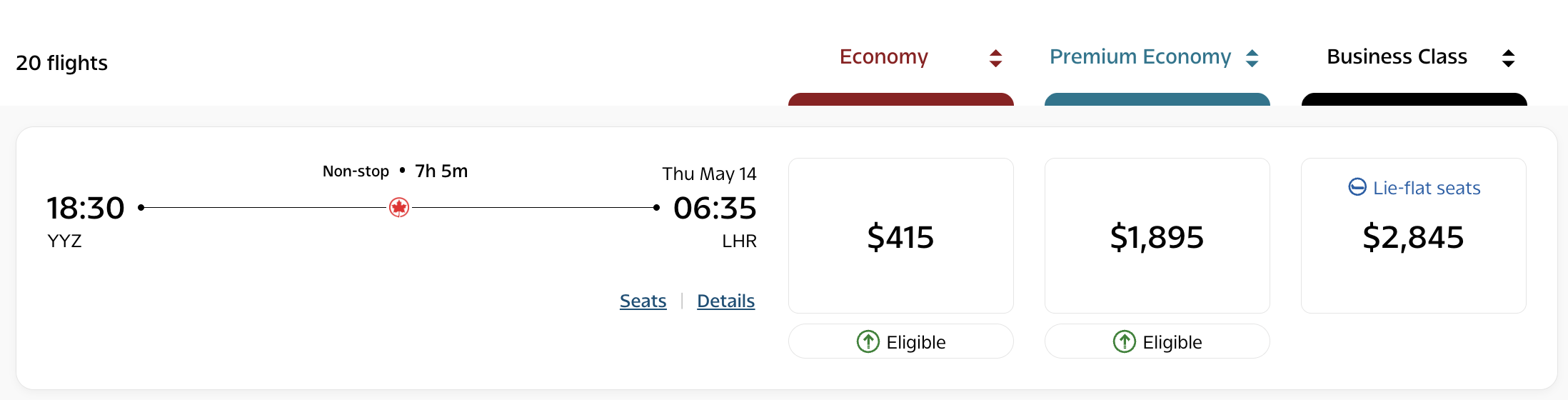
If you have the 11 eUpgrades valid for the date of travel, and if you’ve confirmed that there is eUpgrade space available on the flight, then you’ve just saved yourself over $700 (CAD) for the same seat on the same flight.
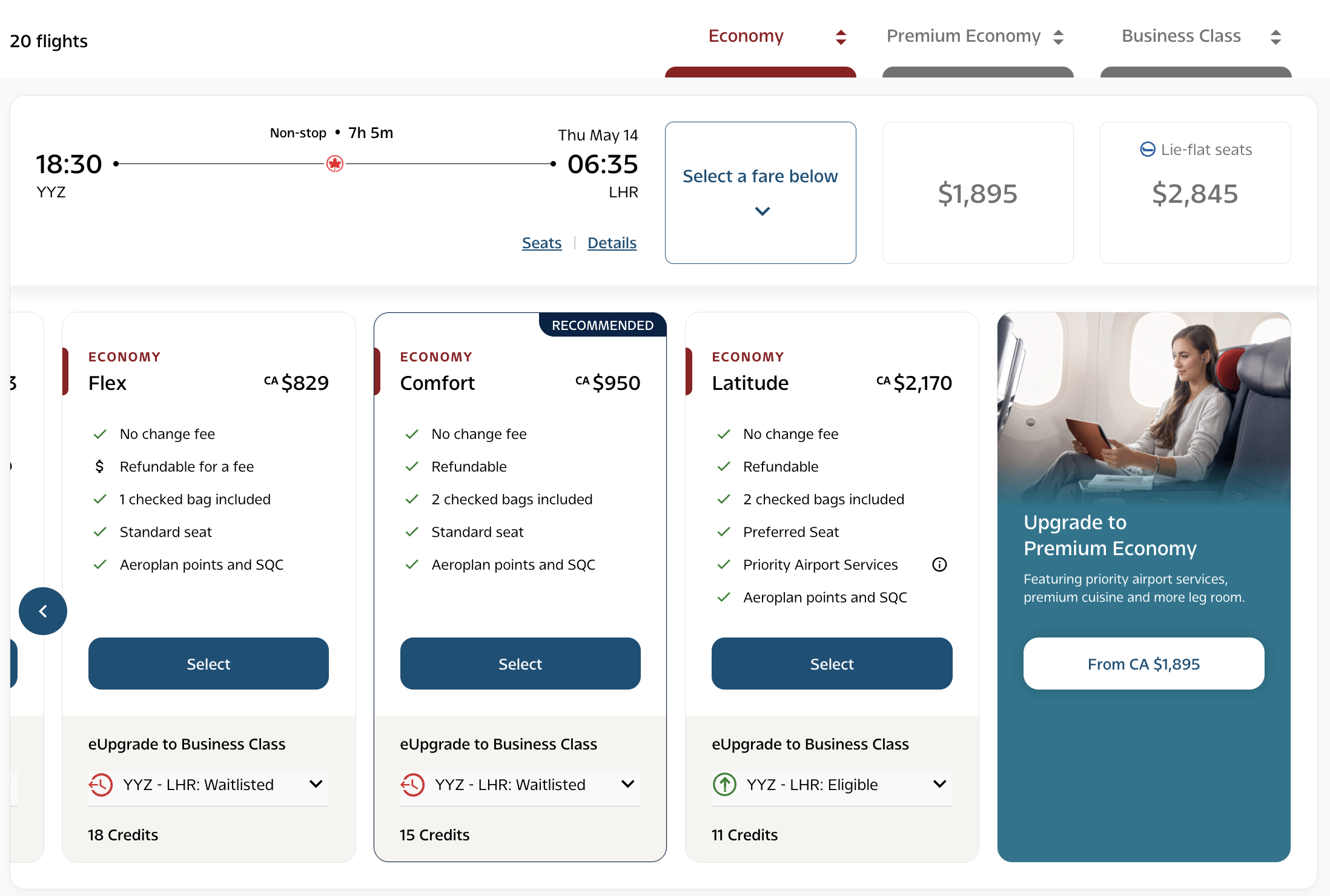
There are many other examples in which a similar approach could work, and if you’re going to pay for business class anyway, then it’s worth looking at Economy (Latitude) fares as well.
Just keep in mind that there’s a small chance that you’ll lose your eUpgrade. If you want to be guaranteed a seat in business class, book business class to begin with.
Premium Economy (Lowest & Flexible) Fares
Let’s quickly look at Premium Economy (Lowest & Flexible) fares. While there are plenty of reasons why premium economy is a great deal, it’s worthwhile adding it to the discussion of fare shopping.
The most obvious reason to book in premium economy is that you’ll enjoy an overall better experience to begin with. You’ll get a seat with more room than economy, a better meal, complimentary drinks, and priority ground services.
Premium Economy (Lowest) fares can, in some cases, be less expensive than Economy (Flex) fares, which is something to always consider when you’re shopping for flights with cash and with Aeroplan points.
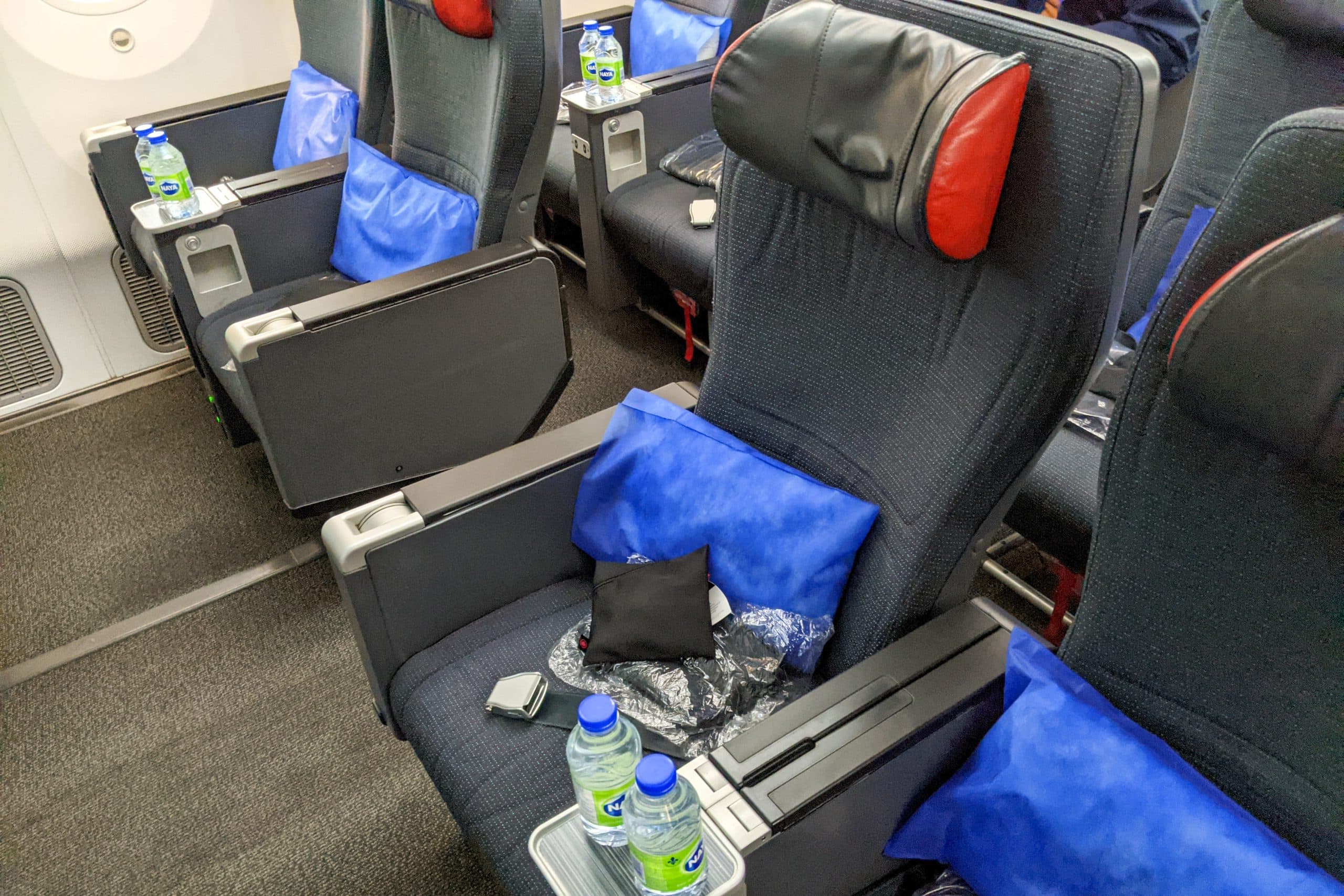
You’ll be at the top of the eUpgrade waitlist with a premium economy fare, which means that you’ll be ahead of everyone else who books an economy fare to begin with.
In this sense, you have the best chances of securing a waitlisted eUpgrade to Air Canada business class if you’ve booked in premium economy; however, you should also be ready to fly in premium economy if the upgrade doesn’t clear.
In many ways, Premium Economy (Lowest) and Economy (Flex) fares are similar, but you’ll earn 125% LQM with Premium Economy fares with the cabin-of-service bonus, and you’ll also enjoy a few more inclusions. eUpgrade add-on fees for Premium Economy (Lowest) fares are much lower than those of economy fares, too.
Premium Economy (Flexible) fares are similar to Economy (Latitude) fares in that they’re refundable and aren’t subject to an eUpgrade clearance window. If, for some reason, it costs less in cash or points to book Premium Economy (Flexible) over Economy (Latitude), then be sure to choose your fare accordingly.
You’ll also get 1 Aeroplan point and accumulate 4 SQC per dollar spent on eligible expenses with Premium Economy (Lowest & Flexible) fares.
Business Class (Lowest & Flexible)
Let’s end with a quick word about Business Class (Lowest & Flexible fares).
These are almost certainly the most expensive of all of Air Canada’s fares, and come with supercharged 150% LQM cabin-of-service bonus to fast track your way to Million Mile recognition.
You’ll also get 1 Aeroplan point and collect 4 SQC per dollar spent on eligible charges, plus additional Aeroplan points if you have Elite Status (2–6x, depending on your status at the time of travel).
The primary difference between the two fares is that the Business Class (Flexible) fare is fully refundable at no cost.
Both fares offer two free checked bags, priority ground services, access to the London Heathrow Arrivals Lounge, and Air Canada’s best in-flight experience.

The only other consideration to note is that not all business class cabins are created equally.
For example, consider if it’s worth paying for a North American-style business class seat, which is largely the same as a premium economy seat, or if there are cheaper ways to score a seat in Air Canada business class.
Conclusion
Air Canada offers a range of fares to customers across all of its markets. Lower fares come with fewer inclusions, while higher fares offer greater flexibility and more perks.
When shopping around for flights, it’s important to consider all options, including benefits that you could otherwise enjoy through an Aeroplan co-branded credit card or with your Aeroplan Elite Status. You’ll also want to consider if the fare you’re looking at is really the best deal, given your goals, travel patterns, and desired comforts.
If you’re unsure, consider reaching out to a qualified travel agent or joining the Prince of Travel community to connect with fellow travel enthusiasts for advice and insights.
This story originally appeared on princeoftravel

