


With throngs of people in Minnesota protesting the Trump administration’s immigration enforcement surge, President Donald Trump and some of his allies repeatedly described the protesters as paid.
“The thugs that are protesting include many highly paid professional agitators and anarchists,” he said Jan. 18 on Truth Social.
“They’re paid agitators and insurrectionists,” Trump said at a Jan. 20 press conference.
The next day in Davos, Switzerland, Trump said the “fake” protests were “done by agitators and professional insurrectionists. … They’re professional troublemakers.”
He added, “We are looking very strong at the money, too, in Minnesota and other places.”
We asked the White House for Trump’s evidence about “paid” protesters and received no response. Although some people on social media have provided what they said is evidence of such activity, we found none of the claims held up to scrutiny.
Yet Trump’s claim has become a talking point among his leaders and supporters. Homeland Security Secretary Kristi Noem said on CBS “Face the Nation” that Minneapolis is distinct from other cities, where she said officials didn’t see “funded protesters.”
Vice President JD Vance at a Jan. 8 White House press briefing asked, “When somebody throws a brick at an ICE agent or somebody tries to run over an ICE agent, who paid for the brick?” (Bricks are commonly falsely described as evidence of organized, paid protests.)
Interviewed Jan. 13 on CNN’s “The Source” about Renee Good’s fatal shooting by an ICE officer, Sen. Markwayne Mullin, R-Okla., called for an investigation of “paid protesters, and who’s paying them to obstruct federal officers from doing their job.”
Minnesotans have responded to immigration agents’ presence in their communities for weeks. The protests have been widely covered and there’s no evidence any of it is staged. None of these politicians explained who they believed was underwriting the protests.
Experts told us that the majority of protesters are locals showing their dissent. We found a large volunteer protest movement in the Twin Cities.
Yohuru Williams, a historian and director of the Racial Justice Initiative at Minnesota’s University of St. Thomas, told PolitiFact in an email that “most protesters are residents of the state who are concerned not only about the presence of ICE in the state but also the President’s usurpation of power.”
People participate in a protest and noise demonstration calling for an end to federal immigration enforcement operations in the city, Jan. 9, 2026, in Minneapolis. (AP)
How Minnesotans are protesting immigration action
The Twin Cities have a long tradition of community organizing among civic groups and institutions. Labor unions, faith-based groups and immigrant organizations have played roles in resisting the federal immigration operation in Minnesota. Groups have staged high school walkouts, marches and sign-waving demonstrations.
The group Singing Resistance holds peaceful vigils with singing. Volunteers have donated to food drives and delivered groceries to families scared to leave their homes. The Smitten Kitten, a Minnesota shop that sells sex products, has collected food, diapers and other necessities for immigrants staying at home. St. Paul’s Mischief Toy Store distributed free whistles for people to alert others to ICE activity. Restaurants offered special menu items such as “f— ICE cold brew” to raise money for an immigrant rights group.
Jillian Hiscock, owner of the women’s sports-themed A Bar of Their Own, told PolitiFact the protesters are not paid.
“We’ve had folks from literally every walk of life stopping in to make posters and grab whistles — families with small children, bundled up seniors with walking canes that we helped create a necklace for their sign so they wouldn’t have to hold onto anything, and everything in between,” Hiscock said in an email.
Hiscock said she has heard many people who are protesting now say they never took action in the past, and the descriptions of “paid protesters” aim to undermine their voices.
“I truly think it’s a made-up sentiment to try to minimize the groundswell of the movement here on the ground,” Hiscock said.
Neighbors joined Signal chats to alert each other to immigration enforcement actions nearby and take action. The Monarca Movement has held “upstander” trainings to teach people how to record video of immigration agents or how to respond if agents leave behind a child or abandon a car during an arrest.
On Jan. 23, thousands of people marched in downtown Minneapolis in subzero temperatures before rallying at the Target Center. Earlier in the day, about 100 clergy members were arrested in an airport protest. Hundreds of businesses closed Jan. 23 for the “ICE Out of Minnesota Day of Truth and Freedom” event.
Describing the weather that day on air, Minnesota Vikings radio announcer Paul Allen joked about protesters getting “hazard pay.” Three days later, he apologized after backlash, calling it “a cheap one-liner” and “insensitive and poorly timed,” and said he would take a few days off.
Danielle K. Brown, a Michigan State University journalism professor who formerly worked at the University of Minnesota, told PolitiFact in an email, “There is no evidence of philanthropic efforts funding expansive civilian protest efforts.”
Professional community organizers have been involved in the protests, which is normal for all protests, Brown said. Groups with different ideologies routinely speak at such events.
However, “The majority of protesters are still locals who do not get paid to engage in protest and resistance work,” Brown said.
Generally, it’s not uncommon for groups to distribute signs.
Timothy Zick, a First Amendment expert and William & Mary law professor, said residents of the community were protesting “what they view as lawless misconduct by ICE agents.” He said the Trump administration’s descriptions of paid protesters are “baseless” and aim to diminish and dismiss dissent.
Critics of 2024’s Israel-Gaza campus protests and 2025’s anti-Trump “Hands Off” protests in Washington, D.C., also used the term “outside agitators” or other terms, but our reporting found the claims lacked merit. Zick previously told PolitiFact the description has been used throughout history to discredit large historical movements, regardless of how peaceful they were.
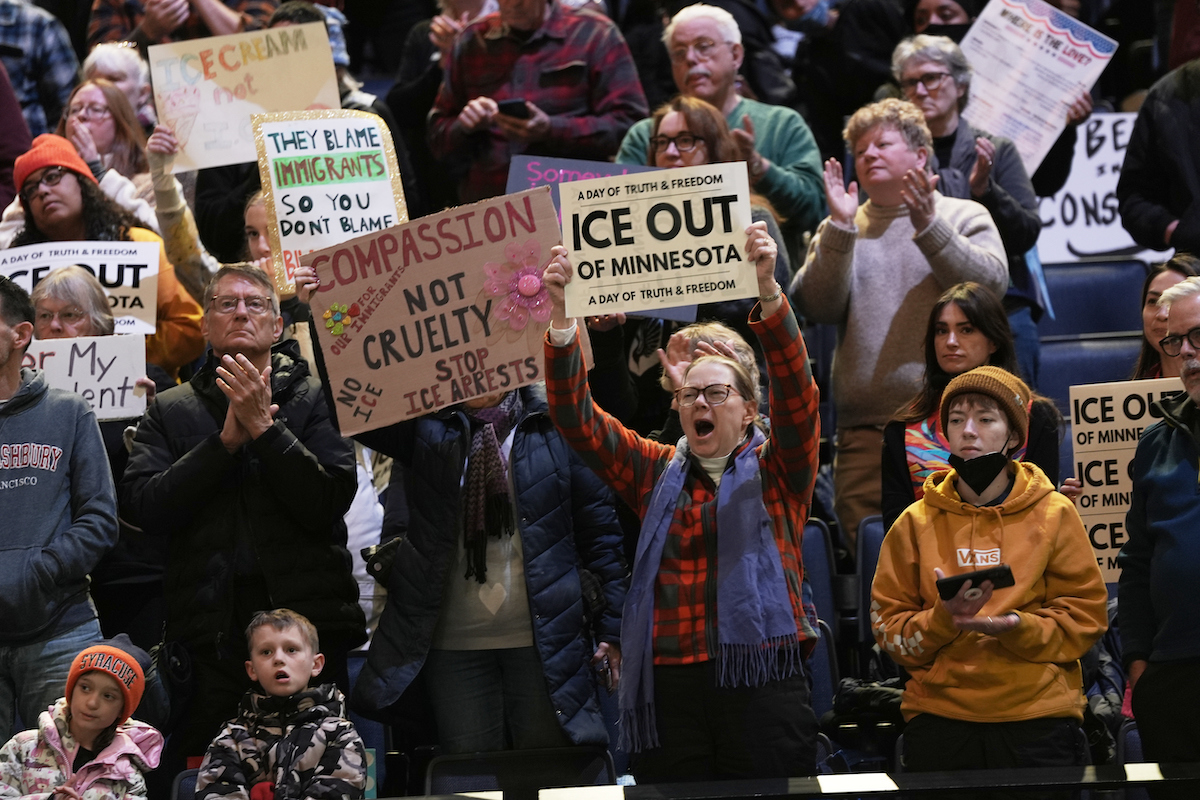
Attendees hold signs during a rally against federal immigration enforcement at Target Center on Jan. 23, 2026, in Minneapolis. (AP)
These videos aren’t evidence protesters are getting paid
Social media users amplified allegations that professional protesters or agitators are in Minnesota to make money. When we reviewed their posts’ evidence, we found they were generated with artificial intelligence or recycled content from years ago.
In one example, an artificial intelligence-generated video shared on TikTok claimed to show conservative influencer Nick Shirley interviewing a protester in Minneapolis, who says he’s jobless but is getting $20 an hour to protest. The video has a watermark for Sora, OpenAI’s video-generating platform. It came from an account which has shared many other AI-generated videos.
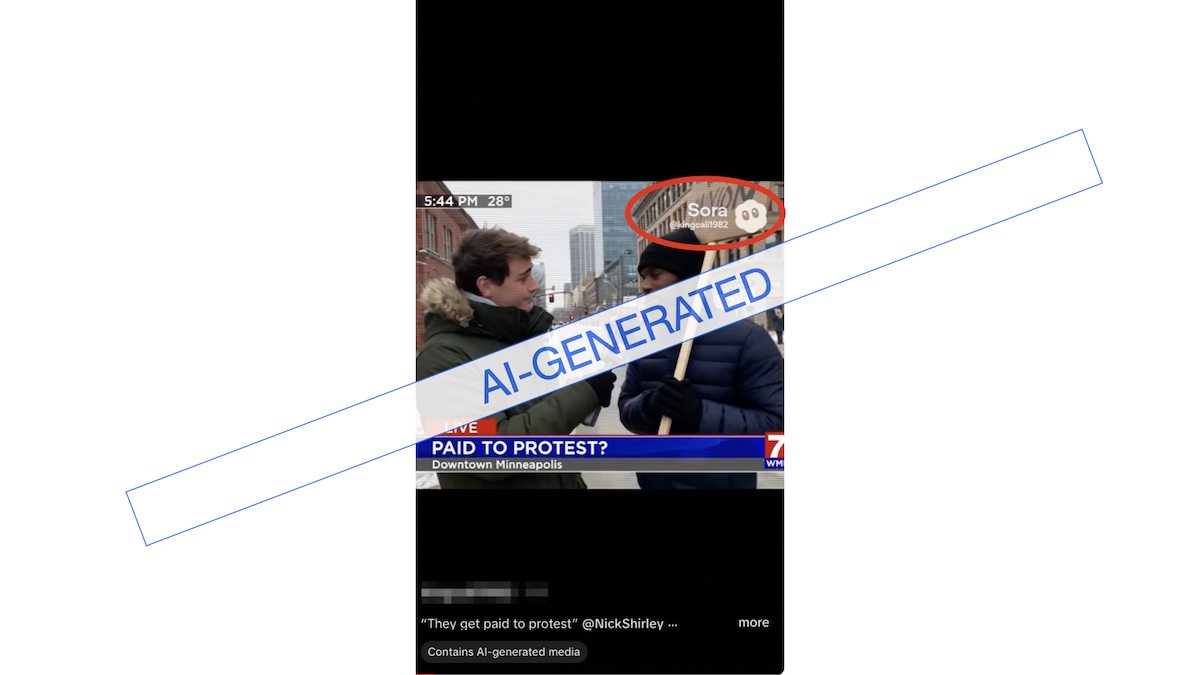
(Screenshot of TikTok post showing Sora watermark.)
In another example, an X post shared photos of documents it said were contract paperwork for paid protesters. “This is 100% proof that NONE of the Democrat protests are organic,” the Jan. 20 post said. “They can all be IGNORED because they are FAKE.”
The same images were shared in previous years, including in a 2018 blog post claiming to show proof that protesters were paid to plan the 2015 Baltimore riots; in 2020 to claim people protesting George Floyd’s murder were following a manual; and in 2024 by Shirley to falsely claim paid protesters were marching outside of the Democratic National Convention to demand a ceasefire in Gaza.
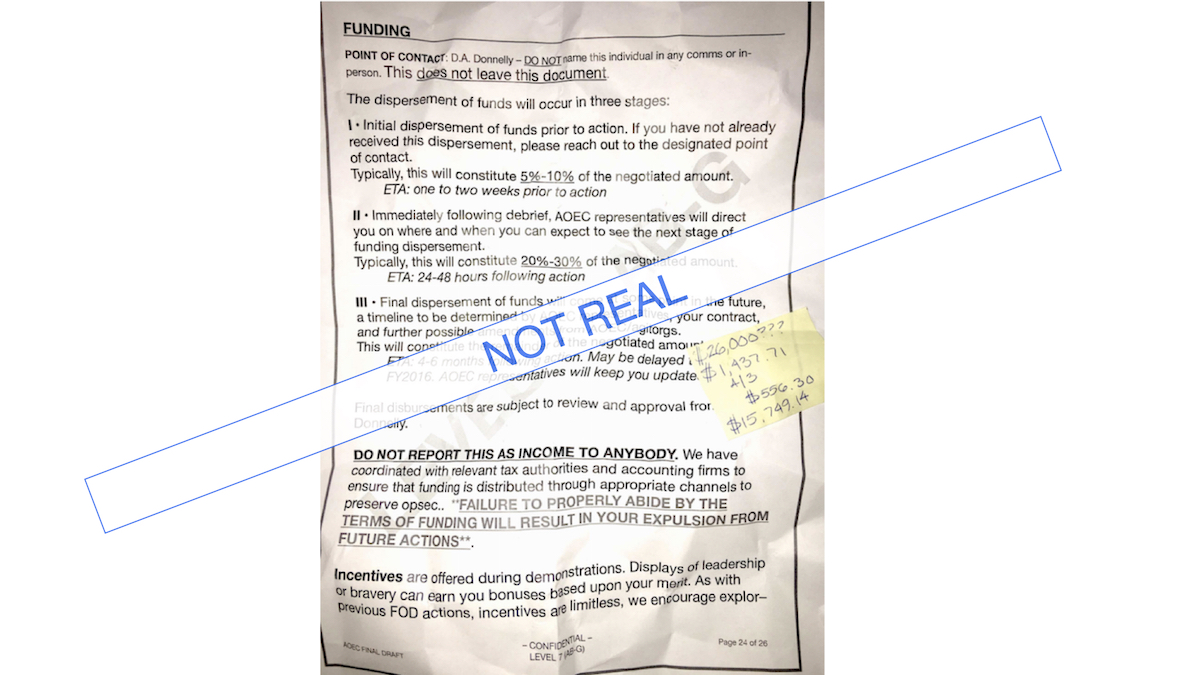
(Screenshot of page of a fake contract for paid protesters.)
One Fox News video was shared widely as if it showed one protester’s admission she had been paid. In it, Fox News host Laura Ingraham stood in the streets of Minneapolis questioning a protester who was shouting, “Shame! Shame! Shame!” in front of the camera. “Do you have a job?” Ingraham asked the woman, whose face was partially covered by a scarf. “I’m getting paid right now,” the protester answered. Ingraham flashed a thumbs up to the camera. PolitiFact couldn’t confirm the protester’s identity or motives and we found no further reporting on the incident.
Our ruling
Trump said protesters against the federal immigration crackdown in Minnesota are conducting “fake protests done by agitators and professional insurrectionists. …They’re professional troublemakers.”
Minnesotans have been protesting immigration agents in their communities for weeks. Some professional community organizers are involved in the protests but evidence shows a large volunteer protest movement in the Twin Cities.The accusation that protesters are “paid” is a frequent talking point to dismiss the legitimacy of grassroots activism and criticism of the government.
The social media posts we found that claimed to show evidence of paid protesters were either AI-generated, recycled conspiracy theories or unsubstantiated.
We rate this statement False.
RELATED: In Context: What did Minneapolis Mayor Jacob Frey say about police fighting ICE?
RELATED: Fact-checking Sen. Mark Warner that Trump shortened ICE agent training to 47 days
This story originally appeared on PolitiFact

