


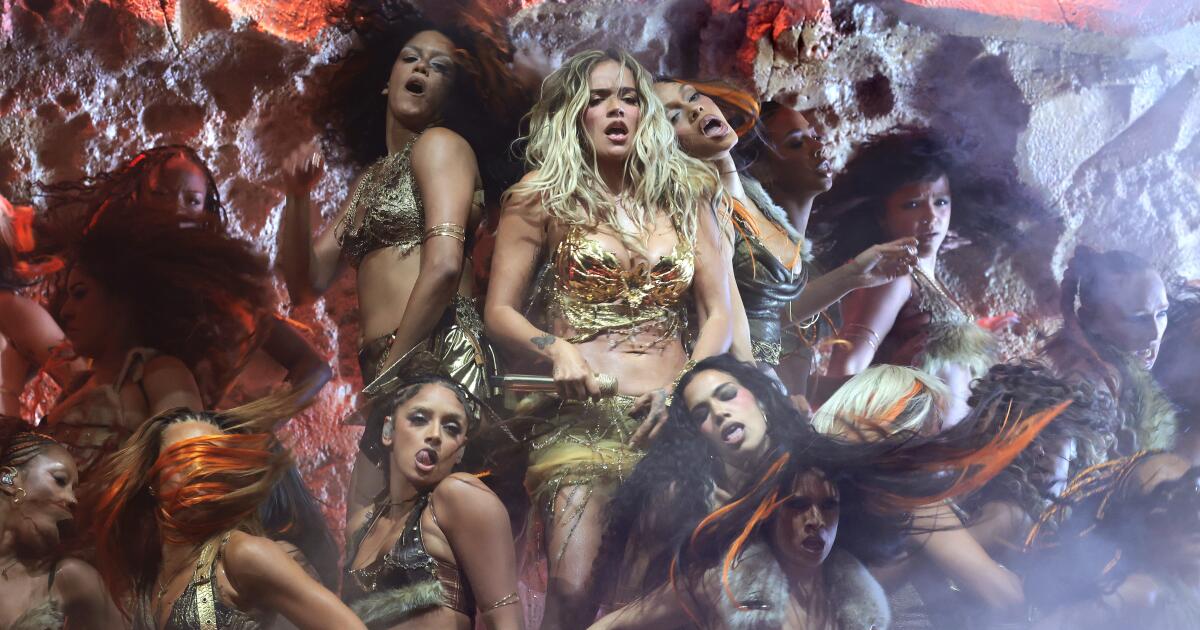
On Sunday night, Karol G became the first Latina to headline Coachella. Along with all her pride in that achievement, she seemed a little angry at that fact too.
“It feels late,” the Colombian superstar said onstage, in a brief English-language address to the audience in a set otherwise fully in Spanish. “ It’s been 27 years of this festival going on…Before me, there were so many great Latino artists that gave me the opportunity.”
“Latinos have been struggling in this country lately,” she continued. “We stand for them. I’m proud this brings out the best of us—unity, resilience, a strong spirit. We want everyone to feel welcome to our culture, our roots, our music, I want everyone to feel proud of where you come from.”
Karol let those lines here serve as her brief indictment of the present, jackbooted environment around immigration and repression in the U.S. Making belated history by headlining Coachella would seem far removed from those concerns.
Yet as this sweeping, heady, spectacularly ambitious and relentlessly lusty set showed over its hour and half, the body is the first site of liberation. If you can’t move like you want, where you want, you’re not free. Karol G finally commanding this stage was living proof it’s possible to kick that door in.
Karol G performs at the Coachella stage on weekend one of the Coachella Valley Music and Arts Festival at the Empire Polo Club in Indio on Sunday, April 12, 2026.
(Christina House/Los Angeles Times)
Karol’s most recent LP “Tropicoqueta” was a history lesson, a joyful and well-studied rip through decades of Latin folk and pop. But this set started older. Primeval, even.
“She was born under a full moon in the arms of mother nature. The jaguars taught her to run, the birds to fly,” her intro video intoned. “A storm of pain fell upon her and all the women of earth.”
Then the stage lit up to show a carved-out cave in a cliffside, housing an absolutely killer all-femme backing band in the grotto and a full company of dancers in every hue of the Americas.
Karol came of age during the ascent of reggaeton and Latin club music as a new default in pop, and the first third of the show played to those uncompromising but crowd-pleasing strengths. The statement piece “Latina Foreva” whipped into the after-hours club cut “Un Gatito Me Llamó,” then the hard-spitting “Oki Doki.” Her stage arrangement of “El Makinon” with guest Mariah Angeliq, was so artfully lascivious, dancers composed like a painting but heaving with sex.
(No shade to last night’s headliner Justin Bieber, but this was the definition of a high-effort set).

Karol G performs at the Coachella stage on weekend one of the Coachella Valley Music and Arts Festival at the Empire Polo Club in Indio on Sunday, April 12, 2026.
(Christina House/Los Angeles Times)
The more regal, history-minded tracks on “Tropicoqueta” got a full build too, like the winsome “Papasito,” then a read on the Mexican classic ballad “Son de la Negra” with an all-female mariachi combo, and her own “Ese Hombre Es Malo” given high drama through time-worn Latin musical tools. She built an enormous parrot at the tip of her B stage, and changed into some red and blue plumage of her own. She nodded to peers like Becky G (who stopped by for “Mamii”), influences like reggaetonero Wisin (a guest on “Pam Pam” and others) and a cover of Gloria Estefan’s “Mi Tierra.” She debuted an absolutely dreamy rock ballad with guest guitarist Greg Gonzalez of the band Cigarettes After Sex, a longtime favorite of Karol’s.
Ramping up towards the set closer with “Gatúbela,” “Bandida Entrenada” and “Ojos Ferrari,” her dancers doused her in pitchers of water (it’s fair to say no artist working today can imbue horniness with this much artistic intent), and her live band shredded through breakthrough Hot 100 hit “TQG” and “Amargura.”
“Si Antes Te Hubiera Conocido, ” her Latin Grammy favorite, will be a block-party fixture for generations to come. But as it bent into a remix of “Provenza,” Karol hit on a classic Coachella denoument—the fireworks—exploding, hands-up rave anthem to end the night. Whatever you knew about Karol G going into this set, watching her scream with delight in the company of her band backstage, you could see she more than belonged there—she’d mastered this role, made this fest-closing slot finally live up to its potential for transformation.
Identity and where one belongs will always be battlefields in this country, literal and cultural. As Bad Bunny showed headlining the Super Bowl (and Coachella in 2023), that’s a tale even older than the United States. For Karol G, an emissary of Colombia, of South America, to open the doors to everything she loves and invite us in: what a gift back to us, even if we were late to accept it.
This story originally appeared on LA Times

