


The 1965 Voting Rights Act has long been considered a landmark Civil Rights era achievement that aimed to end discriminatory practices against Black Americans who tried to vote.
But a recent U.S. Supreme Court ruling largely gutted the law, and many Republicans — including U.S. Rep. Byron Donalds, the GOP frontrunner in the race for Florida governor — celebrated the court’s decision.
Donalds countered that it was Democrats’ discriminatory gerrymandering practices that spurred the Voting Rights Act’s creation in the first place.
Congress wrote and passed the 1965 law “because of the Democrat party at the time, especially in the South, who were racially gerrymandering districts to disenfranchise Black voters,” Donalds said in a May 4 interview with Benny Johnson, a conservative commentator. (Gerrymandering is drawing district boundaries to give one political party, incumbent or group an advantage.)
Historians told PolitiFact that racist gerrymandering was not the driving force behind the law’s creation.
The Voting Rights Act was created to combat discriminatory practices against Black Americans who tried to vote, including literacy and property tests, grandfather clauses, poll taxes, voter roll purges, intimidation and violence.
“Donalds’ statement is not accurate, not even close,” said Alex Keyssar, a Harvard University history and social policy professor. The Voting Rights Act passed because, in most Southern states, Black Americans were not permitted to vote or even register to vote, he said.
“Numerous devices were used to prevent Black people from registering, like literacy tests and understanding clauses, but gerrymandering was not the issue. There was no need to racially gerrymander because they couldn’t vote in the first place.”
Although Donalds pointed at Democrats for the gerrymandering, Democrats today are not the southern Democrats of the 1960s.
Carol Anderson, an Emory University African American studies professor, called Donalds’ comment ahistorical and disingenuous, saying it ignores the Southern Strategy, where Republicans turned the Democratic South into a GOP-stronghold by criticizing the Civil Rights Movement to gain support.
“It treats the demographics of the two parties as stagnant, when it was the mid-1960s through the Reagan era when the major shifts happened.”
PolitiFact asked Donalds’ campaign for comment but received no reply.
President Lyndon B. Johnson moves to shake hands with Martin Luther King, Jr. while others look on during the signing of the Voting Rights Act on Aug. 6, 1965, in Washington, D.C. (photo courtesy of LBJ Library, photo by Yoichi Okamoto)
Why was the Voting Rights Act created?
Congress passed the Voting Rights Act to enforce the 15th Amendment and end over a century of discriminatory practices that prevented Black Americans, particularly in the South, from voting.
Despite Black men gaining the right to vote in 1869 with the amendment’s passage, many Southern states spent decades creating significant barriers for when Black men tried to register or vote. In practice, those barriers nullified the constitutional protection.
“The Voting Rights Act was necessary because the South had choked the life out of democracy through poll taxes, literacy tests, brutality, and white domestic terrorism,” Anderson said.
Other barriers included property tests, allowing only property owners to vote and “grandfather clauses” which said people who didn’t own property could vote if their fathers or grandfathers had voted before 1867 — before Black men had the right to do so.
These Jim Crow obstacles led to decades of marches and voter registration campaigns that left activists brutally beaten or murdered. Mounting civil rights activism, along with increased media attention, pushed the federal government to act.
“Bloody Sunday,” on March 7, 1965, in which police savagely beat hundreds of protesters as they set out to march for voting rights in Selma, Alabama, was another turning point, speeding the Voting Rights Act ’s passage less than a month later.
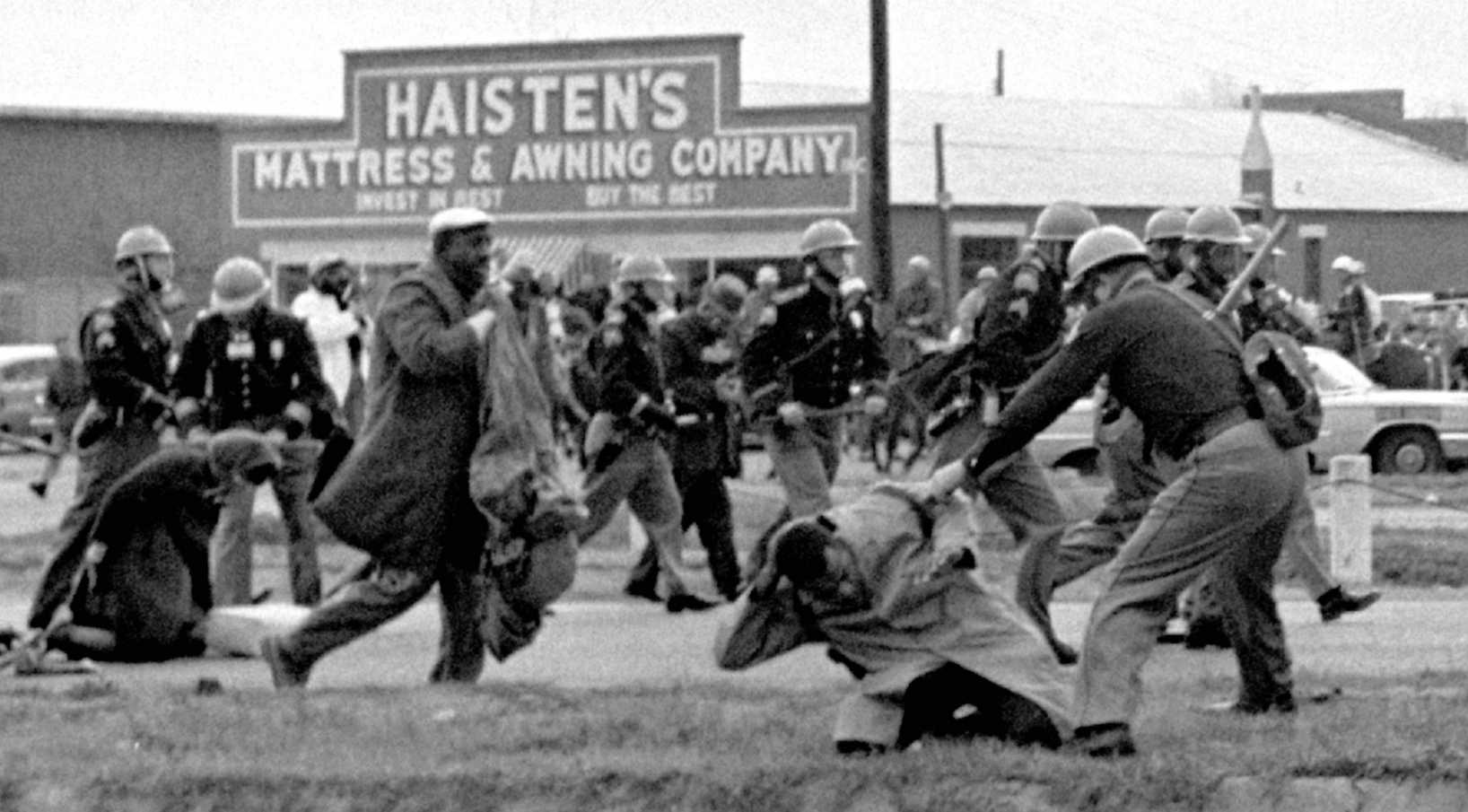
State troopers hit protesters with billy clubs to break up a civil rights voting march in Selma, Ala., on March 7, 1965. (AP)
What the Voting Rights Act did
The law required state and local governments, including some Florida counties, with a history of discriminatory voting practices to go through a federal approval process called preclearance before changing any election laws or procedures. (The Supreme Court overturned this in 2013, ruling that the formula used to determine what places needed preclearance was unconstitutional because it was based on 1960s and ‘70s electoral conditions.)
“The VRA sought to have federal monitoring of areas throughout the U.S. that had a history of these actions,” said Keneshia Grant, a Howard University political science professor. “While much of that discrimination was happening in the South, it was not limited to that region.”
Section 2 of the law also prohibits governments from imposing election procedures or practices that would deny or restrict the right of U.S. citizens to vote based on race or color.
As a result, states drew new congressional maps to create districts with a Black majority, a practice the Supreme Court all but overruled.
How much did discriminatory gerrymandering factor into the law’s creation?
Experts said the VRA primarily sought to fortify the 15th Amendment, which guaranteed that the right to vote could not be denied based on race. The law does not mention “apportionment,” “gerrymandering” or “redistricting.” Instead, it uses a broad brush to prohibit the many ways Black Americans could have their right to vote abridged or denied.
Some cases of discriminatory gerrymandering, primarily in the South, took place before the law passed, but historians say it wasn’t a primary tool for voter disenfranchisement at that time. It was lumped in as one of many discriminatory election procedures that the legislation aimed at remedying without explicitly saying so.
“I would not say that (gerrymandering) was the driving factor for the VRA,” Grant said. “That would be like saying desegregation of buses was the reason for the Civil Rights Act. Are these things related? Yes. But the Civil Rights Act was much bigger than busing. Likewise, the VRA was bigger than just the lines.”
Attempts at racial gerrymandering became more prevalent after the VRA passed, Keyssar, from Harvard said. It was in anticipation of such moves, he said, that the law required some states to get preclearance before amending election laws, which would include districting issues.
Our ruling
Donalds said Congress wrote and passed the 1965 Voting Rights Act because “the Democrat party at the time, especially in the South, were racially gerrymandering districts to disenfranchise Black voters.”
The law sought to enforce the 15th Amendment and end longstanding racist practices against Black Americans to keep them from voting — including literacy tests, poll taxes, property tests, intimidation and violence.
Historians say racist gerrymandering existed before the law passed, but it wasn’t a primary tool for voter disenfranchisement at that time. The practice became more prevalent later in an attempt to neutralize the power of newly cast ballots as more Black people were able to vote.
The law doesn’t mention gerrymandering, and while it’s included as one of many discriminatory practices the law sought to prohibit, it wasn’t the reason for its creation.
We rate Donalds’ statement False.
RELATED: What does federal law say about partisan gerrymandering? Fact-checking Florida Democratic leader
RELATED: Is Florida’s mid-decade redistricting plan ‘illegal,’ as some Democrats say?
This story originally appeared on PolitiFact

