


Great science fiction books don’t just tell a story; they build a believable and fascinating world that readers can easily step immerse themselves in. When creating a universe, every detail must be carefully brought to life, without one being sacrificed for the other. As much as character development is an integral part of any story, it is nothing if the very foundation on which the premise is built is shaky.
While it’s easy to believe that scale is equal to a flawless world, that isn’t always the case. There are some science fiction novels with a massive scope that aren’t able to make readers understand how their universe actually works. The sci-fi books with perfect worldbuilding ensure imagination is matched by structure, and every detail feels like part of a system rather than decoration. From novels grounded in hard science to those that introduce new concepts, the world in these books feels alive because they behave like real ones.
Hyperion by Dan Simmons
The winner of the 1990 Hugo Award for best novel, Hyperion by Dan Simmons, tells an intricate tale that transcends space and time. Set in a distant future where humanity has spread across hundreds of planets after the destruction of Earth, the literary work is centered on seven strangers. These strangers were chosen for a final pilgrimage to the remote and dangerous world of Hyperion, a planet shrouded in mystery and home to the Time Tombs, ancient structures that move backward through time, and the terrifying Shrike, a nearly godlike being associated with pain, death, and prophecy.
Simmons does something extremely smart in Hyperion. The novel is vast and has a lot of moving parts, which readers need to acclimatize to. Instead of overwhelming the reader with information, Hyperion unfolds through the personal narratives of the pilgrims, each exploring a different corner of the universe. Through a priest’s horror-filled experience, a soldier’s time-twisted war story, and a detective’s encounter with artificial intelligence, the reader gradually pieces together how this universe works.
The Left Hand Of Darkness by Ursula K. Le Guin

With The Left Hand of Darkness, Ursula K. Le Guin achieved something that various authors can only dream of; she won both the Hugo and Nebula awards. In the exceptional sci-fi novel, Genly Ai, an envoy from Ekumen, a vast interstellar alliance, is sent to Gethen, where he has been assigned to persuade its people to join a wider community of worlds. However, Genly quickly realizes that his biggest challenge isn’t politics or technology; it’s Gethen’s society, which operates on a different level than his own.
The Left Hand of Darkness is considered a groundbreaking novel because the people of Gethen are ambisexual, a concept which was rarely talked about during the time it was published.
At first glance, The Left Hand of Darkness is a simple story about alliances, but it’s way more than that. As much as the icy landscapes and the incredible details about the planet that Le Guin includes in the novel are why it’s so compelling, it’s how the author builds a fully functioning society that sticks with readers. Karhide, for instance, is an absolutist monarchy while Orgoreyn is a Stalinist country. All this results in a world that is rich in culture and politics.
Foundation by Isaac Asimov

Isaac Asimov is widely considered one of the pioneers of science fiction, with Foundation proving why that’s the case. Like many stories in science fiction, the novel is set in the future, where humanity has spread across the entire Milky Way and formed a vast Galactic Empire. The book begins when the Empire is at its most powerful, but also quietly decaying. Hari Seldon, a mathematician, develops a revolutionary science called psychohistory, which combines history, sociology, and statistical mathematics to predict the future behavior of large populations.
Using this science, Seldon foresees that the Galactic Empire is about to collapse into a long dark age lasting thousands of years. With Foundation being set across the entire Milky Way, the novel gives a sense of a fully populated galaxy with thousands of worlds, cultures, and political systems. Because Asimov’s masterpiece takes place over centuries, readers truly understand the novel’s scale and witness the rise and fall of multiple societies.
The Three-Body Problem by Liu Cixin

The Three-Body Problem is probably one of the most relevant hard science fiction novels of our time, as it gives a glance into how society would react to a looming invasion by extraterrestrial beings. The story starts with Ye Wenjie, a scientist who contacts an alien species called the Trisolarans, beings who live on a planet in a three-star system. Because the gravitational interactions between three suns are chaotic and unpredictable, their planet undergoes constant cycles of extreme heat and cold. As their civilization is unstable, they are desperate for a new home, and thanks to Ye Wenjie, they choose Earth.
Liu Cixin does an incredible job of building two worlds: Earth and Trisolaris. In Trisolaris, the author gives scientifically accurate details about how a planet with three suns would function while also showing the different reactions that humans would have to impending doom. The fact that the alien invasion isn’t immediate and spans centuries allowed Cixin to outline the different ways that the world evolves, adding a vastness to The Three-Body Problem.
The Culture Series by Iain M. Banks

Iain M. Banks’ The Culture series comprises 10 novels, but because of how the books are structured, they could be read in any order. Set in a far-future, post-scarcity civilization called the Culture, where advanced technology has eliminated poverty, disease, and most material limitations, humans and other species live freely and pursue pleasure.
In The Culture series, Banks has created one of the most fully realized and logically consistent futuristic civilizations in science fiction. Every aspect of life in the novel flows naturally from its core premise of post-scarcity abundance to AI governance. Reading about an essentially perfect society might sound boring, but The Culture series is the opposite of that, as it depicts a society that shifts toward questions of identity and personal freedom.
Dune by Frank Herbert
Frank Herbert’s Dune series is often cited as one of the best works in the genre because of its detailed world-building. Paul Atreides, the young heir of House Atreides, whose family is given control of the desert planet Arrakis, the only source of spice, the most valuable substance in the universe. House Atreides, however, is betrayed, and Paul is forced to flee into the desert, where he eventually finds refuge among the Fremen.
The title of Herbert’s book itself is a direct reference to Arrakis, which, in a way, gives readers a glimpse into the novel’s worldbuilding and story. Arrakis isn’t merely a backdrop in Dune but a living ecological system with its sandworms, spice production, and water scarcity being as compelling as the political struggles.
The Dispossessed by Ursula K. Le Guin

Ursula K. Le Guin struck gold again with The Dispossessed, a novel that won both the Hugo and Nebula awards in 1975 and 1974, respectively. The book takes place in two worlds: Anarres and Urras. Anarres is a harsh and barren moon where society is organized around anarchist principles. There is no government, no private property, and no traditional hierarchy. Unlike Anarres, Urras is rich, lush, and highly developed, but it is also deeply divided by inequality, political conflict, and capitalist competition. Shevek, the novel’s protagonist, moves from Annares to Urrras to complete his groundbreaking theory of time.
Le Guin exceptionally uses two opposing planets to explore how humans can live differently but still be unhappy. Through Shevek’s journey between Anarres and Urras, Le Guin builds a thought-provoking and insightful narrative about how political systems shape human behavior, and how idealism often collides with reality. The Dispossessed alternates between Shevek’s life on both worlds, giving us a detailed account of how they function.
The Teixcalaan Series by Arkady Martine

Arkady Martine’s The Teixcalaan series doesn’t get as much love as it deserves, even though they are up there with the best science fiction novels of the past 10 years. The novels center around Mahit Dzmare, a young ambassador from a small independent mining station, as she is sent to the vast and culturally dominant Teixcalaanli Empire. When her predecessor is mysteriously killed, Mahit is pulled into a web of court intrigue, political maneuvering, and hidden power struggles while trying to prevent her station from being destroyed by the empire.
In The Teixcalaan series, Martine introduces the imago machine, a device that allows Mahit to carry the memories and personality imprint of a previous ambassador, which adds a unique concept to an already intriguing world. To say that the novels are vast would be an understatement, as they are quite dense. Martine, however, does manage to make the hierarchy of emperors, factions, and bureaucrats understandable and enjoyable.
The Expanse Series by James S.A. Corey

One of the most popular novels in the science fiction landscape, The Expanse is a space opera set in a future where humanity has colonized the Solar System, with Earth, Mars, and the asteroid belt forming a fragile political balance. The story begins with a missing-girl investigation that quickly expands into a much larger conspiracy involving alien technology and a mysterious substance called the protomolecule.
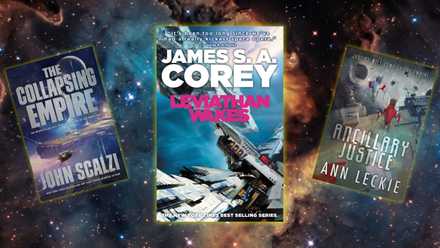
10 Great Sci-Fi Books To Read If You Love The Expanse
Whether you like the intrigue of ancient alien civilizations or battles over the fate of the human race, these books are all brilliant space operas.
James S.A. Corey outlines a fascinating world in The Expanse with a fully developed solar system society that features distinct cultures and political systems. Although the novel seems simple because of how it shows a possible future for humanity, it is really complex and does a wonderful job of gradually developing into an epic space opera filled with mystery, battles, and geopolitical tension.
Neuromancer by William Gibson

William Gibson’s science fiction novel, Neuromancer, is often credited with giving the cyberpunk genre life and inspiring countless movies, TV shows, and video games. The groundbreaking cyberpunk book follows Case, a washed-up computer hacker living on the fringes of a dystopian, high-tech future. Once a brilliant console cowboy who could jack his mind directly into cyberspace, Case is left permanently damaged after his former employers destory his nervous system as punishment for betrayal. His life takes a turn when a mysterious employer offers to restore his abilities in exchange for one last, dangerous job.
Neuromancer is Gibson’s first novel, yet it achieved the rare Triple Crown of science fiction awards, winning the Hugo Award, the Nebula Award, and the Philip K. Dick Award, a testament to how incredible its worldbuilding is. The high-tech, low-life concept is now featured heavily in the genre, thanks to how Gibson depicted it in Neuromancer. The masterpiece sci-fi novel has everything from sprawling, decaying cities to mega corporations, making its world massive and immersive.
This story originally appeared on Screenrant

