


If you carry a Rogers Red card and point your cash back at your Rogers bill, the way that redemption works is about to change. Rogers Bank has begun notifying cardholders that on November 18, 2026, every Rogers Red credit card will start earning up to 5% cash back on eligible Rogers purchases, and the 1.5x redemption bonus that has defined these cards for years will end the same day.
The World Elite cards move to a new insurance package on the same date, and on January 12, 2027, the complimentary Roam Like Home days give way to annual roaming credits. The changes apply to the Rogers Red lineup only, so older Rogers Bank and Fido cards that were never moved onto it aren’t affected.
Whether that adds up to good news depends almost entirely on how you’ve been using the card. Let me walk through each change, run the numbers on a typical household, and look at where these cards still fit once everything takes effect.
What’s Changing for Rogers Red Cardholders
Two of the four changes touch every card, while the insurance changes are limited to the Rogers Red World Elite® Mastercard and Rogers Red World Elite® Business Mastercard.
| Today | After the change | |
|---|---|---|
| Eligible Rogers purchases | Up to 2% cash back, redeemable at 1.5x value | Up to 5% cash back (November 18, 2026) |
| Redeeming toward Rogers purchases | 1.5x face value | Face value (November 18, 2026) |
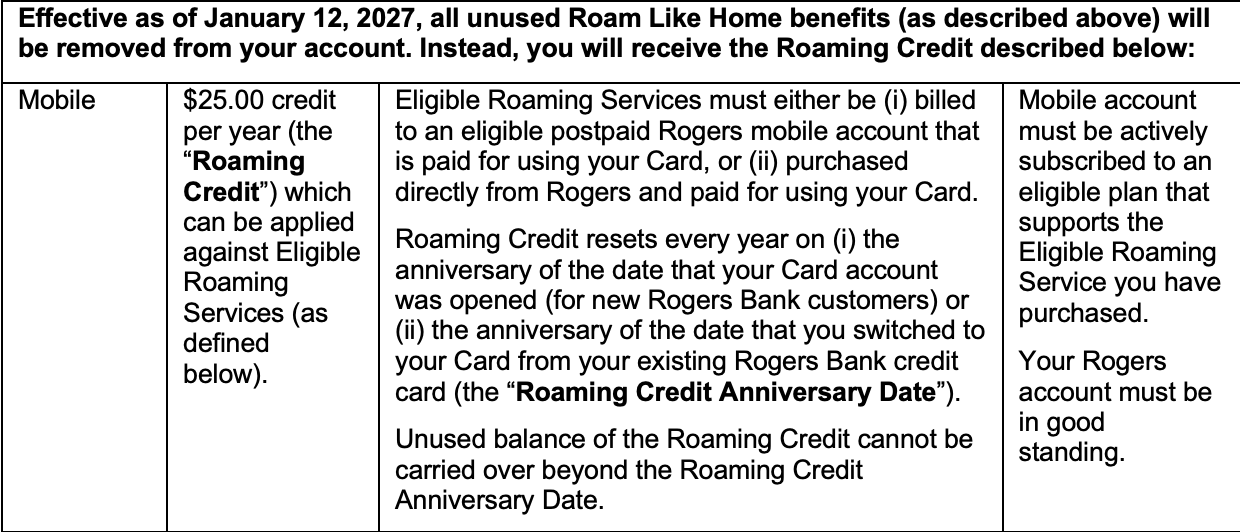
| Roam Like Home | Five complimentary days per year (10 on the World Legend) | Annual roaming credit of $25 to $200 (January 12, 2027) |
| World Elite emergency medical | 10 days per trip for ages 64 and under | 15 days per trip for ages 64 and under (November 18, 2026) |
| World Elite trip cancellation, interruption, and delay | Included | No longer included (November 18, 2026) |
Everything else holds. Cardholders with a qualifying Rogers, Fido, Shaw, or Comwave service keep earning up to 2% on eligible purchases, the extra 1% at Rogers Red Partner locations stays, and the World Elite continues to earn 3% on U.S. dollar purchases.
The annual spending caps that arrived on August 4 remain in place as well.
How the New 5% Rate Works
The 5% applies to what Rogers calls Eligible Rogers Purchases. Rogers gives two examples, a monthly postpaid mobile bill from Rogers, Fido, or Shaw, and products bought through the Rogers or Fido websites.
Three things are specifically excluded. In-store purchases of Rogers, Fido, Shaw, or Comwave products don’t qualify, Toronto Blue Jays tickets don’t qualify, and discounted plans through the Rogers Preferred Program don’t qualify either. Rogers also reserves the right to change the list at any time.
The rate sits inside the same annual caps as everything else, which is why Rogers words it as “up to 5%”. Accelerated rates apply to the first $16,000 in annual spending on the Rogers Red Mastercard, $26,000 on the Rogers Red World Mastercard®, and $61,000 on the Rogers Red World Elite® Mastercard, after which every purchase earns 1%, 1%, and 1.5% respectively. The Rogers Red World Legend™ Mastercard remains the only card in the lineup without a cap.
One detail worth noting is that the 5% doesn’t require a qualifying Rogers service. Anyone holding a Rogers Red card who buys a phone on rogers.com earns it, whether or not Rogers provides their plan.
The 1.5x Redemption Bonus Is Going Away
The quiet strength of the Rogers Red cards has always been on the redemption side rather than the earn side. Cash back redeemed toward an eligible Rogers, Fido, Shaw, or Comwave purchase is worth 1.5 times its face value, which is how a 2% card has been marketed as delivering “up to 3% cash back value”, and it’s the reason a lot of Rogers households put all of their spending on the card and pointed every redemption at the phone bill.
That multiplier ends on November 18. From that date, every point is worth 1 cent regardless of what you redeem it against, and the face-value rule applies to cash back earned before the change as well. If you’ve been sitting on a balance with the Rogers bill in mind, the window to redeem it at 1.5x closes in November.
In effect, Rogers is moving the bonus from the redemption step to the earn step. Instead of everything you spend being worth more when it’s redeemed toward Rogers, only what you spend with Rogers is worth more in the first place, and that trade doesn’t work out evenly for everyone.
I ran the numbers on a fairly typical setup. Picture an eligible Rogers customer with the Rogers Red World Elite® Mastercard who puts a $100 monthly Rogers bill and $2,000 of everyday spending on the card, and who redeems all of it against that bill.
| Cash back earned per month | Value when redeemed toward the Rogers bill | |
|---|---|---|
| Until November 17, 2026 | 2% on $2,100 = $42 | $42 at 1.5x = $63 |
| From November 18, 2026 | 5% on $100 + 2% on $2,000 = $45 | $45 at face value = $45 |
That cardholder earns $3 more in cash back each month and ends up with about $18 less in value, or roughly $216 over a year. The break-even is simple to state. You come out ahead only if your other spending on the card is less than twice your Rogers purchases, which describes very few households once groceries, gas, and everything else are on the same card.
Two groups can set this section aside. If you’ve been redeeming your cash back as a plain statement credit rather than against a Rogers bill, the 1.5x bonus never helped you and nothing is lost. If you aren’t a Rogers customer at all, the same applies.
Who Benefits from the New Structure
The customers who benefit are the ones whose Rogers spending is large next to everything else on the card. A household paying $250 a month for Rogers mobile plus Shaw internet and TV, with only a few hundred dollars of other spending on the card, lands slightly ahead.
Today, 2% on $700 redeemed at 1.5x is about $21, while from November 18, 5% on $250 plus 2% on $450 is about $21.50, and the gap widens in their favour the more of the card’s spending is with Rogers. That profile is more common than it sounds, since plenty of people keep a Rogers Red card for the bill and run their everyday spending elsewhere.
The biggest single win is hardware. A $1,500 phone bought on rogers.com earns $75 at the new rate, against $30 today, or $45 in redemption value at 1.5x. It works with or without a Rogers plan, so non-Rogers customers, who never had the 1.5x to lose, gain here outright.
It’s worth noting that none of the Rogers Red cards come with mobile device insurance. The World Elite’s purchase protection covers a new phone against theft or damage for 90 days, and its extended warranty doubles the manufacturer’s coverage, but after that, the device is on its own.
Older travellers holding the Rogers Red World Elite® Mastercard also do well out of the insurance changes, which I’ll get to below.
Roam Like Home Days Become Roaming Credits
The second wave of changes is about roaming. Today, the Rogers Red Mastercard, Rogers Red World Mastercard®, and Rogers Red World Elite® Mastercard each include five Roam Like Home days a year with an eligible Rogers mobile plan, and the World Legend includes 10.
From January 12, 2027, those days become an annual credit that can be applied to eligible Rogers roaming services, such as Travel Passes or Roam Like Home daily roaming. Any unused days are removed on that date, and the credit resets on your account anniversary or product-switch anniversary.
Rogers values five Roam Like Home days at up to $90 on its own card pages, so a $25 or $75 credit is a step down for anyone who used every day. For anyone who never got through all five, or who would rather buy a Travel Pass for a longer trip, the credit is easier to actually use, and the flexibility is real. Our guide to roaming solutions for international travel covers the alternatives if you’d rather not depend on either.
A New Insurance Package on the World Elite Cards
The Rogers Red World Elite® Mastercard and Rogers Red World Elite® Business Mastercard move to a new Certificate of Insurance on November 18, and the changes cut both ways.
| Coverage | Until November 17, 2026 | From November 18, 2026 |
|---|---|---|
| Emergency medical, ages 64 and under | 10 days per trip | 15 days per trip |
| Emergency medical, ages 65 to 74 | 3 days per trip | 3 days per trip |
| Pre-existing condition stability period, ages 64 and under | 6 months | 90 days |
| Pre-existing condition stability period, ages 65 to 74 | 1 year | 150 days |
| Epidemic and pandemic exclusion | Applies | Removed |
| Trip cancellation | Up to $1,000 per insured person, $5,000 per account per trip | Not included |
| Trip interruption | Up to $1,000 per insured person, $5,000 per account per trip | Not included |
| Trip delay | $150 per day, up to three days | Not included |
| Rental car collision and damage | Up to 31 days, MSRP up to $65,000 | Unchanged, with new exclusions |
On the plus side, emergency medical coverage for travellers aged 64 and under extends from 10 days per trip to 15, while coverage for ages 65 to 74 stays at three days.
The stability period for pre-existing conditions shortens from six months to 90 days for the younger group and from a full year to 150 days for ages 65 to 74, and the exclusion for epidemics and pandemics is removed altogether. Those are real improvements, particularly for older travellers who tend to be shut out of credit card medical coverage entirely.
On the minus side, trip cancellation, trip interruption, and trip delay coverage are gone. Today, cancellation and interruption pay up to $1,000 per insured person to a maximum of $5,000 per account per trip, and trip delay pays $150 per day for up to three days.
Travel booked and charged to the card before November 18 is still assessed under the current coverage, even if the trip itself happens later, so anything already on the books is fine. Rental car collision and damage insurance also picks up a handful of new exclusions, including rentals in Jamaica and losses tied to natural disasters or events known when the rental agreement was signed.
What really caught my eye is the trip cancellation piece. That coverage was one of the reasons a no-fee World Elite card punched above its weight, and its loss matters more than five extra medical days help for most of the trips people actually book. The Rogers Red Mastercard has no travel insurance today, so none of this applies there, and the new certificates are posted on the Rogers Bank legal page for anyone who wants the full wording.
What Rogers Is Really Doing Here
Rogers describes the changes as a simplification, and on the earn side that’s fair. A single 5% rate on Rogers purchases is easier to explain than a 2% rate with a 1.5x redemption multiplier attached, and 5% is higher than anything else in the Canadian market for a telecom bill. The Scotia Momentum® Visa Infinite +* Card tops the recurring bill category at 4%, and most cards land at 2% or 3%.
The trade is that the value now lives inside the Rogers ecosystem rather than on top of it. The 1.5x bonus rewarded you for bringing your whole wallet to the card and spending the proceeds with Rogers, while the 5% rate rewards the Rogers bill itself, and the roaming credit follows the same logic. What the card does well hasn’t changed, but the list of things it does well has gotten shorter.
Credit where it’s due. Rogers has kept the 2% base rate under the cap, which remains one of the best no-fee returns in Canada, and it has strengthened the part of the insurance that’s hardest to find on a no-fee card.
For everyday spending under the cap, the card is still what it was. It just no longer turns that spending into 3% when you point it at your phone bill.
Where the Card Still Fits
On paper, a flat 2% card with no cap and no foreign transaction fees, such as the Wealthsimple Visa Infinite +* Card, now beats the Rogers Red cards on general spending. There’s one place a Visa can’t follow, though, and it happens to be one of the biggest line items in a lot of Canadian households.
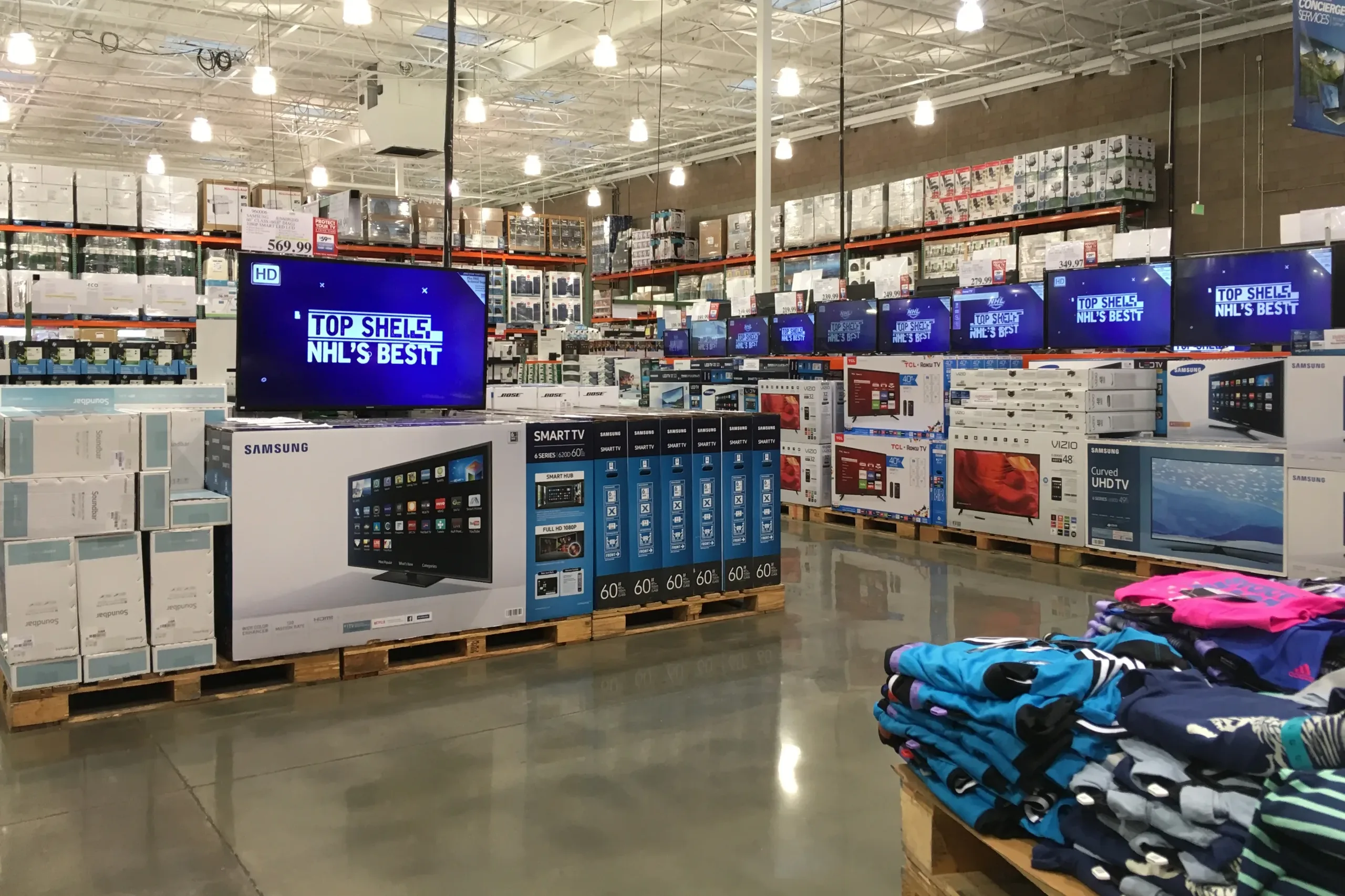
Costco warehouses only accept Mastercard, and the Rogers Red World Elite® Mastercard is already our pick for the best cash back card at Costco in our guide to the best credit cards for Costco. Nothing in this update touches that. Rogers customers keep earning 2% at Costco under the $61,000 cap, and non-customers keep earning 1.5%, which is still in line with the best no-fee cash back Mastercards.
Add the 5% on the Rogers bill itself, and the card settles into a narrower but still useful role. The pairing I’d expect most people to land on is a flat 2% card for everything else and a Rogers Red card for Costco and the Rogers bill.
With no annual fee on either the Rogers Red Mastercard or the Rogers Red World Elite® Mastercard, there’s also no cost to keeping one in the wallet while you decide. The changes reduce what the card can do, but they don’t give you a reason to cancel it.
Conclusion
The one time-sensitive step is clear. If you have a cash back balance on a Rogers Red card and a Rogers bill to apply it to, redeeming it before November 18 locks in the 1.5x value that disappears after that date.
After that, I’d treat the card as a specialist rather than a daily driver. Keep it for Costco, where it remains the best no-fee cash back Mastercard, and for the Rogers bill at 5%, and let a flat 2% card carry the rest of your spending. If you never used the 1.5x bonus, or you aren’t a Rogers customer, very little changes for you either way.
If you kept the Rogers Red World Elite® Mastercard around for its travel insurance, line up another card or a standalone policy for trip cancellation before November 18. The card remains a strong everyday earner under its cap, but that particular job now needs a new home.
Rogers isn’t taking away the 2%. It’s asking you to spend with Rogers to earn the rest, and with no annual fee, a card that does two things well is still worth a spot in the wallet.
This story originally appeared on princeoftravel

