


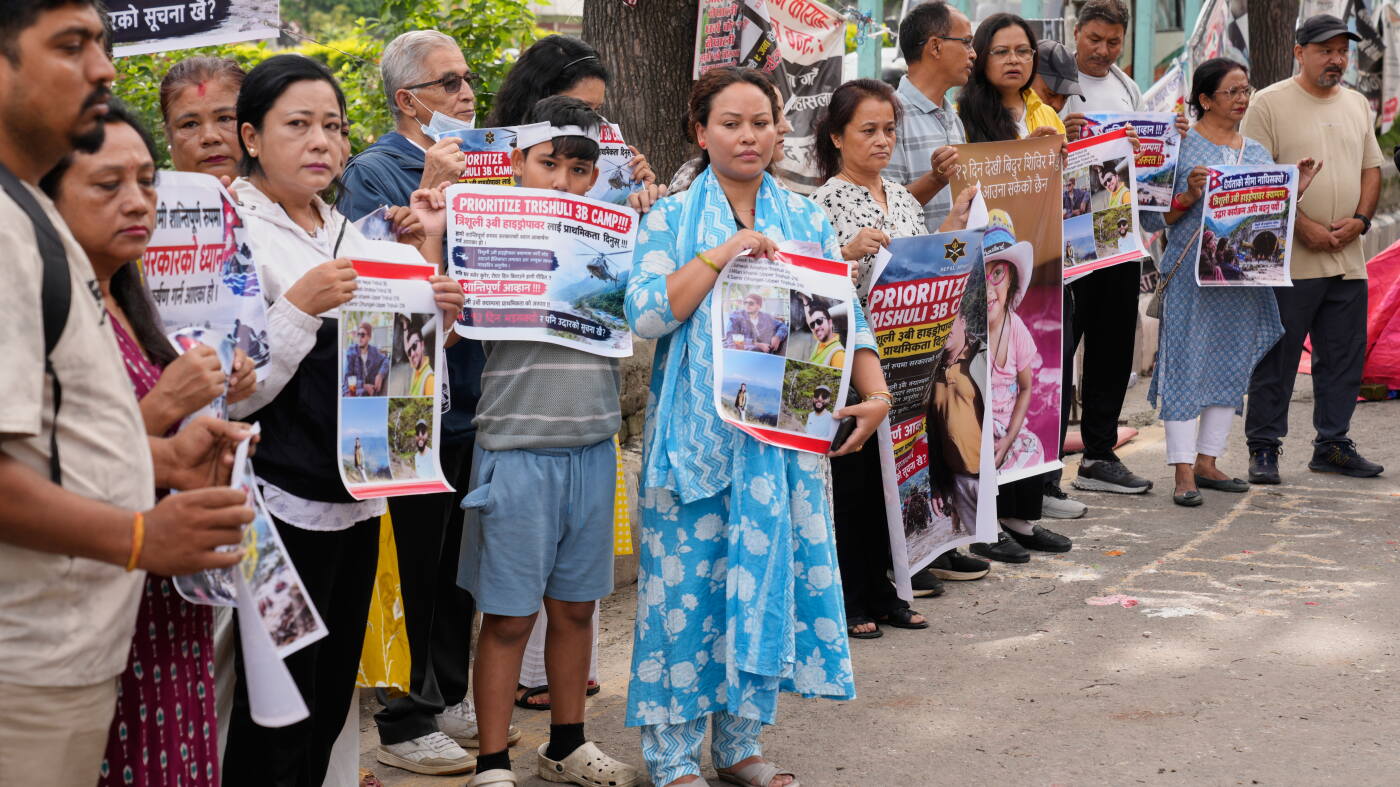
Relatives of recent flash flood victims hold banners urging authorities to step up efforts to find their missing loved ones during a demonstration in Kathmandu, Nepal, on Monday.
Dar Yasin/AP
hide caption
toggle caption
Dar Yasin/AP
BEIJING — Shortly after the deadly flash floods hit the border of Nepal and China on Aug. 26, Nepalese authorities released a list of names, ages and nationalities of hundreds of missing foreigners. In contrast, Chinese authorities took five days to disclose that the 261 foreigners missing in Tibet come from 23 countries.
Twelve days on, very little is known about the victims in Tibet as Chinese authorities have restricted reporting on the floods.
To date, Nepal has reported over 1,300 dead and nearly 5,000 missing, while China is reporting over 40 dead and more than 500 missing.
“Xinhua (state-run news agency) and (state broadcaster) CCTV have total information dominance,” said David Bandurski in Taipei with the China Media Project, which monitors news censorship in China.
These outlets are expected to “guide public opinion,” he said.
While China has always censored information, controls have tightened steadily over the last decade, he said to levels that are “unprecedented.”
No independent access
Rights groups that have been closely following the disaster relief say the lack of independent access to the area of the flooding in Gyirong County in Tibet is striking.
“This is in contrast to the Nepal side of the border where there was immediate access given for journalists, for other observers, for international humanitarian relief organizations,” said Ryan Fioresi of the DC-based International Campaign for Tibet.
To report on the rescue efforts in Nepal, NPR was able to check in with international aid agencies on the ground and speak with a rescue pilot. Nepal’s police, disaster management authority and the tourism board have also been providing regular updates on their social media feeds.
Whereas in China, the government restricts foreign journalists from entering the politically sensitive region.
It took more than a week of repeated requests from multiple international media outlets before the Chinese government allowed foreign journalists in Tibet.

People take part in a candlelight vigil for victims of the floods in Nepal and Tibet, at Durbar Square in Kathmandu, Nepal, Saturday, Sept. 5, 2026.
Dar Yasin/AP
hide caption
toggle caption
Dar Yasin/AP
However, it was limited to a small number of foreign outlets in a carefully arranged visit. NPR was not granted access.
The International Campaign for Tibet claims at least 300 homes were destroyed in Gyirong County, and Fioresi said the casualty count could be “much higher” than the dozens reported by Chinese officials so far.
He also said Tibetans in the worst affected areas were relocated to “tightly controlled holding areas.”
“Their communications with the outside world have been extremely limited and curtailed,” Fioresi said, adding that it hampers local rescue efforts.
China’s foreign ministry has not responded to NPR’s request for comment.
However, in an earlier briefing with reporters in Beijing, foreign ministry spokesperson Guo Jiakun denied China was understating the number of missing and dead, saying China has been “open, transparent and timely in information release.”
“Smear and disinformation is most unwelcome at a time of disaster response,” Guo said.
How different Chinese media are covering the tragedy
China’s commercial media, which were still subject to censorship but had more leeway, would have sent journalists to a disaster site quickly in the past, according to Rose Luqiu, an associate professor of journalism at Hong Kong Baptist University who studies Chinese propaganda and censorship.
She said she saw the Beijing News and Southern Weekly had tried to do some of their own reporting.

China Fire and Rescue personnel arrive at Trishuli camp after inspecting the tunnel site in Rasuwa, in the aftermath of flash floods in Nepal’s Nuwakot district on August 31, 2026. Rescuers struggled on August 31 through mud and debris for a sixth day, as the number of missing people soared to nearly 5,000 since tsunami-like glacial floods roared down from the China-Nepal border, creating an “unimaginable” disaster.
ARUN SANKAR/AFP
hide caption
toggle caption
ARUN SANKAR/AFP
“For example they tried to interview tourists. Not victims or those directly impacted in the local villages but they’re trying to … provide some more information,” she said.
In the 2008 Sichuan earthquake, various Chinese media outlets sent hundreds of journalists to the scene “in direct violation of an explicit ban from the central propaganda department of the Communist Party,” Bandurski said.
This time, he said, the Southern Metropolis Daily, known for its journalistic investigations, ran only one front page cover on the floods in the days after the disaster, and it was an article reprinted from the official Xinhua news agency.
“They didn’t do additional reporting,” Bandurski said, adding that it was unusual for the paper.
Bandurski said his team saw the same pattern in other commercial Chinese media outlets.
“Xi Jinping has reined in the [commercial] press, such as it was developing in the 2000s,” he said. “We see a total control of the narrative and basic news and information.”
Foreign ministry spokesperson Guo has denied China deletes videos and first-hand accounts online.

A Buddhist monk offers prayers for the departed soul of the victims of flash flood on the bank of Trishuli river in Devighat, Nuwakot district, Nepal, Saturday, Sept. 5, 2026.
Niranjan Shrestha/AP
hide caption
toggle caption
Niranjan Shrestha/AP
But many of the videos that were circulating widely after the floods were being actively deleted, according to Bandurski.
Recently the Chinese police penalized 10 people for spreading what they called misinformation about the floods.
Chinese state media, such as Xinhua, CCTV and Tibet Daily, have sent journalists with rescue teams, sometimes hiking overnight with them at high altitudes, sleeping openly under the rain, to reach the worst affected area at the Gyirong-Rasuwa border crossing.
The focus of their coverage is on the rescue teams, logistics of the operations and how government leaders are reacting quickly to the disaster, according Luqiu.

She said there are state media reports on people affected by the floods, but compared with the reports on the rescue operations, “the situation about the victims and the village members is relatively very small.”
NPR’s Diaa Hadid in Mumbai, and Mamita Bhandari in Kathmandu contributed to this report.
This story originally appeared on NPR

