


Good morning. You’re reading the Up First newsletter. Subscribe here to get it delivered to your inbox, and listen to the Up First podcast for all the news you need to start your day.
Today’s top stories
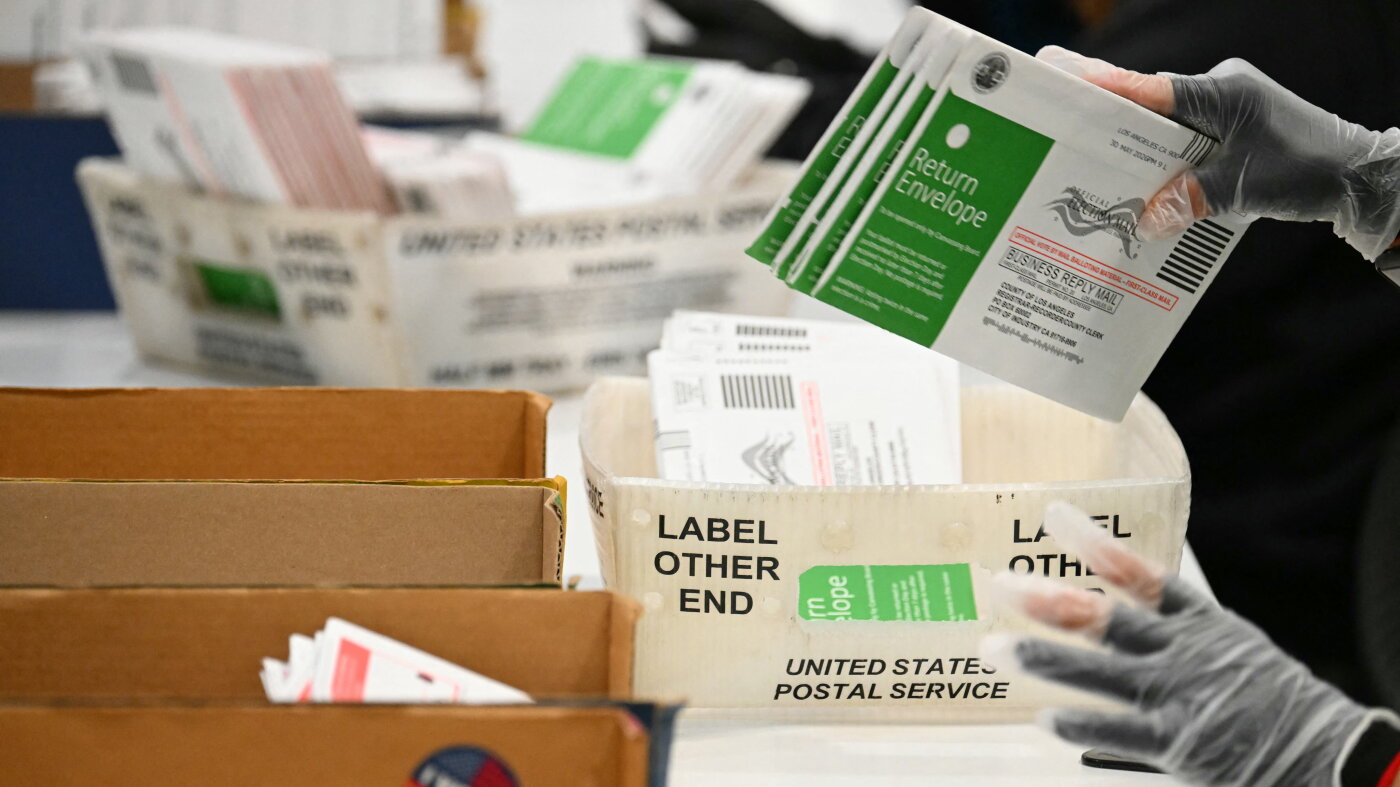
The Trump administration has asked the Supreme Court to lift a federal judge’s temporary restraining order blocking the U.S. Postal Service from implementing the administration’s plans to restrict mail-in voting. President Trump issued an executive order in March calling for the Department of Homeland Security to develop lists of adult U.S. citizens in each state and for the USPS to refuse to deliver mail-in ballots when state election officials don’t turn over these lists. Last week, the Supreme Court addressed a procedural issue about one of the lawsuits related to the order. Now, the administration is asking the court to weigh in on its legality. North Carolina starts mailing out its absentee ballots today, officially kicking off this year’s midterm voting season. Here’s what you need to know about the current state of mail-in voting.
An election worker processes mail-in ballots in June in Industry, Calif.
Justin Sullivan/Getty Images
hide caption
toggle caption
Justin Sullivan/Getty Images
- 🎧 For now, mail-in voting is still available to all voters who are eligible for it in their states, NPR’s Hansi Lo Wang tells Up First. Election officials and voters are concerned that major disruptions to the midterms could occur if the Supreme Court allows the plan to move forward. Many election officials say it’s too late to carry out the plan. The administration didn’t meet its own deadline today to publish its state-by-state lists of eligible voters.
The IRS has proposed a rule that would revoke the tax-exempt status of private schools and colleges that have programs designed to help students based on race. Many institutions currently offer programs to support Black or Latino students who may be the first in their families to attend college. Some also aim to foster a diverse student body by offering scholarships and other initiatives. The administration argues these programs amount to racial discrimination.
- 🎧 The administration is attempting to apply financial pressure on these schools to get what it wants: an end to race-based programs, NPR’s Adrian Florido says. By operating as non-profit, tax-exempt entities, these schools avoid paying federal income taxes. This status also serves as a crucial fundraising tool, as donations from alumni and others become eligible for tax deductions. The IRS hasn’t clarified how it plans to identify schools with programs it disapproves of, but it estimates that about 18,000 private schools could be affected. Legal challenges are likely to arise, as the authority of the IRS to unilaterally redefine racial discrimination and revoke tax-exempt status remains unclear.
Federal prosecutors have charged an ICE officer with six counts of making false statements for allegedly lying to investigators about the shooting of a Venezuelan man in Minnesota earlier this year. The sealed criminal case was confirmed by a source not authorized to speak publicly on the matter. In January, during the broad immigration crackdown in Minnesota known as Operation Metro Surge, officer Christian Castro fired his weapon through a closed door, shooting Julio Sosa-Celis in the leg. Castro initially claimed under oath that Sosa-Celis attacked him, but surveillance footage contradicted his claim.
- 🎧 NPR’s Ryan Lucas says these charges mark a rare instance in which the Justice Department is seeking to hold a federal immigration officer accountable for his actions. But Sosa-Celis’ attorney said that the DOJ hasn’t gone far enough, and Castro should face more severe civil rights charges. NPR’s Ryan Lucas says it is worth noting that no one has been charged in the killings of Renee Macklin Good and Alex Pretti, two American citizens fatally shot by federal immigration officers during the same major enforcement operation earlier this year. Lucas says shootings involving immigration officers are not uncommon, and under this administration alone, there have been more than 20.
Diesel prices have hit a record high with a national average of $5.85 per gallon, according to AAA. This spike surpasses the $5.81 diesel prices reached in June 2022, a few months after Russia launched its full-scale invasion of Ukraine. A gallon now costs up to $2 more than it did just before the Iran war. Much of the industrial supply chain relies on diesel, and the increased costs may trickle down to consumers. Farming equipment relies heavily on diesel, and the rising cost of farming will eventually make food more expensive. About 90% of U.S. school buses run on diesel, and many school district budgets are strained as the new academic year begins.
Watch this

Go face-to-face with the person of the moment. NPR’s Newsmakers video podcast brings the biggest names in politics, business, sports, arts, and culture out of the headlines and into the interview chair to discuss the mark they’re making on the world. Follow the Newsmakers podcast or subscribe to NPR’s YouTube channel to get new episodes as soon as they’re available.
Comedian Robby Hoffman says she doesn’t yet know if there’s any topic that’s “off limits” in her work. But she does know she doesn’t want to lie. She’s gained popularity for her no-holds-barred approach to comedy, her roles in shows like Hacks and her Netflix special Wake Up. But she’s also gotten backlash for some of her comments, including lengthy jokes about the non-binary community. Hoffman, who describes herself as “somebody who’s clearly in the queer space,” tells NPR’s Juana Summers that it’s fair for people to be mad, but she wants to talk about the things she experiences day to day. On NPR’s Newsmakers, Hoffman discusses how she copes with and explores life through jokes and how she got her start in the comedy business.
Watch or listen to the interview or read the article about their discussion.
Weekend picks

Cher Álvarez stars as Lou, part of a couple being haunted in the play Paranormal Activity.
Matthew Murphy/Matthew Murphy
hide caption
toggle caption
Matthew Murphy/Matthew Murphy
Check out what NPR is watching, reading and listening to this weekend:
🍿 Movies: The horror-thriller It Ends follows four friends who find themselves on a road that winds through a dense forest, and it seems to never end.
📺 TV: The new show Sterling Point features a mysterious inheritance, a teen love triangle and deep generational lies and secrets.
📚 Books: This month brings a plethora of new books. NPR has a preview of some of the offerings, which include three Pulitzer Prize winners, a Booker Prize winner and two Booker longlisted authors. Nearly all of them have had their works adapted for the screen, or expect to soon.
🎵 Music: Erykah Badu and the Alchemist’s long-awaited collaborative album, Before The World Blows, begins with a 7-minute incantation titled “Echos.” NPR’s Rodney Carmichael analyzes why the song feels transcendent and highlights other happenings in hip-hop this week.
🎭 Theater: Some of Broadway’s “theater magic” is created behind the scenes by real magicians. NPR spoke with magician Chris Fisher about his work in devising the illusions for Paranormal Activity, which opened on Broadway last month.
❓ Quiz: You have made it to Friday! Time to celebrate by testing your knowledge of what happened this week.
3 things to know before you go

Sarah McLachlan and Olivia Rodrigo perform on the Dandelion Stage during the Daisy Chain Fields music festival.
Monica Schipper/Getty Images/Getty Images North America
hide caption
toggle caption
Monica Schipper/Getty Images/Getty Images North America
- Olivia Rodrigo put politics center stage with her inaugural one-day Daisy Chain Fields festival. The event raised $20 million for 10 organizations, including the Center for Reproductive Rights and the National Women’s Law Center.
- Researchers at the University of Vermont, as part of an international team, have found how bats avoid disease and live long lives. Their findings may one day help humans achieve the same. (via Vermont Public)
- Jurors in Lindsay Clancy’s murder trial return today to continue deliberations, after telling the judge for the third time yesterday that they remained deadlocked. A single juror appears to be in disagreement with the others. (via WBUR)
This newsletter was edited by Suzanne Nuyen.
This story originally appeared on NPR

