


What’s the Difference Between Damaged, Delayed, and Lost Baggage?
It’s important to know how insurance companies, airlines, governing bodies, and policies define damaged, delayed, and lost baggage.
Delayed Baggage
Under the Montreal Convention, a bag is considered delayed if it simply doesn’t arrive at your destination. There’s no specific minimum time mentioned.
For delayed baggage, Europe’s EU261 and Canada’s APPR have adopted the wording of the Montreal Convention.
In practice, this means that even though you might not be covered by the Montreal Convention, the Montreal Convention’s policies may still be applicable.
For example, if you have delayed baggage while flying on a domestic flight within a European country, the Montreal Convention wouldn’t apply. However, you’d still be covered by EU261, which essentially has the same protections as the Montreal Convention as it pertains to all baggage issues.
Credit card insurance policies are usually more detailed regarding language surrounding delayed baggage.
For example, with American Express cards, baggage delay insurance kicks in if your luggage is delayed by at least six hours.
However, baggage delay insurance is also only applicable on outbound flights. If you arrive back home and your baggage is delayed, you aren’t covered.
It’s a similar story with other popular travel credit cards, such as the TD® Aeroplan® Visa Infinite* Card and the CIBC Aeroplan® Visa Infinite* Card. Baggage delay insurance is only applicable to outbound flights, and must be delayed by at least six hours.
On the other hand, some cards have baggage delay insurance that kicks in after a shorter delay. For example, the delayed baggage insurance on the Scotiabank Gold American Express® Card kicks in after just four hours.
Keep in mind that not all travel credit cards that have travel insurance include baggage delay insurance. For example, the RBC® Avion Visa Infinite† doesn’t come with any insurance for damaged, delayed, or lost baggage.
Lost Baggage
Under the Montreal Convention, a bag is considered lost if it hasn’t been located within 21 days of the original arrival date. That same timeframe is used in Europe’s EU261 and Canada’s APPR.
Most credit card insurance policies don’t have a specified date for when a bag is deemed lost. Rather, insurance coverage tends to kick in after a minimum amount of time.
Credit card insurance for lost luggage will typically reimburse amounts that aren’t covered by the airline or other insurance, up to the maximum specified in the policy.

In all cases, a bag must be delayed before it’s considered to be lost.
Damaged Baggage
The Montreal Convention states that airlines are liable in the event of destruction or damage to checked baggage under certain circumstances.
The damage must have occurred during any period in which the checked baggage was in the charge of the carrier. However, the airline won’t be liable if the damage was due to the inherent defect, quality, or vice of the baggage, and there have been many cases wherein airlines have denied claims on cosmetic defects, such as dents and scratches.
As for carry-on luggage, including personal items, the airline can still be liable if the damage was caused by the airline, or one of the airline’s agents.
The Montreal Convention’s wording regarding damaged baggage also applies to EU261 and the APPR.
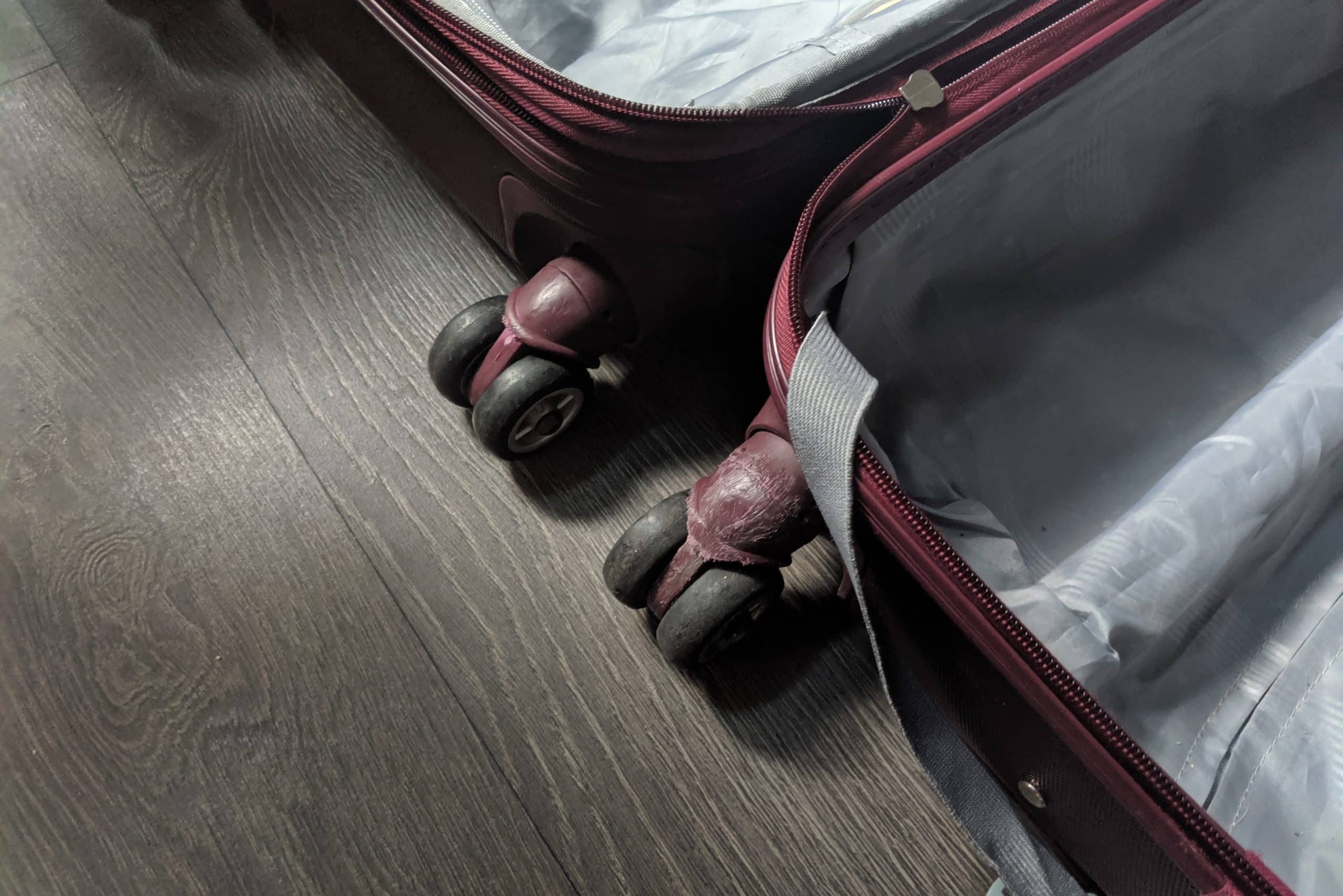
Not all credit card insurance covers damage to baggage. In fact, some credit cards that provide coverage for delayed and lost baggage might not cover damage.
You’ll have to look at the specific wording of your credit card insurance policy, which can usually be found under the lost baggage section of the insurance policy.
What’s more, some credit cards that cover damaged baggage may have specific exclusions.
For example, the American Express Platinum Card covers damaged baggage; however, it won’t cover damage to sunglasses, cell phones, laptops, cameras, and other excluded items.
Once again, be sure to read through the insurance policy that comes with your credit card to understand the inclusions and exclusions.
What to Do If Your Baggage Is Damaged, Delayed, or Lost
If your baggage isn’t waiting for you at your destination, or if it is, but has been damaged, there are immediate steps you’ll need to take to ensure you’re compensated.
Respect the Timelines
For damaged luggage, if the Montreal Convention, EU261, or APPR apply, you’ll have seven days from when you receive your luggage to make a claim.
For delayed baggage on international flights, you’ll have 21 days from the date of your arrival to file a claim.
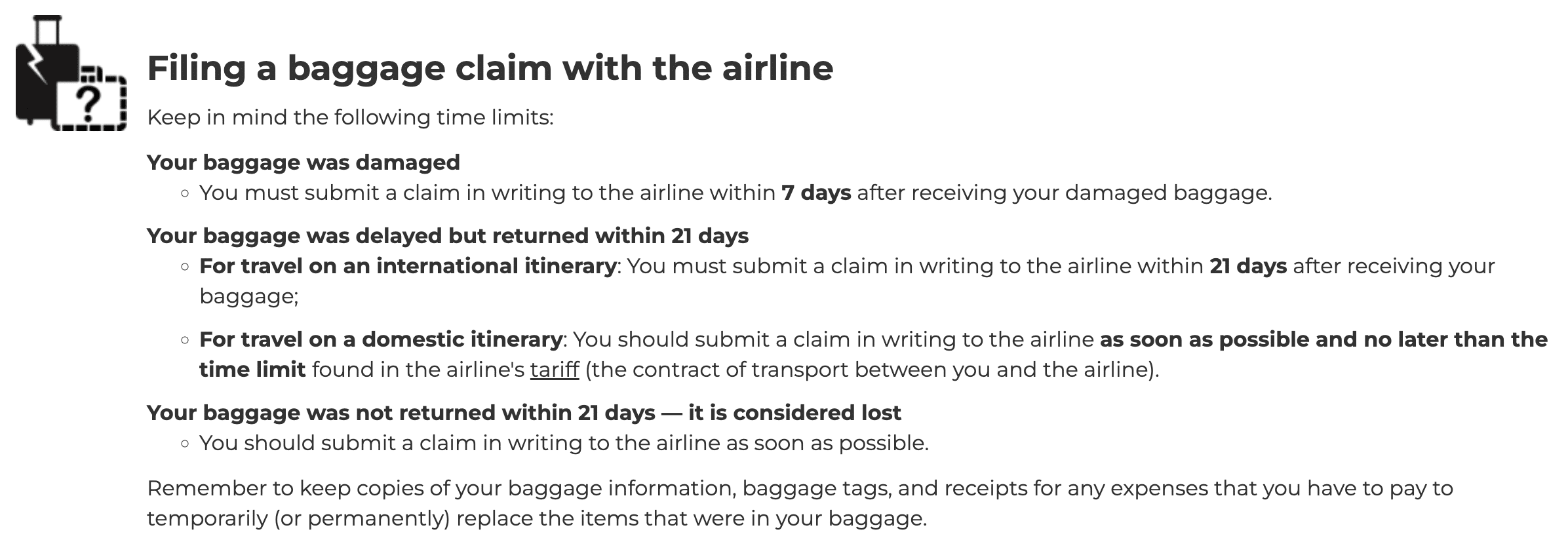
For delayed baggage on domestic flights within Canada, you’ll have to consult the airline’s tariff for timelines. For example, you have 21 days to submit a delayed baggage claim with Air Canada and WestJet.
Whenever the Montreal Convention, EU261, or APPR don’t apply, you’ll need to be aware of the airline’s internal filing deadlines and policies.
If you’re making a claim through credit card insurance, you’ll also need to be mindful of your specific card’s deadlines and requirements, which are outlined in the insurance booklet.
File a Report with the Airline
The first step in the event of damaged, delayed, or lost luggage is to file a claim with the airline.
Baggage services desks are typically located close to luggage carousels in the arrivals area of airports, and you should ask for what’s called a property irregularity report (PIR), which serves as an acknowledgement from the airline.
A PIR details the damage to your baggage, or in the case of delayed baggage, indicates the tracking/tracing number of your delayed bag.
If there’s no reporting desk, or if it’s closed at the time of your arrival, you’ll have to look at alternative ways to contact the airline. There are usually dedicated pages on the airline’s website for filing a report.
It’s also a good idea to take photographs of your luggage before you leave, as well as have a list of its contents.
We’ve included the process for filing claims with popular North American airlines at the end of this guide.
Purchase Necessary Items
In the event of delayed baggage, you can begin purchasing necessary items as soon as your baggage is confirmed to be missing.
Be sure to keep any receipts from your purchases, as you’ll need to provide them to the airline when you file a claim.
It’s only possible to claim expenses for items that can be reasonably justified. For example, if you’re travelling to a sunny destination, it’s likely not reasonable to buy a brand new winter coat.
However, it’d likely be entirely reasonable to purchase a bathing suit, sunscreen, and anything else that’s in your delayed baggage that you need for the intended purpose of your trip.
Keep in mind that airline and insurance policies are subjective, so use your best judgement in purchasing or renting temporary replacements. Also, allowable claim limits aren’t a carte blanche for you to go on a shopping spree. After all, airlines and insurance providers may deny or limit your claim on the basis of them being beyond reason.
Claiming Expenses
If you eventually receive your bag, you’ll need to complete separate claims for the expenses you’ve incurred. This is why it’s imperative to keep receipts, and to be able to justify each purchase you make.
To cover all your bases, you’ll need to make parallel claims with the airline, the credit card insurance provider, and any other travel insurance policies you may have purchased. As the “last payors”, insurance policies will usually wait for the result of your claim with the airline before they can assess your payout with them.
Typically, with the airline, you’ll need to provide a detailed breakdown of expenses, as well as copies of the original receipts. This can usually be done on the airline’s website. After you’ve submitted your claim, the airline will process it, and then initiate a money transfer for all approved expenses.
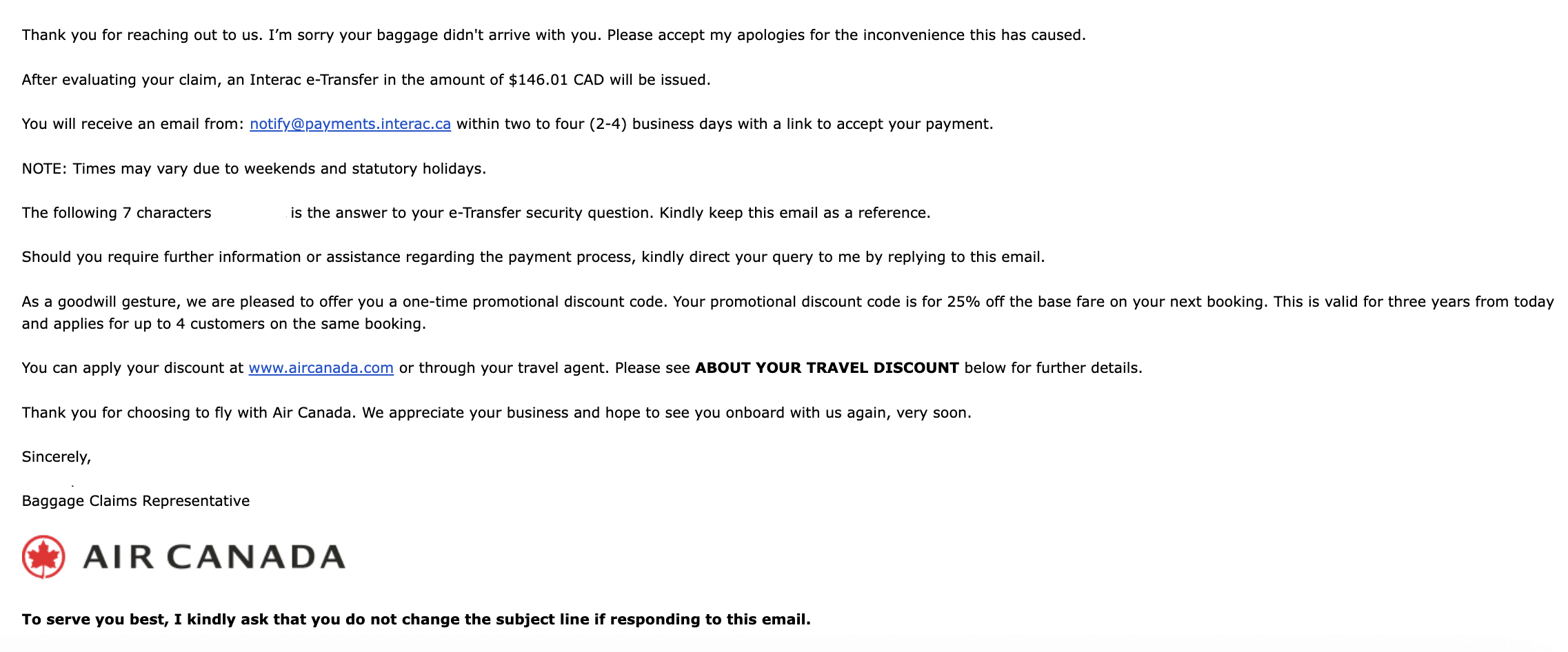
If there are expenses beyond what the airline deems as the limit, you can try to claim them against the applicable insurance policies. For example, when the airline is only willing to cover part of your ski gear rental, you can try to claim the remainder with your credit card insurance.
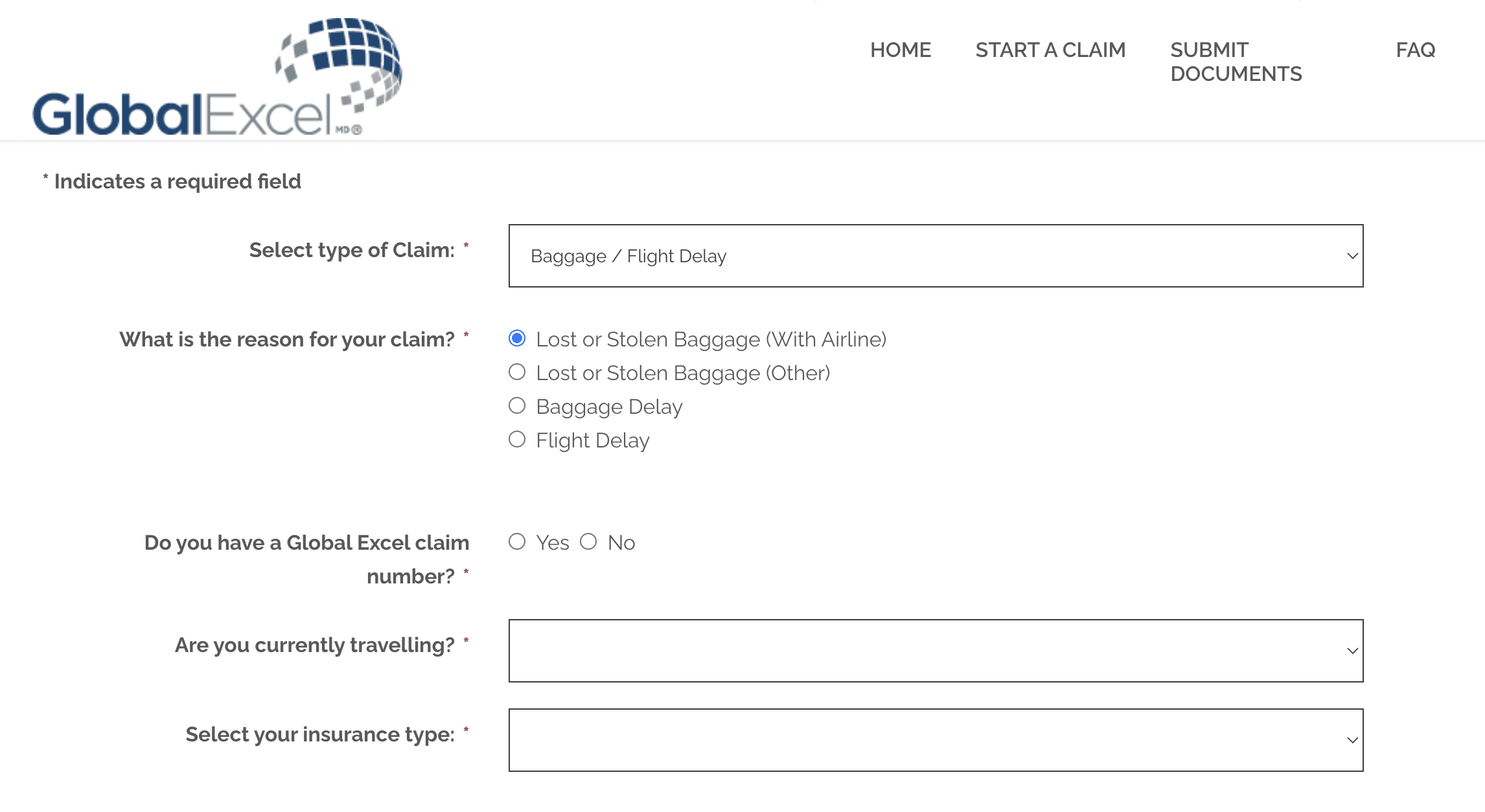
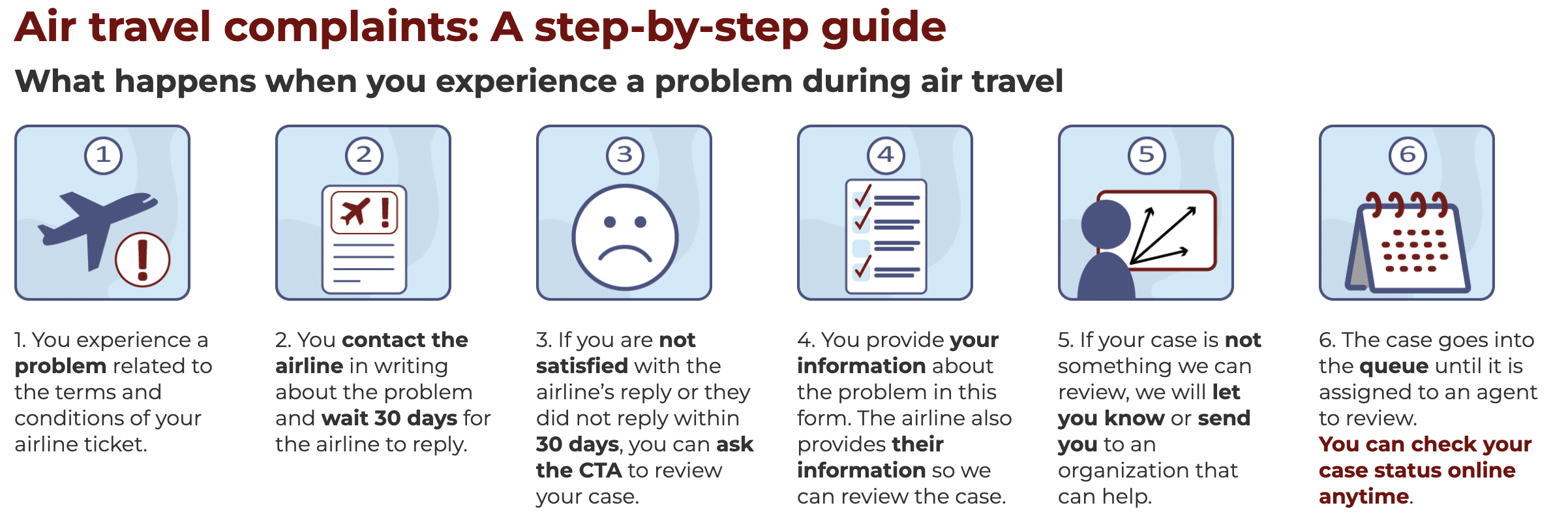
If there are denied expenses that even insurance won’t cover, you can escalate your claim against the airline to a regulatory body or beyond through legal action. Just be prepared to justify all expenses.
If your bag is damaged, you can choose to have it repaired by submitting a repair quote to the airline, and the airline is liable for the expenses.
If your bag is damaged beyond repair, the airline is liable to replace it. You may be offered a replacement bag; however, you don’t have to accept it, and are entitled to a replacement of the exact make and model.
Should your bag be deemed lost after 21 days, you’re entitled to replace the luggage and all of its contents.
In any of the above cases, any fees paid for checked baggage must be refunded, too.
Each credit card travel insurance issuer will have a different process for filing claims. However, you’ll likely need to provide receipts and other proof to support your claim. Hence, it’s imperative for you to hold on to boarding passes, baggage tags, and any other documentation you’ll receive throughout the process.
How Much Can You Claim for Damaged, Delayed, and Lost Luggage?
The total amount of expenses you can claim is spelled out under the appropriate regulations, or through credit card insurance policies, when applicable.
As a reminder, the EU261 and APPR policies have both adopted the Montreal Convention’s wording regarding all baggage issues.
Instead of using dollar figures, the Montreal Convention uses what’s called Special Drawing Rights.
Special Drawing Rights is a singular international reserve asset created by the International Monetary Fund. It’s based on the US dollar, the Chinese renminbi, the Japanese yen, the euro, and the British pound sterling.
Under the Montreal Convention, airlines are liable for up to 1,519 Special Drawing Rights in the event of destruction, loss, damage, or delay to your baggage. This is equivalent to around $2,900 (CAD) or $2,025 (USD).
This limit was revised upward from 1,288 SDR in December 2024, as part of ICAO’s five-year inflation adjustment. The next review is scheduled for 2029.
However, this doesn’t mean that you’ll automatically receive a cheque for that amount. Rather, you can make a claim for up to that amount for expenses incurred because of your baggage being delayed, lost, or damaged.
Often, airlines will ask for receipts to substantiate your claim. However, this isn’t 100% mandatory, and if necessary, you may execute a statutory declaration of the contents of your bags instead.
If you have credit card insurance that can be used to cover expenses related to delayed, lost, or damaged baggage, you’ll have to look at your specific policy to see how much is covered in excess of the airline’s liability.
Most cards that provide coverage will only cover up to $500–1,000, and there might be a few items that won’t be covered.
What’s more, you may only be covered for items within the first four days of your trip, even if your luggage has been delayed for more than four days.
Tips for Protecting Your Baggage
While knowing your rights is essential, there are also proactive steps you can take to minimize the impact of a baggage mishap.
Use a Luggage Tracker
Bluetooth luggage trackers like Apple AirTags have become incredibly useful for travellers. By dropping one inside your checked bag, you’ll know exactly where your luggage is at all times – often before the airline does.
If your bag doesn’t make a connection, you’ll see it in real time on your phone. This gives you a head start on filing a report, and it also provides concrete evidence of your bag’s location if the airline is slow to acknowledge the delay.
At roughly $40 for a single AirTag, it’s a small investment that can save you significant stress.
Pack Essentials in Your Carry-On
The simplest way to reduce the impact of a delayed bag is to pack a change of clothes, any medications, and essential toiletries in your carry-on.
This is especially important on itineraries with tight connections or multiple legs, where the risk of a bag not making it onto the same flight increases. If you’re connecting through a busy hub like Toronto Pearson or London Heathrow with a short layover, your bag is more likely to be delayed than on a non-stop flight.
Keep Your Documentation Organized
If the worst does happen, you’ll thank yourself for being prepared. Before you leave, take a quick photo of the exterior of your bag and its contents. This makes it much easier to substantiate a claim later on.
Throughout the process, keep digital copies of your boarding passes, baggage tags, the property irregularity report, and all receipts for emergency purchases. A simple folder on your phone works well for this.
The more organized your documentation, the smoother and faster your claim will be – whether you’re dealing with the airline, a credit card insurance provider, or both.
How to File Baggage Claims with Airlines
If your baggage is damaged, delayed, or lost, consult the below list for information on how to file baggage claims with airlines. For all airlines, it’s best to file the initial report at the airport.
Air Canada
If your baggage is lost, damaged, or delayed with Air Canada, you can file a claim on the Air Canada website.
You can also contact Air Canada at 1-888-689-BAGS (2247) from 5am–11pm Eastern Time, within Canada or the United States.
If you’re calling from outside Canada or the United States, Air Canada has a list of international numbers on its website.
WestJet
For delayed baggage, WestJet offers the choice of either creating a baggage report with a baggage services agent at the airport, or filing a report online.
For damaged baggage, you’ll have to create an online report, or see a baggage services agent within seven days of receiving your damaged luggage.
Porter Airlines
If you’re flying with Porter and your baggage is delayed, you can submit a delayed baggage report online. You can then submit a separate claim once you receive your bags for any expenses incurred.
For damaged baggage, you’ll have up to seven days from the date you receive your baggage to submit a claim online.
Air Transat
If your baggage is lost, damaged, or delayed with Air Transat, you can file a claim on Air Transat’s website, or contact the airline at 1-800-388-5836.
For delayed baggage, you have 21 days to make a claim from when you received your bag, and 30 days for lost baggage.
Once you receive your bag, or if it’s lost, you’ll have to submit a claim online to recoup any expenses.
Sunwing
If your baggage is delayed or damaged on a Sunwing flight, you can create a report online, or you can call Sunwing at 1-844-853-3751.
You have seven days from the date you received the bag to make a damage claim, or 21 days from the date on which you received the bag for a delayed baggage claim.
Delta Air Lines
If your baggage is lost, damaged, or delayed with Delta Air Lines, you’ll first need to report it to a Delta agent, who’ll give you a File Reference Number.
Once you have a File Reference Number, you can file a claim on the Delta website.
Delta Air Lines can be reached at 1-800-325-8224.
American Airlines
If your baggage is lost, damaged, or delayed with American Airlines, you’ll first need to report to an American Airlines agent, who’ll give you a 13-character file ID.
Once you have your file ID, you can check the status of your delayed bags online.
If it’s been more than five days, and you still haven’t received your bag, you’ll need to submit an online claim using the same 13-character file ID.
For damaged bags on flights within the US, you’ll need to file a report before leaving the airport, or within 24 hours of receiving your bags.
For damaged bags on international flights, you’ll need to file a report before leaving the airport, or within seven days of receiving your bags.
United Airlines
If your baggage is lost, damaged, or delayed with United Airlines, you’ll first need to report the issue to United.
If you’re at the airport, you can go to United’s Baggage Service Office. If you’ve left the airport, you’ll need to call United’s Baggage Service Center at 1-800-335-2247.
You have seven days to report damaged baggage, or 21 days to report delayed baggage.
After reporting the issue, you’ll receive a file reference number, which you’ll use to file a claim on United’s website.
You have up to 45 days to submit your claim after your arrival.
JetBlue
If your baggage is lost, damaged, or delayed with JetBlue, you have to make a baggage claim with a JetBlue staff member while you’re at the airport.
If you’ve left the airport, you can make a baggage claim by calling the JetBlue Central Baggage Services at 1-866-538-5438 within four hours of landing.
You’ll then receive an email with further information and instructions on how to proceed.
Southwest Airlines
If your baggage is lost, damaged, or delayed with Southwest Airlines, you can make a report in person at the Baggage Service Office at the airport, or by calling Southwest at 1-888-202-1024 or 1-855-234-4654.
You’ll have to make a report within four hours of arrival for domestic flights, or within seven days of arrival for international flights.
Conclusion
Arriving at your destination without your bag, or with unexpected damage to your luggage, is an unpleasant way to start or end any trip.
Fortunately, the Montreal Convention, Europe’s EU261, and Canada’s Air Passenger Protection Regulations protect travellers in the event of baggage irregularities. With the December 2024 revision, the Montreal Convention now covers up to 1,519 SDR (~$2,900 CAD) per passenger – an 18% increase from before.
Furthermore, if you used a credit card to purchase your flight, you may also be able to claim compensation under your credit card insurance policy.
In any event, you’ll want to file a claim with the airline promptly, keep track of any expenses with receipts and photos, and consider using a luggage tracker like an AirTag to stay one step ahead. A little preparation goes a long way toward turning a stressful situation into a manageable one.
This story originally appeared on princeoftravel

