


Nothing throws off a vacation mood like last-minute baggage fees.
Just when you’re ready to start your trip, these fees can add up, especially if you’re travelling with a family or bringing extra gear, making a dent in your budget before you even take off.
Fortunately, with a few smart strategies, you can make the most of Air Canada’s baggage policies to save on fees – or avoid them altogether.
Air Canada’s Baggage Policy
Understanding Air Canada’s baggage policy is the first step in strategizing how to avoid those pesky fees.
Baggage allowances depend on the type of bag, whether it’s a carry-on, checked luggage, or special equipment like a snowboard. So it’s important to familiarize yourself with the rules for each.
Carry-on Baggage Rules
Air Canada’s carry-on baggage policy is quite simple and straightforward. Each passenger can bring one standard article and one personal article on board, regardless of destination.
A standard article typically refers to a carry-on baggage or a large backpack, while a personal article may include a small backpack, briefcase, pet carrier, or a garment bag.
However, there’s an exception: Economy Basic fare tickets purchased on or after January 3, 2025, only include a personal item – no standard carry-on – on flights within Canada and to or from the U.S., Mexico, Central America, and the Caribbean. On international itineraries beyond those regions, the full carry-on allowance still applies, even if your trip includes a connection through one of them.
If you check in online or at a kiosk on a Basic fare, Air Canada will pre-authorize a CA/US $65–$78 tax-inclusive gate handling fee on your credit card. That fee is only charged if you actually arrive at the gate with a carry-on. If you’re travelling with just a personal item, the pre-authorization is released in five to seven business days.
A few groups are exempt from this restriction, including Aeroplan Elite Status members, Star Alliance Gold members, Aeroplan Premium credit cardholders (permanently), Aeroplan Core credit cardholders (until November 30, 2026), and Status Pass holders boarding with Zone 2.
While Air Canada does not impose weight restrictions for carry-on items, there are strict dimension limits:
Standard Article Dimensions:
- Height: 55 cm (21.5 in)
- Depth: 23 cm (9 in)
- Width: 40 cm (15.5 in)
Personal Article Dimensions
- Height: 33 cm (13 in)
- Depth: 16 cm (6 in)
- Width: 43 cm (17 in)
Checked-in Baggage Rules
Air Canada’s rules for checked baggage can be a bit complex, as they vary based on factors like fare class, destination, and Aeroplan loyalty status. Before diving into those specifics, let’s first review the general weight and size restrictions that apply across all itineraries.
Regular checked baggage
- Maximum weight per bag: 23 kg (50 lb)
- Maximum linear dimensions per bag: 158 cm (62 in)
Note that maximum linear dimensions are calculated by adding together its greatest outside height, width, and length, including wheels and handles.
Additional checked baggage
- Overweight Limits: 23 to 32 kg (50 to 70 lb)
- Oversized Limits: 158 to 292 cm (62 to 115 in) linear dimensions
Being mindful of these size and weight limits can help you avoid additional fees for overweight or oversized bags at check-in.
Determining Your Baggage Allowance
The most accurate way to check your baggage allowance and any applicable fees is to use Air Canada’s baggage calculator. However, here’s a general guideline based on fare class, assuming you don’t have Aeroplan loyalty status or a co-branded Aeroplan credit card:
- Economy Basic: No checked bags included
- Economy Standard: No checked bags included (except for travel between Canada and international destinations excluding U.S., Mexico, the Caribbean, and Central America)
- Economy Flex: One checked bag included
- Economy Comfort: Two checked bags included
- Economy Latitude: Two checked bags included
- Premium Economy: Two checked bags included
- Business Class: Two checked bags included (32kg each)
When flying Air Canada with Aeroplan points, the baggage allowance largely mirrors that of cash bookings, with a couple key differences:
- There is no Basic or Comfort fare option for Aeroplan economy award flights.
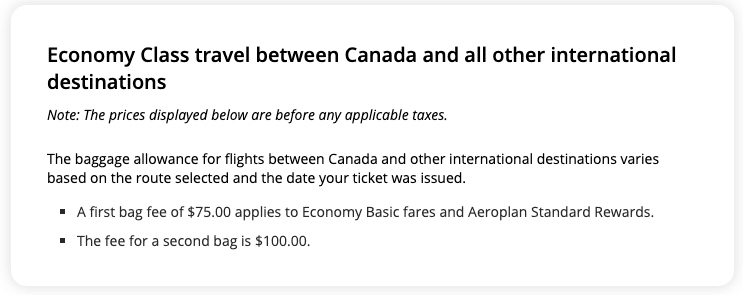
- Aeroplan Standard Reward bookings on international itineraries are charged the same checked bag fees as Economy Basic cash fares: CA/US $75 for the first bag, $100 for the second, and $225 for each additional bag.
Checked-in Baggage Fees
When the fare type you booked doesn’t include a checked bag, you’ll need to pay a fee to check it in. These fees vary based on factors like your cabin class, Aeroplan loyalty status, and travel itinerary.
As of April 13, 2026, Air Canada raised its domestic and transborder checked bag fees. On Economy Basic and Standard fares, the first checked bag now costs CA/US $54 (up from $42), and the second bag costs CA/US $72 (up from $60). International fees were not changed: the first bag on Economy Basic (or an Aeroplan Standard Reward) remains CA/US $75, the second bag is $100, and each additional bag is $225.
To get a rough estimate of baggage fees, refer to Air Canada’s checked baggage fees page, but as mentioned earlier, the most accurate way to determine fees for your specific flight is to use the Air Canada baggage calculator.
Simply input details like your origin, destination, loyalty program status, and class of service, and the tool will display the baggage fees for your particular trip.
Sports equipment, musical instruments, and hunting gear come with additional fees may apply based on the type of equipment, weight, and destination. The best source for detailed information is Air Canada’s special items page, which outlines specific fees and conditions.
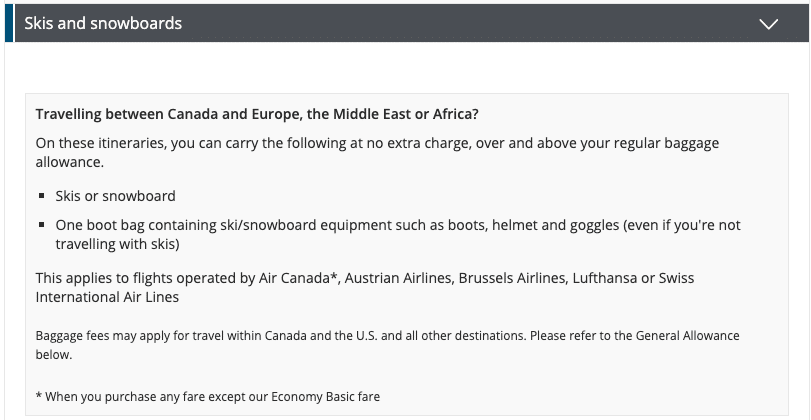
As an example, you can check in skis or a snowboard at no additional cost if you’re travelling between Canada and Europe, the Middle East, or Africa on Air Canada, Austrian Airlines, Brussels Airlines, Lufthansa, or Swiss International Air Lines – a great bonus for winter adventure travellers heading to the Alps. The free allowance applies to all fares except Economy Basic, and includes one boot bag carried alongside the skis or snowboard.
Golf bags are also generously treated: one bag with clubs, balls, and shoes counts as a single piece of baggage with no oversize charge, as long as it weighs under 23 kg.
Other categories – hockey gear, bicycles, musical instruments, surfboards, hunting equipment, and so on – have their own specific rules. The best move is to check Air Canada’s special items page directly, or click the chat bubble at the bottom-right of any page to ask AskPOT.
Therefore, planning ahead and familiarizing yourself with Air Canada’s baggage rules will help you avoid surprises and choose the right fare for your needs.
How to Avoid Air Canada’s Checked Baggage Fees
There are numerous ways to reduce or eliminate checked baggage fees. From holding a co-branded credit card to achieving Aeroplan Elite Status, here are some strategies that can help you save on your baggage fees.
Hold an Aeroplan Co-branded Credit Card
One of the easiest ways to get free checked bags on Air Canada flights is by holding an eligible co-branded credit card. Many of these cards come with baggage benefits that apply to both you and your travel companions.
Air Canada has six co-branded credit cards in Canada, and all six include the same core baggage benefit: the primary cardholder and up to eight guests on the same reservation each get their first checked bag free. The six cards are:
- Core cards ($120–$139 annual fee): TD® Aeroplan® Visa Infinite* Card, CIBC Aeroplan® Visa Infinite* Card, American Express® Aeroplan® Card
- Premium cards ($599 annual fee): TD® Aeroplan® Visa Infinite Privilege* Card, CIBC Aeroplan® Visa Infinite Privilege† Card, American Express® Aeroplan® Reserve Card
The Core cards are more than enough to cover most travellers’ needs – a free first checked bag for up to nine people on a single booking is excellent value for a $120–$139 annual fee. The Premium cards layer on higher earning rates, Maple Leaf Lounge access, and the permanent Basic-fare carry-on exemption mentioned earlier, which can be worth the step up if you often book Basic fares.
A great example is the TD® Aeroplan® Visa Infinite* Card. Although your Aeroplan number is linked to the card in the backend (meaning you don’t have to pay with the card to get the free checked bag), paying with the TD card unlocks additional benefits.
Here are some benefits you’re entitled to by paying with the TD® Aeroplan® Visa Infinite* Card:
- Travel Medical Insurance†
- Trip Cancellation/Trip Interruption Insurance†
- Flight Delay Insurance†
- Delayed and Lost Baggage Insurance†
- Common Carrier Travel Accident Insurance†
These perks not only add value to your travel experience but also provide peace of mind should the unexpected occur.
Choose the Right Fare
Choosing the right fare class can be another effective way to save on baggage fees. Air Canada offers fares that already include checked baggage, which can be more cost-effective if you know you’ll need it.
A light traveller can make do with the Basic or Standard Economy fares, which don’t include checked baggage, may work just fine. However, if you anticipate needing checked luggage, upgrading to a fare that includes a bag could be a better option.
Let’s look at an example flight from Toronto (YYZ) to Vancouver (YVR).
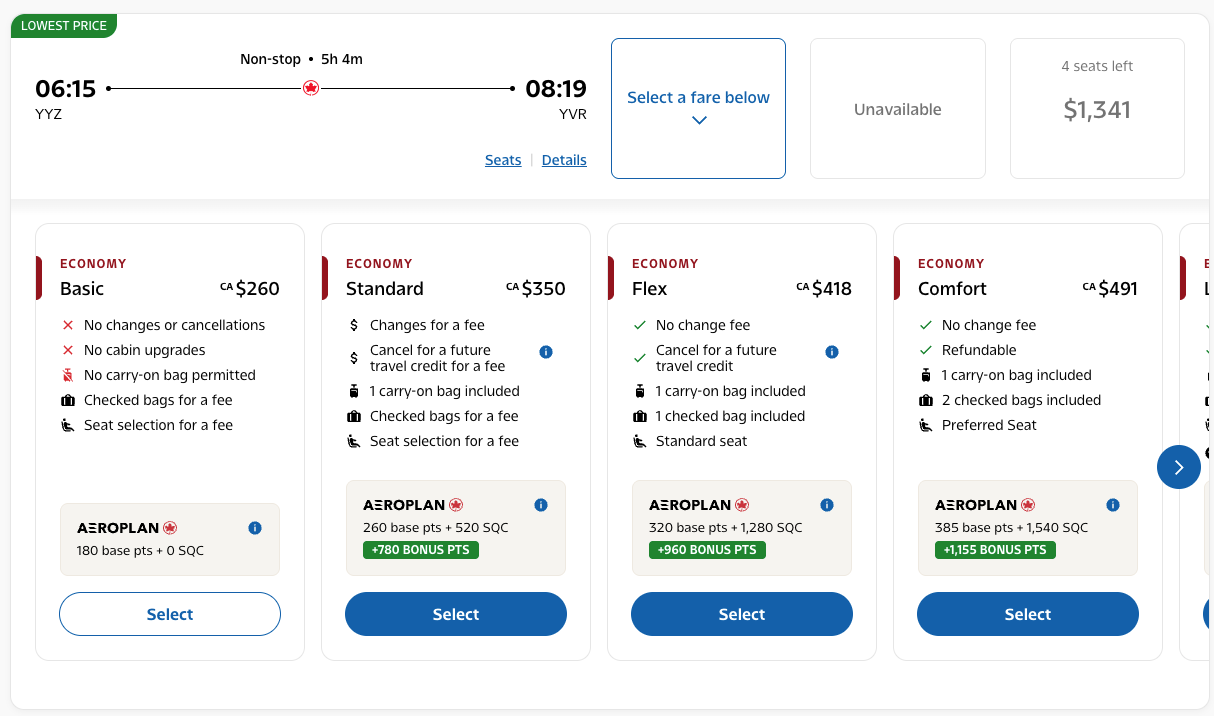
In this example, the Basic Economy fare costs $260 (all figures in CAD) and doesn’t include any checked baggage. Adding one checked bag would cost an additional $54 as of April 13, 2026, bringing the total to $314.
At this point, it’s worth comparing to the Flex fare at $418. While this fare is $104 more than Basic plus a bag, it includes several other perks along with one free checked baggage.
With the Economy Flex fare, you’ll earn 100% Aeroplan points from the flight. Since the Toronto to Vancouver route is 2,085 miles, you would earn 2,085 Aeroplan points. Since we value Aeroplan points at 2.1 cents per point, those points are worth approximately $43.79, chipping away at the premium.
Additionally, Flex fares offer perks like free schedule changes, the ability to cancel for a flight credit, and the option to select a standard seat at booking, giving you more control over your travel experience and seat preference.
Travellers who value flexibility and already need a checked bag will find the premium easy to justify.
This story originally appeared on princeoftravel

